Artificial Intelligence has rapidly evolved from static, rule-based systems to dynamic, autonomous agents capable of reasoning, planning, and adapting to new contexts. The next frontier in this evolution is Agentic AI, a model in which intelligent agents don’t just process information but also take initiative, make decisions, and collaborate with other agents or humans to accomplish complex tasks.
At the core of this movement lies the concept of agentic workflows, structured yet adaptive sequences of actions driven by intelligent agents. Unlike traditional automation or simple AI models that respond passively to inputs, agentic workflows operate proactively. They plan, execute, reflect, and iterate toward achieving a defined goal, often without continuous human supervision.
Understanding agentic workflows means understanding the future of AI-driven automation – one that blends intelligence, autonomy, and collaboration to transform industries such as finance, healthcare, logistics, and enterprise operations.
In this blog, we’ll explore how agentic workflows work, their architecture, real-world use cases, and how frameworks such as LangChain, CrewAI, and others enable the next generation of AI-driven orchestration.
What Are AI Agents?
An AI agent is a system capable of perceiving its environment, reasoning about it, and taking autonomous actions to achieve a specific goal. In today’s context, this typically involves large language models (LLMs) combined with tools, APIs, and memory modules that allow agents to act in dynamic environments.
For example, imagine an AI assistant that can not only answer your questions but also perform real-world actions, book meetings, send follow-up emails, retrieve data from your CRM, and adapt its strategy when faced with new constraints. This is what differentiates an AI agent from a traditional chatbot or static automation script.
Agents can be designed for various roles:
- Research agents that find, summarize, and verify information.
- Workflow agents that orchestrate multi-step processes, like onboarding or approvals.
- Coding agents that write, test, and deploy code autonomously.
- Decision-support agents that analyze data and make contextual recommendations.
The strength of AI agents lies in their ability to combine reasoning (powered by LLMs), tool use (via APIs or connectors), and memory (short-term and long-term) to deliver goal-driven outcomes.
Core Components of AI Agents
For AI agents to function in a truly “Agentic” way, they must rely on several interconnected components that allow for autonomy, adaptability, and continuous learning.

1. Reasoning
Reasoning is what enables an agent to “think” through problems rather than execute pre-coded logic. LLMs like GPT or Gemini perform reasoning through task decomposition, breaking large goals into smaller, manageable subtasks.
For instance, when debugging code, an agent may first analyze the error, then search relevant documentation, fix the issue, and re-run the test iteratively until successful.
Agents reason in two modes:
- Planning: Determining the steps needed to reach a goal.
- Reflection: Evaluating outcomes and adjusting actions accordingly.
This iterative reasoning cycle mimics how humans problem-solve, plan, act, observe, and adapt.
2. Tool Use
LLMs are powerful but limited to the knowledge they were trained on. To extend their utility, agents use tools and external systems such as APIs, databases, search engines, and enterprise applications.
This allows agents to:
- Fetch real-time information from the web.
- Access business data via ERP or CRM APIs.
- Perform transactions, send messages, or run scripts.
This process, known as function calling, bridges the gap between generative AI and operational automation, turning natural-language instructions into executable actions.
3. Memory
Memory enables context awareness, a crucial aspect of intelligent behavior. Agents typically use two kinds of memory:
- Short-term memory: Tracks current interactions, tasks, or sessions.
- Long-term memory: Stores historical data and learnings for personalization and improvement.
For example, a customer support agent may remember previous complaints to personalize responses, while a research assistant might recall the structure of prior reports to maintain consistency.
Memory also allows context continuity across sessions, making agentic systems progressively smarter and more efficient over time.
4. Feedback Mechanisms
Agents learn not only from their own actions but also from human or system feedback. Techniques like Human-in-the-Loop (HITL) supervision ensure quality and alignment, especially in critical workflows.
In more advanced systems, agents may also receive feedback from other agents, creating multi-agent collaboration networks where specialized agents critique, review, or refine each other’s outputs.
5. Multi-Agent Collaboration
In complex environments, a single agent may not be sufficient. Multi-agent systems (MAS) distribute roles and responsibilities among multiple agents that communicate and coordinate with one another.
For example:
- One agent retrieves market data.
- Another analyzes it for anomalies.
- A third agent generates an executive summary.
This parallelized approach significantly improves scalability, specialization, and fault tolerance.
6. Integrations
To be practical in enterprise environments, agentic workflows must integrate with existing infrastructure, including ERPs, CRMs, data warehouses, and communication tools.
Frameworks like LangGraph, CrewAI, and OpenDevin provide orchestration layers for integrating multiple agents and tools while managing dependencies and error recovery.
This ensures seamless interaction between AI agents and existing business systems, such as Salesforce, NetSuite, or SAP, creating true agent-to-application synergy.
In summary, agentic workflows rely on these foundational components to function autonomously:
- Reasoning – for goal-driven planning and reflection.
- Tools – for real-world interaction and task execution.
- Memory – for context and continuity.
- Feedback – for improvement and error correction.
- Collaboration – for scaling across complex multi-agent tasks.
| Recommended Read: Agentic AI Explained: The Future of Autonomous Intelligence |
What Are Agentic Workflows?
At their core, workflows are sequences of tasks designed to achieve a specific outcome. But agentic workflows redefine this paradigm by making workflows adaptive, intelligent, and self-correcting.
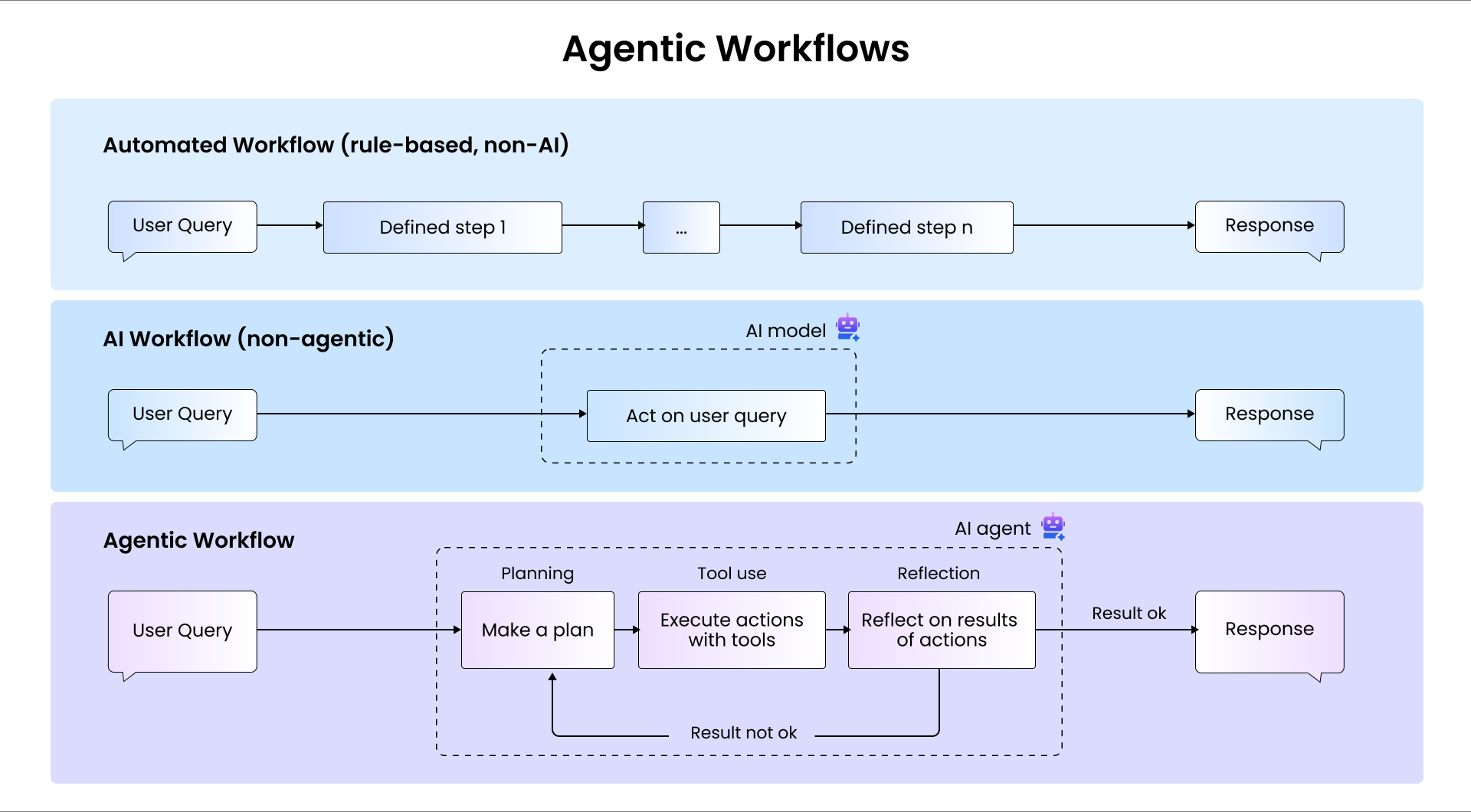
In traditional automation, workflows are deterministic; they follow fixed rules like:
“If invoice amount < $5000 → auto-approve.”
While efficient, such workflows can’t adapt to uncertainty or changing data.
In contrast, agentic workflows use AI agents that dynamically plan and adjust their steps based on context. They:
- Make decisions autonomously.
- Access tools and APIs to complete tasks.
- Learn from outcomes to improve future actions.
For example, an agentic customer onboarding workflow might:
- Analyze customer data.
- Decide which verification steps are required.
- Automatically trigger KYC checks.
- Adapt the process if documents are missing.
- Escalate to a human if anomalies are detected.
Each step is guided not by hard-coded rules, but by reasoning, perception, and self-learning, allowing true adaptability.
Key distinction:
| Workflow Type | Definition | Flexibility |
| Traditional Workflow | Fixed rules and steps. | None |
| Non-Agentic AI Workflow | Uses AI models for one-off tasks (e.g., summarization). | Limited |
| Agentic Workflow | AI agents plan, act, and adapt dynamically. | High |
Key Patterns in Agentic Workflows
While every agentic workflow is unique, they generally follow recurring design patterns that define how agents think, act, and evolve over time. These patterns enable agents to break down complex objectives, leverage external data intelligently, and continuously refine their performance.
The three most common and effective patterns are Planning, Tool Use, and Reflection.
1. Planning Pattern
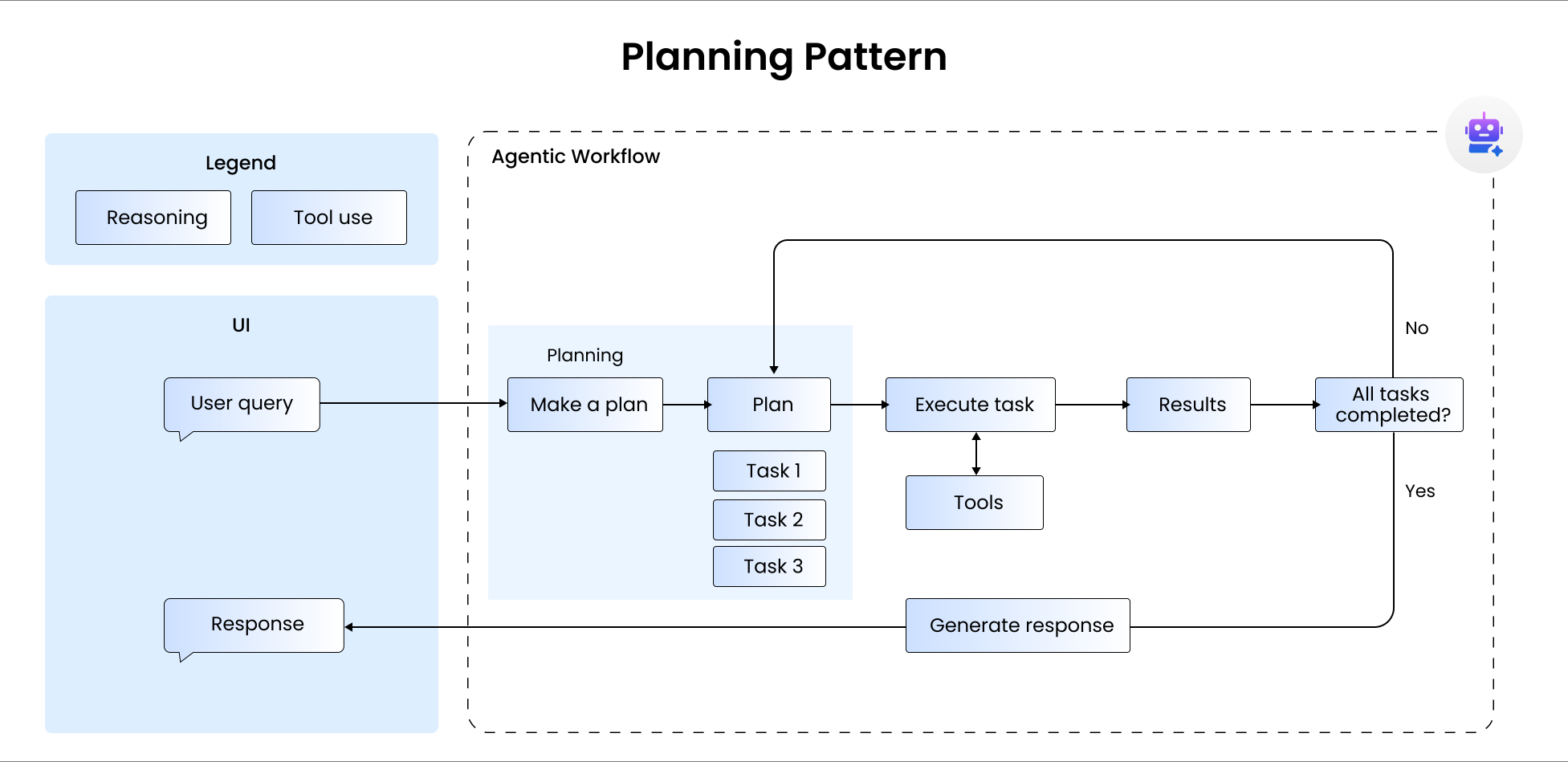
The Planning Pattern is the foundation of intelligent agentic behavior. It enables an agent to autonomously break down complex goals into structured, actionable subtasks, a process often referred to as task decomposition.
For example, if an agent is tasked with generating a market analysis report, it may first break the task into substeps:
- Gather relevant industry data.
- Analyze market trends.
- Compare competitors.
- Summarize insights into a structured report.
2. Tool Use Pattern
The Tool Use Pattern extends an AI agent’s capabilities beyond its internal model. LLMs are trained on static datasets and therefore lack access to real-time or domain-specific data. Through tool calling, agents can bridge this gap, connecting to APIs, databases, or other computational tools to retrieve live information or trigger actions.
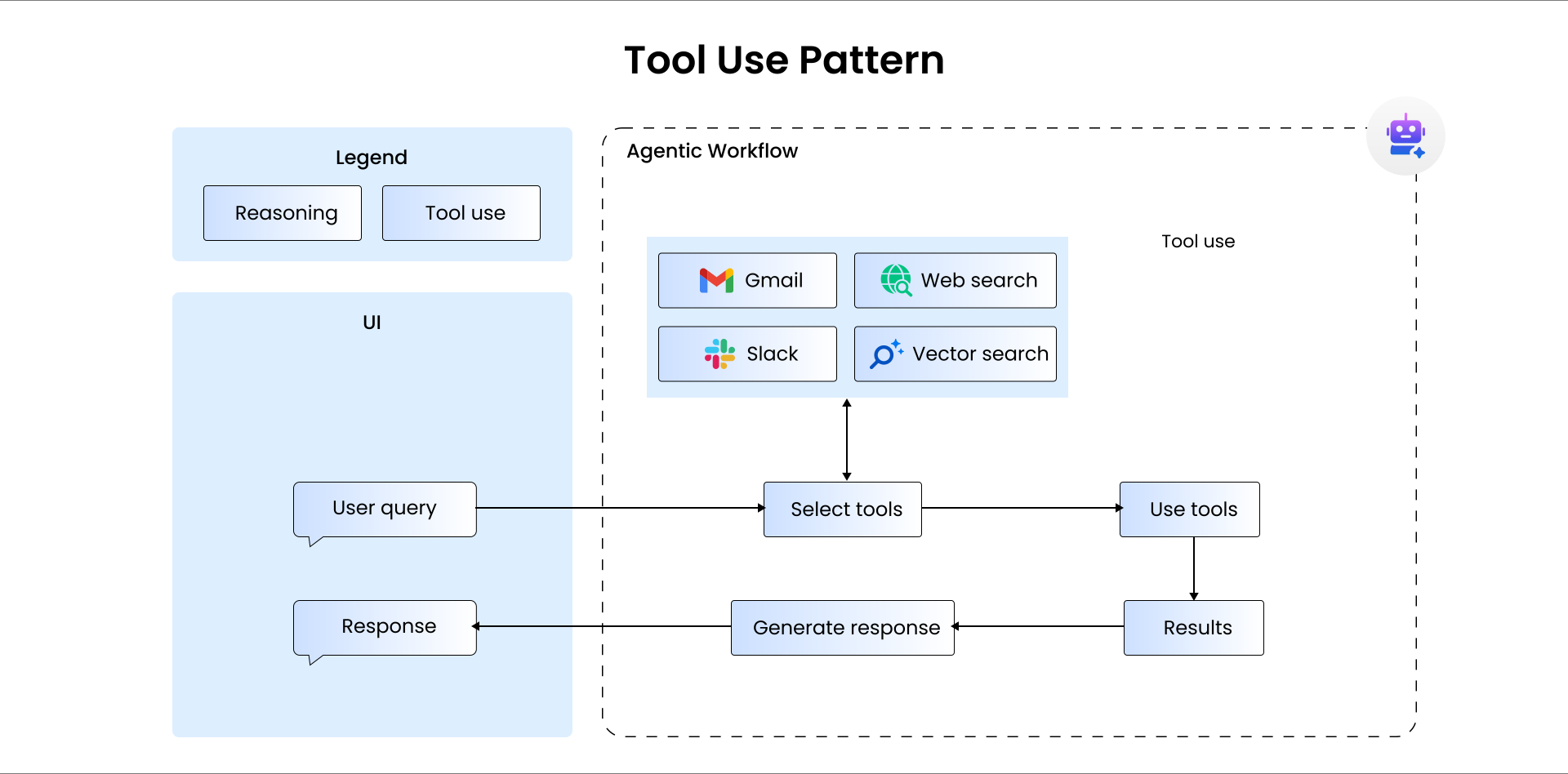
Example tools include:
- APIs: For CRM lookups, HR systems, or ERP operations.
- Web search: For real-time information retrieval and content validation.
- Vector databases: For contextual memory or knowledge retrieval (e.g., RAG pipelines).
- Code interpreters: To execute Python scripts, data transformations, or simulations.
Unlike traditional data pipelines, this interaction is dynamic; agents decide when and which tool to invoke based on reasoning. For example, a financial planning agent might fetch real-time stock data, simulate portfolio outcomes, and update projections, all autonomously.
This makes the Tool Use Pattern essential for enterprises looking to connect AI reasoning directly to operational systems such as Salesforce, NetSuite, or Azure Data Lakes.
3. Reflection Pattern
The Reflection Pattern is the backbone of self-improvement in agentic systems. It allows an agent to evaluate its own performance, identify weaknesses, and refine future responses without external supervision.
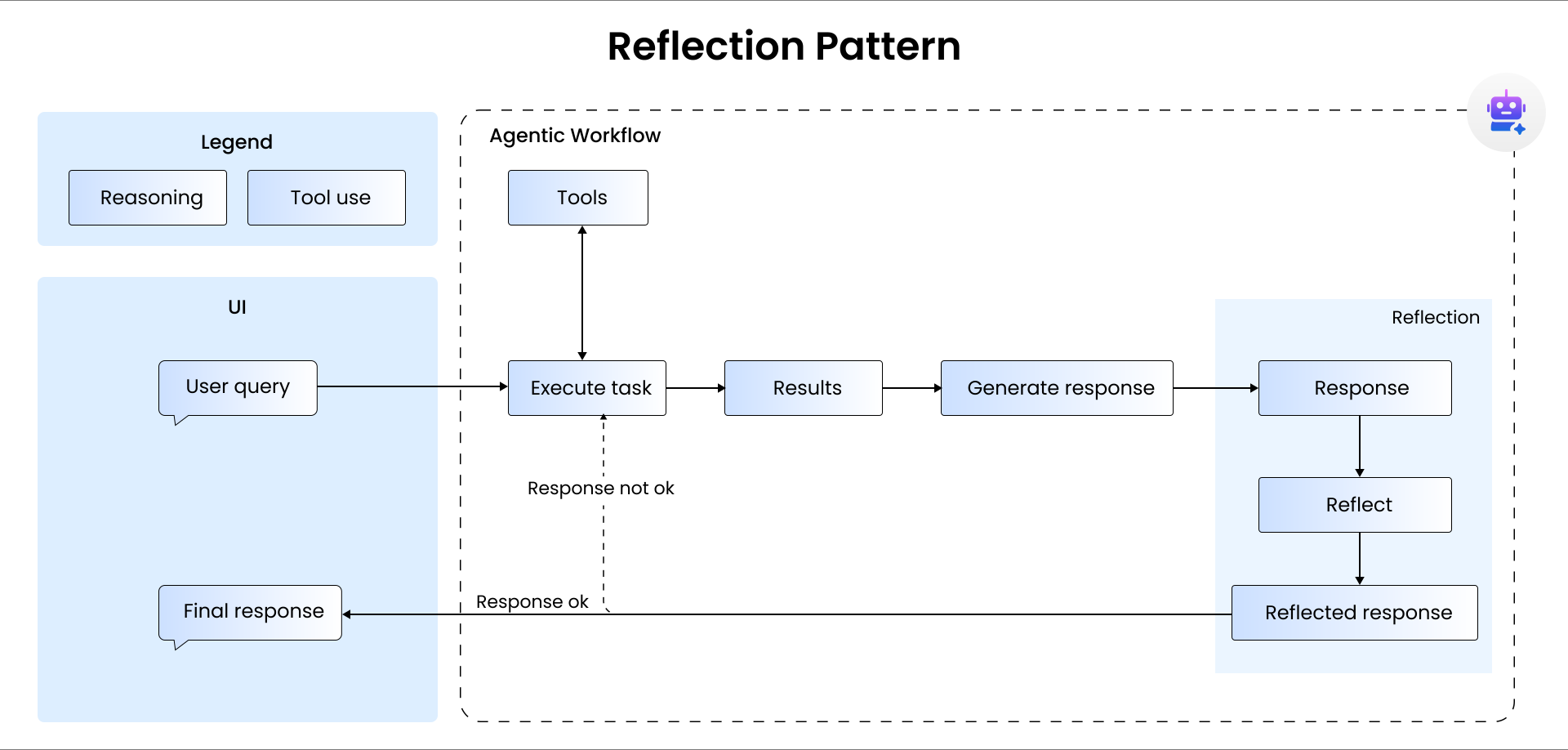
Reflection typically occurs after each action cycle:
- The agent executes a step.
- It assesses whether the result aligns with the intended outcome.
- It iteratively adjusts its strategy to improve the next step.
For instance, an agentic coding assistant might generate a script, test it in a sandbox, and, upon detecting an error, automatically debug and retry until the output runs successfully.
Over time, these reflections can be stored in the agent’s memory, allowing it to develop long-term intelligence, essentially learning from experience. This is what differentiates reactive agents (which respond) from cognitive agents (which learn and adapt).
| Recommended Read: How Boomi AI Agents Transform Integration with Automation & Intelligence? |
Agentic Architectures vs. Agentic Workflows
The terms agentic workflow and agentic architecture are often used interchangeably, but they represent distinct layers of an AI system.
- Agentic Workflow:
This is the process layer, the series of actions and decisions that an agent executes to achieve a goal. It defines how tasks are planned, what tools are used, how results are evaluated, and when decisions are made.
Example: A workflow where an AI research agent retrieves data, analyzes it, writes insights, and revises them based on feedback. - Agentic Architecture:
This is the system layer, the technical blueprint that defines how multiple agents, tools, memory stores, and APIs interact. It determines what infrastructure supports these workflows, including orchestration, communication, and decision-making mechanisms.
Example: A distributed architecture where multiple agents (data retriever, summarizer, validator) collaborate across cloud APIs and vector databases under a centralized controller.
In simpler terms:
Workflow is the “journey”;
Architecture is the “map and vehicle” enabling that journey.
Together, they create the foundation for scalable, modular, and intelligent agentic systems.
Types of Agentic Architectures
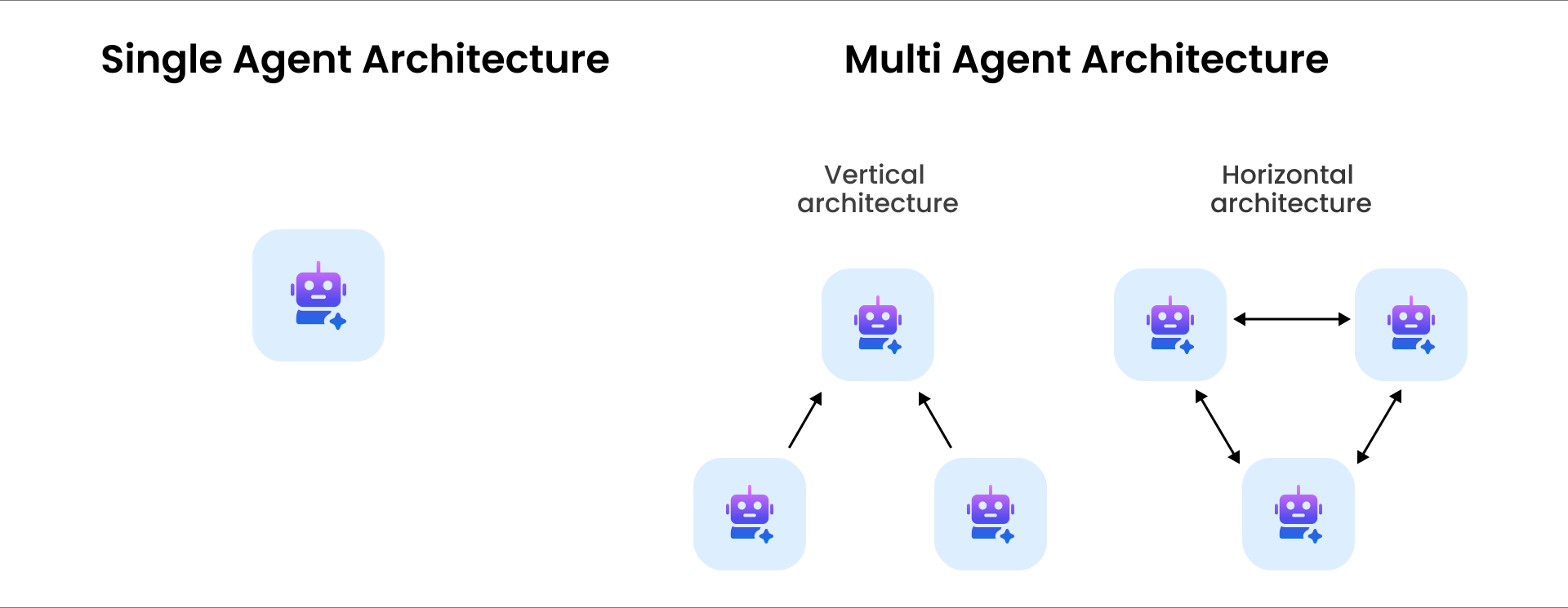
Different agentic architectures cater to different levels of autonomy, collaboration, and scale. The four most recognized forms are Single-Agent, Multi-Agent, Horizontal, and Hybrid Architectures.
1. Single-Agent Architecture
This is the simplest form, in which one autonomous agent handles all tasks within a defined scope. It’s ideal for focused workflows where reasoning and task management can be handled by a single decision-maker.
Example Use Cases:
- An AI coding assistant generates and debugs code.
- Sales AI agent analyzing customer queries and generating responses.
2. Multi-Agent Architecture
In this setup, multiple specialized agents collaborate to solve complex tasks. Each agent is assigned a specific domain expertise; for instance, one focuses on data retrieval, another on reasoning, and another on summarization.
Agents communicate through shared memory or message passing, ensuring coordination without redundancy. This structure mimics human teamwork, distributed yet collaborative.
Example Use Cases:
- Research automation systems combining agents for data collection, synthesis, and visualization.
- Customer experience platforms where one agent handles sentiment analysis, another routes tickets, and another drafts responses.
3. Horizontal AI Architecture
Horizontal architectures extend agentic functionality across an organization’s systems rather than limiting it to one domain.
For example, a horizontal agent layer could integrate across CRM, ERP, and HR platforms, creating unified intelligence across business functions.
4. Hybrid Architecture
The Hybrid Architecture combines the strengths of multiple models, for instance, multi-agent collaboration within a horizontal system.
A hybrid setup may involve:
- Specialized agents (finance, sales, IT) working collaboratively.
- Central orchestration that manages cross-department workflows.
- Shared memory repositories for context persistence.
Example Visualization
| Architecture Type | Key Characteristic | Ideal Use Case |
| Single-Agent | One agent handles all reasoning and execution | Coding assistants, email automation |
| Multi-Agent | Multiple agents collaborate with distinct roles | Research assistants, complex process automation |
| Horizontal | Cross-system orchestration across business functions | CRM + ERP + HR automation |
| Hybrid | A combination of multi-agent and horizontal | Enterprise-grade agentic ecosystems |
Different Agentic Frameworks
Agentic frameworks provide the architectural and orchestration backbone that enable intelligent agents to function cohesively, managing reasoning, communication, and memory as they interact with the real world.
Broadly, these frameworks fall into three conceptual categories: Reactive, Deliberative, and Cognitive Architectures.
1. Reactive Architectures
Reactive architectures represent the simplest form of agentic systems, operating based on direct stimulus-response patterns.
They respond immediately to inputs without relying on memory or complex reasoning.
Key Characteristics:
- Fast and efficient for simple or repetitive tasks.
- Minimal computational overhead.
- Limited adaptability, cannot handle complex reasoning or multi-step dependencies.
Reactive architectures are effective when reliability, speed, and predictability matter more than autonomy, as in chatbots, ticket classification bots, and automated alerts.
2. Deliberative Architectures
Deliberative architectures form the core of modern agentic systems.
These agents don’t just respond, they plan, reason, and make decisions based on goals, constraints, and contextual information.
They use symbolic reasoning and logical inference models to break tasks into actionable plans. For example, an agent tasked with “analyze customer churn” might:
- Identify relevant datasets,
- Choose an algorithm to process data,
- Generate a summary of patterns, and
- Recommend next steps based on outcomes.
Key Characteristics:
- Enables multi-step reasoning and decision-making.
- Supports structured planning and adaptive workflows.
- More computationally intensive but significantly more powerful.
3. Cognitive Architectures
Cognitive architectures represent the next frontier of agentic AI.
They integrate reasoning, perception, memory, and learning to replicate human-like cognition. These systems continuously evolve, learning from past outcomes, dynamically refining strategies, and applying multi-modal reasoning (text, vision, sound).
Cognitive architectures often combine:
- Short-term memory (STM) for session-level context.
- Long-term memory (LTM) for knowledge retention.
- Metacognition, the ability to reflect and self-assess performance.
In practical terms, a cognitive agent could perform multi-domain reasoning, like combining financial analysis, customer sentiment, and market predictions into a unified strategic insight.
These architectures underpin advanced use cases such as:
- Personalized recommendation systems.
- Multi-agent collaboration networks.
- Generative research assistants capable of synthesis and critique.
Enterprise Use Cases and Applications of Agentic Workflows
Agentic workflows are rapidly becoming the backbone of enterprise automation, analytics, and decision intelligence. They bridge the gap between generative AI and business operations, allowing enterprises to automate not just execution, but thinking.
Let’s explore five leading enterprise use cases:
1. Agentic RAG (Retrieval-Augmented Generation)
Traditional RAG systems retrieve information from knowledge bases and feed it to an LLM to generate contextualized answers. Agentic RAG extends this model by adding planning and reflection layers.
Example:
An enterprise knowledge assistant receives a request: “Compare Q3 revenue across regions and suggest underperforming markets.”
Instead of retrieving static data, an agentic RAG system:
- Decomposes the request into smaller queries,
- Retrieves region-specific data from multiple sources,
- Analyzes trends, validates accuracy, and
- Synthesizes a prioritized recommendation.
This combination of reasoning + retrieval + self-verification allows enterprises to achieve higher accuracy and explainability in AI-driven insights.
2. Agentic Research Assistants
Modern businesses handle massive volumes of fragmented data, from PDFs and dashboards to emails and code repositories. Agentic research assistants streamline this by autonomously researching, analyzing, and summarizing relevant information.
Example: A corporate strategy team asks, “How are competitors using AI for supply chain forecasting?”
The research assistant:
- Searches external sources for credible data,
- Cross-checks industry reports,
- Synthesizes findings, and
- Drafts a detailed competitive analysis.
Unlike conventional chatbots, these assistants don’t just summarize; they think, analyze, and iterate until the output meets quality benchmarks.
Platforms like Perplexity, Claude Research, and OpenAI Deep Research already demonstrate this agentic capability, delivering contextual, verifiable insights from unstructured data.
3. Agentic Coding Assistants
The evolution from prompt-based code generators to autonomous coding agents marks a major step forward.
These assistants, like Cursor AI or Claude Code, not only generate code but also execute, debug, and refine it in real time.
In a typical agentic coding workflow:
- The agent generates code based on natural language instructions.
- Executes it in a sandbox environment.
- Interprets errors or test failures.
- Refines and resubmits improved code automatically.
Benefits of Agentic Workflows
Adopting agentic workflows delivers a range of tangible benefits beyond traditional automation or LLM pipelines:
| Benefit | Description |
| Adaptive Decision-Making | Agents dynamically adjust actions based on context, allowing systems to respond intelligently to changing conditions. |
| Continuous Learning | Built-in feedback loops and memory enable agents to improve performance with every interaction. |
| Operational Scalability | Agentic architectures can scale across departments and domains, supporting thousands of concurrent tasks. |
| Cost Efficiency | Automation of reasoning-driven tasks reduces human overhead and error rates, significantly cutting operational costs. |
| Enhanced Collaboration | Multi-agent systems mirror human teams, allowing parallel task handling and distributed intelligence. |
| Transparency and Traceability | Each decision, tool call, and result can be logged for explainability, essential for compliance and auditing. |
The Future of Agentic Workflows
Agentic AI represents a paradigm shift, one in which automation evolves into autonomy and decision-support systems transform into decision-making collaborators. Over the next few years, agentic workflows will fundamentally redefine how enterprises build, manage, and scale their digital ecosystems.
1. The Rise of Autonomous Enterprise Systems
Organizations are moving toward autonomous operations, where AI agents continuously monitor KPIs, optimize processes, and execute corrective actions in real time. For instance, supply-chain agents will automatically rebalance inventory when sensing delays, while finance agents will proactively reconcile ledger anomalies, all without manual triggers.
2. Seamless Multi-Agent Collaboration
Future workflows will involve multi-agent ecosystems, where specialized AI agents operate across departments, sales, HR, procurement, and engineering, sharing memory and collaborating like digital teammates. These agents will communicate via natural-language protocols, forming a dynamic mesh of cognitive intelligence within the enterprise.
3. Integration with Agentic Architectures
We will see tighter integration between Agentic AI frameworks (such as LangGraph, CrewAI, and AutoGen) and enterprise systems, including ERP, CRM, and iPaaS platforms. This convergence will bring context-aware orchestration, where workflows evolve based on live business data and external market signals.
4. Evolution of Ethical and Compliant AI Systems
As agents gain autonomy, enterprises must focus on responsible AI governance. Future workflows will incorporate explainability layers, permission boundaries, and human-in-the-loop (HITL) checkpoints, ensuring that every automated decision remains transparent and auditable.
5. Domain-Specific Agentic Models
Industry-focused agentic systems will emerge, for example:
- Healthcare agents for diagnosis, triage, and patient engagement.
- Financial agents for risk modeling and portfolio optimization.
- Manufacturing agents for predictive maintenance and demand forecasting.
Agentic AI will not replace human judgment – it will augment it. The most successful organizations will be those that combine human strategy with machine autonomy, creating hybrid ecosystems of intelligent collaboration.
| Recommended Read: NetSuite AI Connector Service Explained: How to Integrate AI Models into Your ERP for Smarter Automation |
Why Choose NeosAlpha for Agentic AI Solutions
As enterprises begin adopting agentic workflows, choosing the right implementation partner is key to success. NeosAlpha stands apart as an AI-first integration specialist, helping organizations transform automation into strategic, scalable intelligence.
1. Deep Technical Expertise
Our engineers specialize in Agentic AI, LLM orchestration, and multi-agent systems. From architecture design to deployment, we ensure every workflow is optimized for scalability, security, and real-world adaptability.
2. Unified Integration Across Platforms
NeosAlpha connects agentic systems seamlessly with platforms such as NetSuite, Salesforce, Workato, Boomi, and Apigee. We enable cross-platform intelligence, where AI agents can access data, trigger workflows, and deliver actionable insights across CRM, ERP, and custom applications.
3. Custom Framework Development
We build custom agentic frameworks tailored to your business domain. Whether you need an autonomous research assistant, an AI-driven operations monitor, or a real-time supply-chain agent, our modular architecture ensures low maintenance and fast extensibility.
4. Proven Track Record
From AI chatbots to enterprise orchestration platforms, NeosAlpha has successfully delivered AI-powered automation for global clients across industries. Our solutions reduce operational overhead, enhance accuracy, and create long-term competitive advantage.
Conclusion
Agentic workflows are more than just an evolution of automation; they are the foundation for self-learning, self-optimizing digital ecosystems.
By combining reasoning, tool use, and memory with enterprise integration, these systems transform workflows from static sequences into adaptive intelligence networks that can continuously improve.
Businesses that embrace this transformation today will lead tomorrow’s AI-driven economy, where workflows don’t just execute, but think, plan, and evolve.
With its expertise in Agentic AI design, multi-system integration, and cloud automation, NeosAlpha is uniquely positioned to help enterprises unlock this future, delivering resilient, intelligent, and scalable agentic solutions tailored to their industry and growth goals.
Frequently Asked Questions
1. What is the main advantage of agentic workflows over traditional automation?
Agentic workflows incorporate reasoning, adaptability, and feedback, enabling AI systems to handle unpredictable or evolving conditions that traditional rule-based automation cannot.
2. Are agentic workflows suitable for all industries?
While agentic AI fits best in data-rich, dynamic environments such as finance, manufacturing, healthcare, and technology, lightweight agentic systems can enhance any process that requires contextual understanding or adaptive decision-making.
3. How do agentic workflows differ from standard AI workflows?
Standard AI workflows generate outputs from prompts; agentic workflows go further, they plan, act, evaluate, and improve autonomously through multi-step reasoning and real-world tool interaction.
4. What are the key components of an agentic workflow?
An agentic workflow typically includes AI agents, large language models, tool integrations, memory systems, and feedback mechanisms, orchestrated under a structured framework.
5. How can NeosAlpha help implement agentic workflows?
NeosAlpha designs and deploys custom agentic frameworks integrated with ERP and CRM platforms, ensuring secure orchestration, transparent governance, and measurable ROI from intelligent automation.