Disconnected Sales
Salesforce and NetSuite operated independently, resulting in inconsistent customer records and duplicate data entries that reduced operational efficiency.
NBS, formerly National Building Specification, is a leading UK-based construction technology platform that has been shaping the built environment for over five decades. Originally established to standardize building specifications, NBS has evolved into a digital-first organization that delivers cloud-based tools enabling architects, engineers, and construction professionals to create accurate, compliant, and collaborative documentation. Today, NBS plays a critical role in connecting design and product data across the construction lifecycle while driving innovation in specification management.
The client’s primary objective was to establish Salesforce as the single, centralized source of truth for customer and revenue data while ensuring seamless synchronization with NetSuite. They aimed to eliminate manual handoffs between sales and finance, enable real-time visibility into the opportunity-to-cash process, and improve forecasting accuracy. The broader vision was to build a scalable and automated integration framework that would support business growth and enhance collaboration across teams.
Construction
Salesforce
CRM–ERP Integration

Salesforce and NetSuite operated independently, resulting in inconsistent customer records and duplicate data entries that reduced operational efficiency.
Closed-won opportunities required manual re-entry into NetSuite, resulting in processing delays and an increased risk of billing errors.
Sales teams lacked access to invoice and payment status in Salesforce, limiting their ability to proactively manage customer accounts.
Finance and sales teams generated reports from different systems, creating mismatched figures and reducing trust in revenue forecasts.
Existing point-to-point integrations were not sustainable and could not support long-term business expansion or additional system integrations.
Unlock the full potential of Salesforce by integrating it with your ERP for automated, accurate Quote-to-Cash processes.
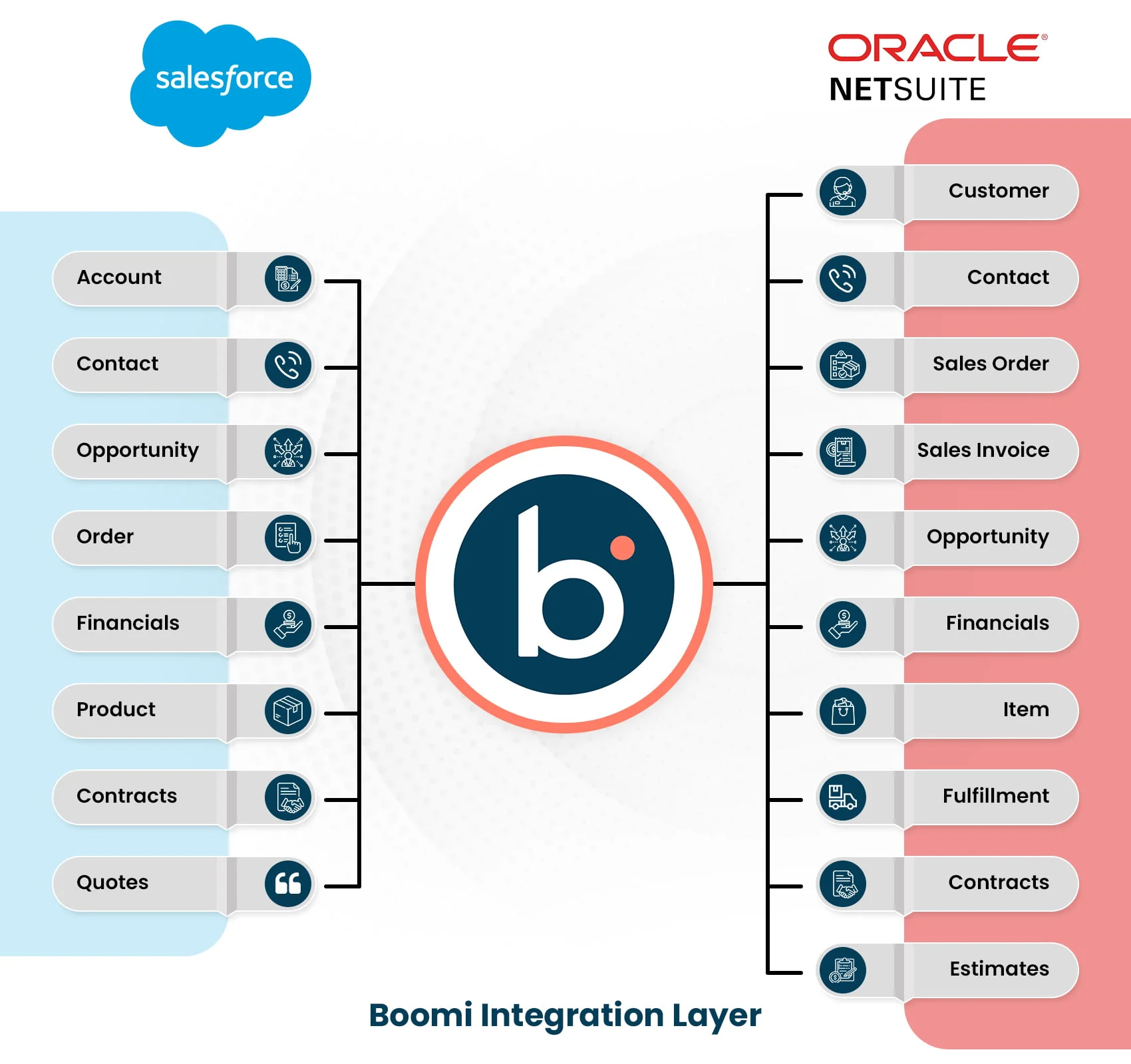
Explore our Salesforce CapabiltiesNeosAlpha designed a Salesforce-first integration framework that positioned CRM at the centre of the revenue lifecycle. Instead of operating as separate systems, Salesforce and NetSuite were unified into a connected ecosystem, with Salesforce serving as the operational command centre for customer and sales data.
Closed-won opportunities in Salesforce were automatically converted into sales orders in NetSuite, eliminating manual data entry and significantly reducing billing cycle delays.
Invoice status, payment information, and order updates from NetSuite were synchronized back into Salesforce. This provided sales teams with complete financial transparency directly within the CRM environment.
Using Boomi, structured validation rules, monitoring mechanisms, and automated error handling were implemented to ensure high data integrity and proactive issue resolution.
The integration was built using reusable components and API-led connectivity principles, enabling future system enhancements without disrupting the core revenue operations.
Manual data entry between Salesforce and NetSuite was fully eliminated, streamlining the opportunity-to-cash lifecycle.
Sales teams gained real-time access to billing and payment information within Salesforce, improving responsiveness and customer engagement.
Synchronized CRM and ERP data enabled consistent reporting across sales and finance, significantly improving forecasting reliability.
Automation minimized discrepancies and improved data accuracy across departments.
The organization now operates on a future-ready integration architecture designed to support expansion and long-term growth.


Tell us what you're looking for and we'll get you connected to the right people.