Have you considered whether your integration system is prepared for updates, architectural changes, and intelligence-driven transformation? As SaaS, APIs, cloud, and AI grow, integration becomes a critical foundation for business.
According to research, integration platforms are becoming central to modern enterprise operations, and the iPaaS market is projected to grow from $19.15 billion in 2026 to $108.76 billion by 2034 with a CAGR of 24.2%. At the same time, AI and intelligent agents are significantly changing how integration operates. Instead of humans manually orchestrating every flow, AI-driven systems increasingly consume, act on, and generate events across enterprise systems. This shift requires integration platforms to deliver clean, real-time, governed context.
Organizations that modernize integration are better positioned to adapt to change, while those that rely on outdated approaches face rising complexity, slower innovation, and increasing operational risk. This top enterprise integration trends will help you understand the growth of integration and how it will impact businesses.
The Growth of Enterprise Integration in 2026
Enterprise integration is entering into a new growth phase driven by the convergence of AI adoption, SaaS sprawl, hybrid cloud architectures, and real-time business expectations. What was once considered a backend IT concern has now become a board-level strategic priority, with integration platforms acting as the connective tissue of modern digital enterprises.
Global spending on integration platforms and data integration solutions continues to grow at double-digit rates, fueled by the need to connect hundreds of applications, APIs, data sources, and AI models.
Why Integration Is Growing Faster Than Ever?
Several structural shifts are accelerating enterprise integration growth in 2026:
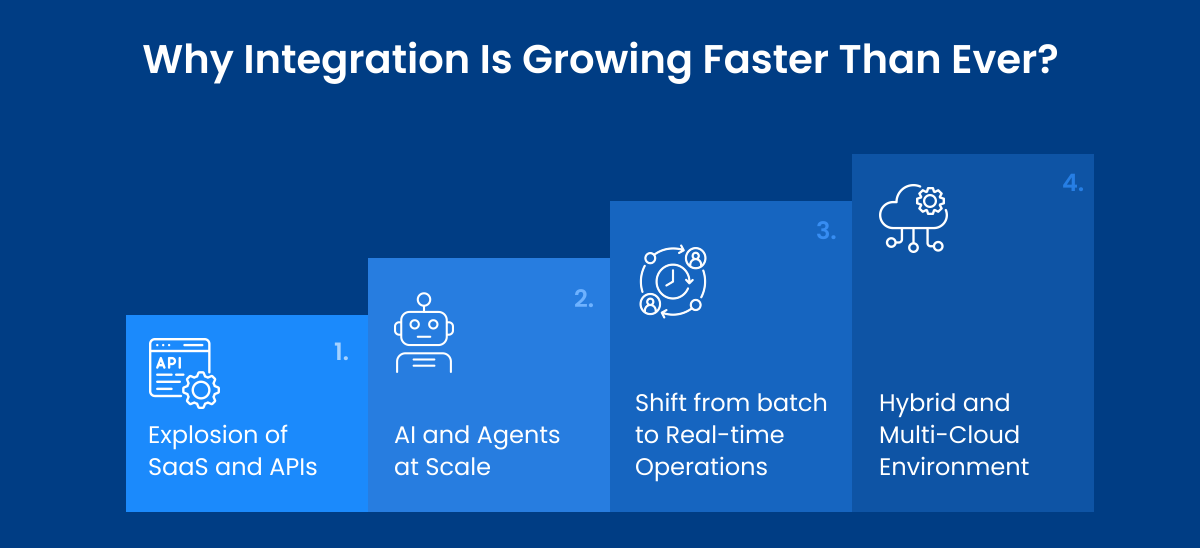
- Explosion of SaaS and APIs
Enterprises use hundreds of SaaS tools across different departments, and each new application adds to integration complexity, underscoring the need for unified platforms more than ever.
- AI and Agents at Scale
AI systems require real-time, well-governed context to operate workflows and systems. Integration platforms like Workato are becoming the primary mechanism for delivering this context reliably to models, copilots, and autonomous agents.
- Shift from Batch to Real-time Operations.
To gain real-time data insights and drive actions, organizations are moving away from traditional batch data pipelines toward event-driven integration architectures.
- Hybrid and Multi-Cloud Environment
Many businesses are still using on-premises systems and private clouds and want to use public clouds as well. iPaaS platforms are the only way to unify all the environments without excessive custom efforts.

Advancement of Leading Integration Platform Boomi vs. Workato
| Features | Boomi | Workato |
| AI Architecture | Agent Garden is a framework for governing and auditing AI agents. Focuses on “Agent Session Logs” to track AI reasoning steps and “Intelligent Recommendations” to find AI use cases in legacy data. | Genies for a low-code environment to build “AI Coworkers” (Genies). Focuses on rapid deployment where agents autonomously perform tasks using existing recipes as “skills.” |
| Core Connectivity | Native support for Model Context Protocol (MCP) to expose Boomi APIs as discoverable tools for external LLMs. | Massive expansion of “Genie-compatible” connectors (Atlassian, Salesforce, GitHub) that require zero-config to be used by AI agents. |
| Security & Governance | Advanced secrets management for GCP/AWS and localized audit logs. Focuses on securing data across on-prem “Atoms” and cloud environments. | Identity propagation that ensures AI agents act “on behalf of” a specific human user (OIDC/SAML), maintaining strict permission boundaries. |
| Integration Logic | Replaces manual scripting with a visual tool that handles complex JSON profiles for AI-to-App data mapping, reducing development time for agents. | A new asset type that centralizes complex business rules into table-driven logic, allowing AI agents to make consistent, auditable business decisions. |
| Runtime & Scale | Supports cluster-wide scaling for event-based integrations (Kafka, Solace) in the Boomi Cloud, aimed at high-volume message processing. | A major security overhaul of the on-prem agent with enhanced certificate storage and support for long-running (24hr+) stored procedures. |
Top 7 Enterprise Integration Trends Shaping 2026
Enterprise integration is no longer evolving at the edges. What is happening now is a bigger structural change in how organizations connect systems, manage data, and enable intelligence across the business. Integration is becoming the foundation that supports AI, automation, real-time operations, and secure digital ecosystems. The following trends are fundamentally reshaping integration strategies.
1. Integration Platforms as Enterprise MCP Layer
Integration platforms are moving beyond connecting applications to the Enterprise Model Context layer, acting as the secure, governed bridge between AI agents and enterprise systems. Instead of allowing agents to access systems directly, iPaaS as MCP layer exposes trusted actions, APIs, and workflows with built-in governance, observability, and policy control. This approach ensures that AI operates with the right context, permissions, and safeguards, making agent-based automation enterprise-ready.
For instance, Workato is acting as an MCP by making integrations and automations agents ready by design. Its architecture allows AI agents to securely discover and execute recipes, APIs, and workflows via MCP, with runtime governance, quality of service controls, and LLM-agnostic execution.
Boomi
Boomi serves as the operational backbone for Enterprise MCP by providing robust integration, API exposure, security, and observability. It enables AI agents to discover available actions and inherit enterprise authentication and access controls.
2. API-First Integration as the Default Architecture
Organizations are not merely using APIs for communication or byproducts but treating them as long-lived products. By designing APIs first, enterprises create modular, reusable services that are easier to integrate, scale, and govern. This approach supports internal development, enables partner ecosystems, and provides a controlled interface for analytics and AI systems.
| Recommended Read: API Trends in 2026 and Beyond: What’s Shaping the Future of APIs? |
3. AI-Powered Integration Intelligence
Integration platforms ain’t only using AI to support applications, but they are using AI internally to transform how integrations are designed, executed, and managed. Intelligent mapping, automated flow recommendations, anomaly detection, and predictive monitoring help teams handle increasing integration complexity with greater accuracy and less manual effort. AI agents further extend this capability by enabling autonomous interaction with enterprise systems. Instead of static workflows, agents can observe events, interpret context, decide on actions, and trigger integrations dynamically.
For instance, Boomi enables agent-driven integration through its AI agent capabilities and Agent Studio.
Workato extends AI-powered integration intelligence through Genies, intelligent assistants that understand business intent, generate automation logic, and execute workflows across applications.
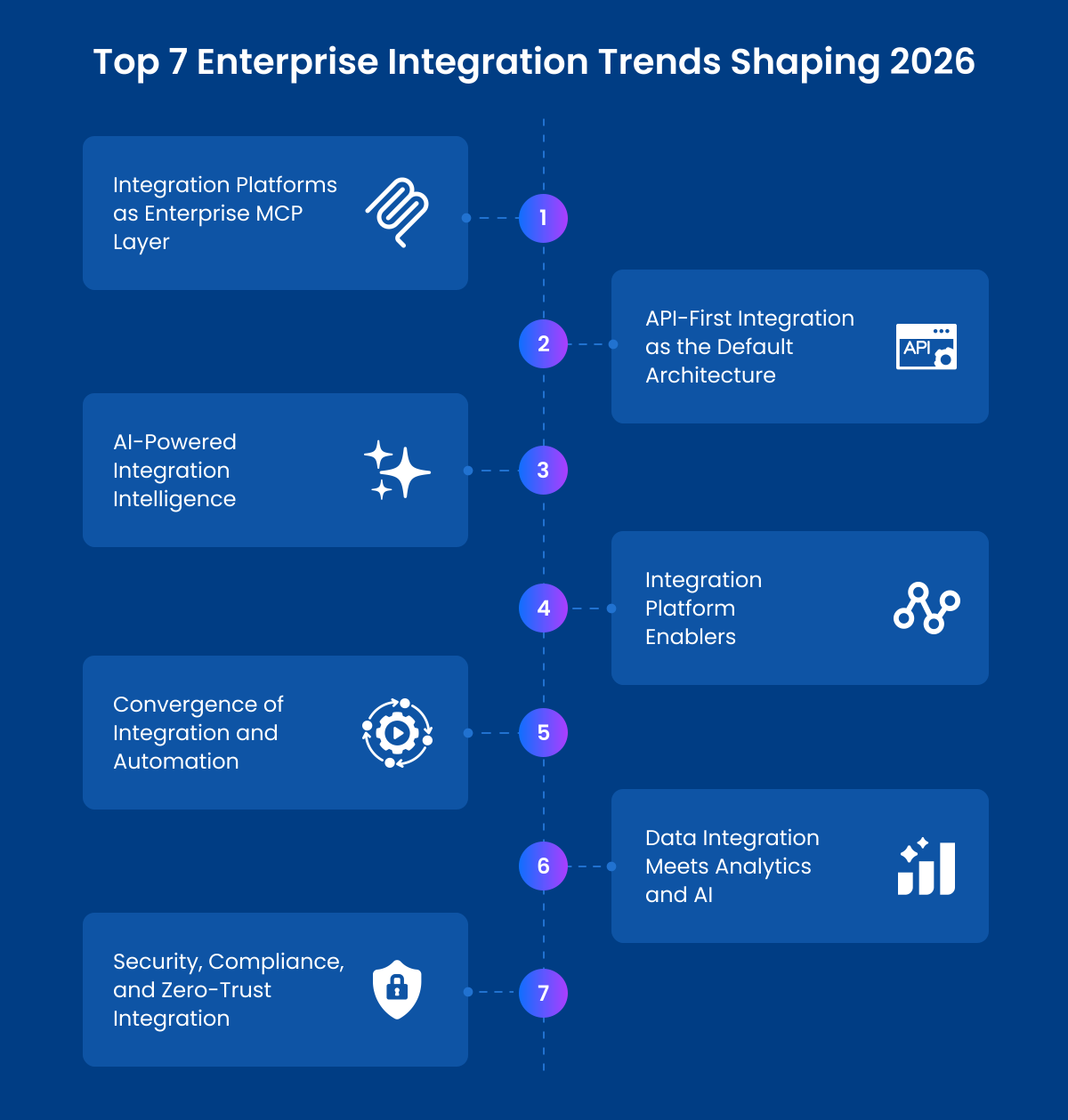
4. Integration Platform Enablers
Traditional system integration platforms focused on designing, implementing, and maintaining integration projects as one-time engagements. Now, the integration platform role is shifting towards enabling scalable platforms, governance models, and long-term operational excellence. Modern integrators now help organizations adopt reusable integration architectures, support ongoing change, and ensure platforms evolve alongside new technologies such as AI, automation, and real-time systems.
Integration is moving beyond system and data connectivity. Organizations are using integration to orchestrate workflows and trigger actions across multiple applications. This convergence allows enterprises to connect insights directly to execution, reducing the gap between detecting a change and acting on it. When business logic and data movement are managed together, it gets easier to automate workflows.
6. Data Integration Meets Analytics and AI
Rather than moving data only for reporting, integration solutions are now feeding analytics dashboards, predictive models, and AI systems directly. The synchronization ensures that analytical and AI workloads receive updated, accurate, and governed data.
7. Security, Compliance, and Zero-Trust Integration
As integration scales, enterprises are embedding security and compliance directly into their architecture. To ensure continuous authentication, authorization, and monitoring, integration platforms apply zero trust principles to APIs, data flows, and events. Modern integration platforms like Boomi and Workato provide centralized visibility and policy enforcement, allowing organizations to scale integration and AI initiatives without increasing risk.
What does this mean for Enterprises in 2026?
This year marks a turning point in which the integration strategy directly determines business agility, AI success, and operational resilience. Today, integration is no longer a technical function, but it is now a core enterprise capability that shapes how your organization quickly adapts to innovation, scales, and responds to change.
1. Integration Becomes a Business Capability
Enterprises are moving away from one-time project-based integrations toward full-fledged integration platforms. Integration experts now support ongoing changes like new SaaS tools, evolving APIs, AI initiatives, and regulatory updates without constantly rebuilding systems, helping organizations move faster and reduce technical debt.
2. AI Readiness Depends on Integration Maturity
For many organizations, integration maturity becomes a limitation of AI success. AI systems need accurate, real-time, and well-governed data to work effectively. If your iPaaS fails to deliver context, AI initiatives face reliability, security, and scalability issues. Boomi Agentstudio ensures you lay a strong foundation for AI in your integration system.
| Recommended Read: What is Agentic iPaaS? The Next Big Leap In Enterprise Integration |
3. Real-Time Operations Become the Expectation
Customers, employees, and partners increasingly expect real-time responses and insights. To achieve this, businesses are adopting event-driven and streaming integration approaches. The real-time integration helps with quick decision-making, more responsive experiences, and smoother operations, while batch-based or point-to-point systems struggle to keep up.
4. Stronger Governance Without Slowing Innovation
With the use of AI, intelligent automation, and agentic workflows, the risk of security breaches, compliance failures, and data issues increases. To speed with control, modern integration platforms enable centralized governance, observability, and policy enforcement while still supporting low-code and self-service integration. This allows innovation to scale without sacrificing security or compliance.
5. Organizational and Skill Shifts
The advancement and modernization of integration also change team structure and skills. Integration teams are evolving into platform teams that enable business units, citizen integrators, and AI systems. The focus is continuously shifting from writing custom code to designing reusable integration assets, managing API and events, etc.
How Can an Integration Partner Help You Adapt to these Trends?
An experienced integration partner can help your organization turn evolving integration trends into measurable business outcomes. We can help you adopt the new capabilities that align with your integration platform, its architecture, governance, and operating models, unleashing the full potential of your investment.
- Help you choose the right integration solution, such as Boomi or Workato, for your business needs.
- Designs scalable, future-ready integration architectures aligned with business growth
- Provides ongoing post-integration support, monitoring, and optimization
- Enables faster adoption of new iPaaS features, trends, and platform updates
- Implements governance, security, and observability across integrations
- Ensures integration solutions evolve with changing business and technology needs
Conclusion
Enterprise integration is no longer a background IT task, but it is an operational layer that enables intelligence, adaptability, and scalability. The shift from point-to-point integration to MCP-driven architecture and agent-ready workflows showcases a deeper transformation in how enterprises operate today.
Organizations are not paying only for integration platforms; they are also investing in faster innovation, cleaner data pipelines, stronger governance, and the ability to support AI agents and automation at scale. Those relying on outdated integration models will feel the impact in fragmented systems, slower change cycles, security gaps, and reduced AI value.
It is very clear that integration is no longer just a technical function; it is a strategic business capability, and the enterprises that recognize this early will lead the next wave of digital and AI-driven growth.
Frequently Asked Questions
1. How is AI impacting enterprise integration?
Artificial intelligence is enabling intelligent integration by automating workflows, generating predictive insights, and detecting anomalies. AI tools and agents assist businesses in designing, operating, monitoring, and optimizing integration with minimal human effort.
2. How are enterprises combining data integration with analytics and AI?
Businesses are using integration platforms like Boomi, combined with analytics and AI, to create unified insights from disparate data sources. This enables predictive analytics, automated decision-making, and real-time intelligence. To leverage the full potential of your iPaaS platform, contact us.
3. Why is API-First integration becoming a default approach in 2026?
An API-first integration approach ensures systems are modular, scalable, and easy for both human and AI agents to access. This shift supports quicker deployments, better governance, and improved interoperability across services.
4. How are iPaaS platforms like Boomi and Workato evolving into an MCP layer?
iPaaS is evolving into an enterprise MCP layer, becoming the foundational system that supplies, governs, and orchestrates context for AI models across the enterprise. Integration is no longer about connecting applications, but also feeds AI models with reliable, real-time, and governed enterprise context.
5. What new integration capabilities is Boomi introducing in 2026?
Boomi is expanding its traditional iPaaS with stronger API management, event-driven integration, and AI-assisted automation. It is focusing on more hybrid and multi-cloud connectivity, improved observability, and trusted data integration, making Boomi a strategic enterprise integration or MCP layer rather than just a middleware tool.