Introduction
What if your integrations could think for themselves? That’s precisely the holding for all the enterprises. Integration Platform as a Service (iPaaS) has been enhancing connectivity by linking applications and data and enabling seamless cross-cloud and cross-system integration. The introduction of Agentic AI, a form of artificial intelligence capable of autonomous reasoning, decision-making, and action, is elevating integrations from simple automation to intelligent, self-learning ecosystems that can reason, adapt, and optimize in real time.
Businesses can maximize the potential of iPaaS by integrating Agentic AI into their digital ecosystem, unlocking new levels of agility and innovation. This blog will help you understand how AI and iPaaS work together and why it is essential for your business.
What is Agentic AI in Enterprise Systems?
Enterprise systems like ERP, CRM, HRIS, and SCM have traditionally operated on fixed rules and human-driven workflows. They are reliable, but rigid, any change requires manual intervention. Agentic AI shifts this model by introducing systems that can independently interpret situations, make decisions, and act across connected applications.
Unlike rule-based automation or chatbots, agentic AI systems understand intent, plan multi-step actions, and adapt dynamically. For example, instead of just flagging a supply shortage, an agent can identify alternative suppliers, rebalance inventory, notify stakeholders, and update forecasts, all within defined governance boundaries.
This shift is why integration has become critical. Agents rely on real-time access to enterprise data and systems, making iPaaS the backbone that enables them to function effectively at scale.
The Three Layers of Agentic AI in the Enterprise
- Perception (Connecting to Enterprise Data in Real Time): Agentic systems require continuous access to data across ERP, CRM, and other systems. iPaaS enables this real-time connectivity, ensuring agents operate with complete and current context.
- Reasoning (Understanding Context, Not Just Conditions): Instead of simple rule checks, agents evaluate multiple variables, priorities, and trade-offs to determine the best course of action using AI models.
- Action (Executing Across Systems Autonomously): Agents take action across connected platforms, updating records, triggering workflows, or notifying teams, while operating within defined policies and human oversight.
Why do Your Businesses Need Agentic iPaaS?
Modern enterprises rely on dozens of SaaS applications, internal systems, and data sources, but traditional iPaaS still requires some manual effort and limits scalability. AI integration in iPaaS changes this by turning your conventional integrations into intelligent, self-optimizing workflows.
Agentic iPaaS architecture can access, interpret, and act on enterprise data across systems, something only integration platforms can provide. Instead of manually designing flows, businesses can rely on AI to generate mappings, detect errors, apply business rules, and automate decisions in real time. This dramatically reduces operational overhead and improves accuracy.
With agentic AI in your iPaaS, integrations evolve from static pipelines to autonomous, context-aware processes that adapt to load, system changes, or business events. As a result, organizations gain faster automation, better efficiency, and a resilient digital foundation that keeps pace with modern business needs.
| Recommended Read: Agentic AI Explained: The Future of Autonomous Intelligence |
Architecture Deep Dive: How AI and iPaaS Work Together
AI-powered iPaaS platforms leverage advanced machine learning, autonomous agents, and event-driven architectures to make integrations smarter, faster, and self-optimizing.
Leading platforms like Boomi and Workato have introduced Agentic AI, which goes beyond automation, enabling systems to reason, adapt, and autonomously orchestrate workflows across enterprise ecosystems.
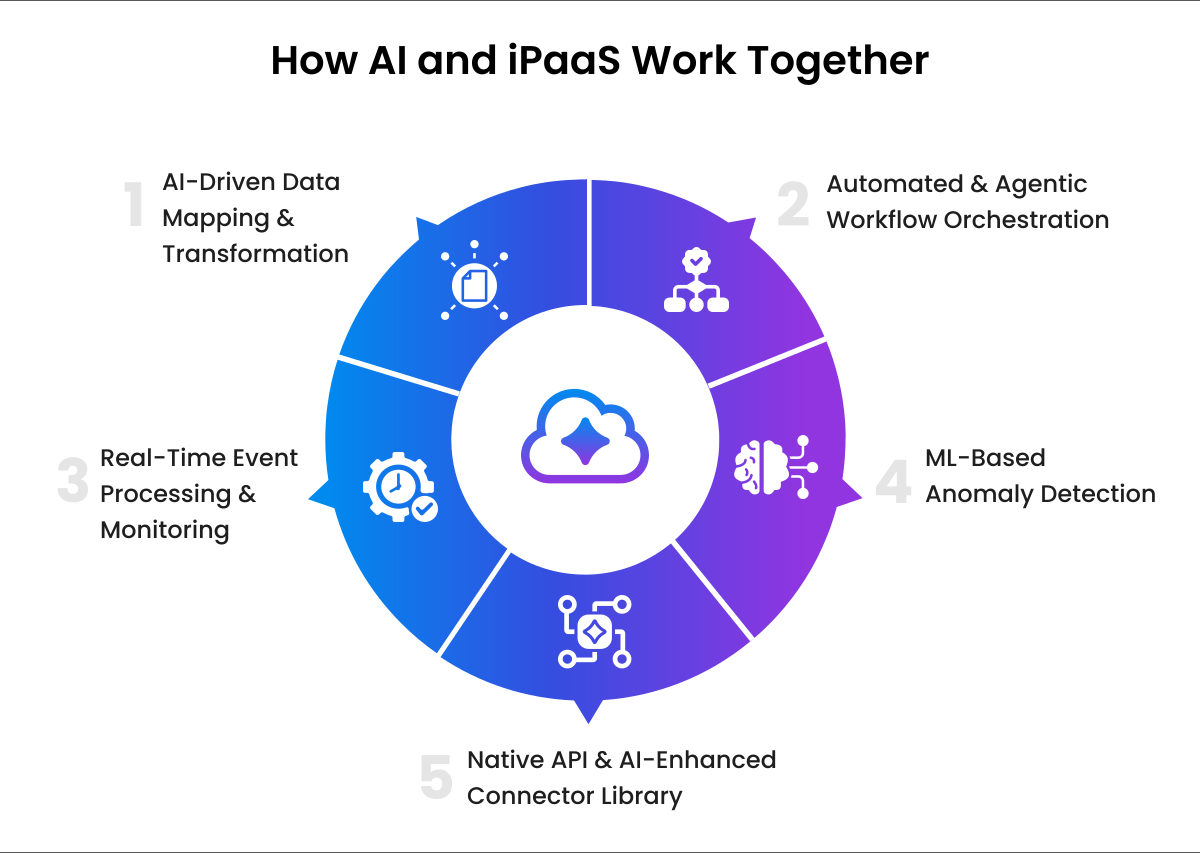
1. AI-Driven Data Mapping & Transformation
Modern integrations demand seamless connectivity between disparate schemas. AI-powered iPaaS platforms automate this by learning from historical data and immediately predicting accurate mapping.
- AI Schema Detection – Automatically identifies fields, structure, and relationships across multiple systems.
- Predictive Field Matching – Use context and past integration patterns to recommend best-fit mappings.
- Dynamic Data Cleansing – Standardizes formats, resolves inconsistencies, and validates data quality before transformation.
- Contextual Rules – Automatically apply business logic (currency conversions, data formats, enrichment).
2. Automated & Agentic Workflow Orchestration
iPaaS requires manual API sequencing, but Agentic iPaaS introduces AI-driven orchestration that adapts workflows in real time based on conditions (like Workato Genies and Boomi AI Agents).
- Event Condition Action Logic – Automatically triggers workflows when specific data events occur.
- Adaptive Scheduling – Based on load, latency, and system health, Agentic iPaaS automatically adjusts sync frequency.
- Workflow Recommendations – Reduce bottlenecks by suggesting optimal tasks.
- AI Load Balancing – Distributes workloads across nodes to ensure peak performance.
3. Real-Time Event Processing & Monitoring
Agentic AI in iPaaS provides high-throughput event ingestion and real-time processing.
- Stream Ingestion Engines – Ingests high-volume data from Kafka, MQTT, IoT devices, and apps.
- AI Filtering & Routing – Removes noise and intelligently directs relevant events.
- Real-Time Dashboard – Real-time data gives decision-makers instant visibility across integration flows.
- Automated Alerts – Automatically alert with Slack, SMS, or email notifications when thresholds are breached.
4. ML-Based Anomaly Detection
AI in iPaaS continuously monitors integration patterns to prevent disruptions before they escalate.
- Outlier Detection – Identifies unusual data spikes or corrupted entries and learns what “normal” looks like for automatic adjustments.
- Sequence Analysis – Spots breaks in expected event behavior (e.g., sudden API failures).
- Root-Cause Intelligence – Pinpoints recent schema changes, connector issues, or data drifts.
- Automated Remediation – Initiates rollback, quarantine, or corrective workflows.
5. Native API & AI-Enhanced Connector Library
iPaaS is known for its extensive connector library, and integration of AI makes it even smarter.
- Certified Connectors – Pre-built connectors for SaaS, ERP, CRM, HRIS, and on-prem apps.
- AI-Optimized Endpoints – Manages batching, throttling, retries, and rate limits intelligently.
- Auto Version Detection – AI identifies API changes and auto-updates mapping or connector logic.
- Semantic Search – Natural language (NLP) search helps users find fields, functions, or connectors instantly.
| Recommended Read: Agentic AI Workflows and Architectures Explained: Components, Frameworks, and Future Impact |
Advantages of Combining iPaaS with AI Agents
1. Autonomous Workflow Automation
AI agents eliminate manual workflow building by automatically generating, adapting, and optimizing workflows, reducing IT effort and accelerating delivery.
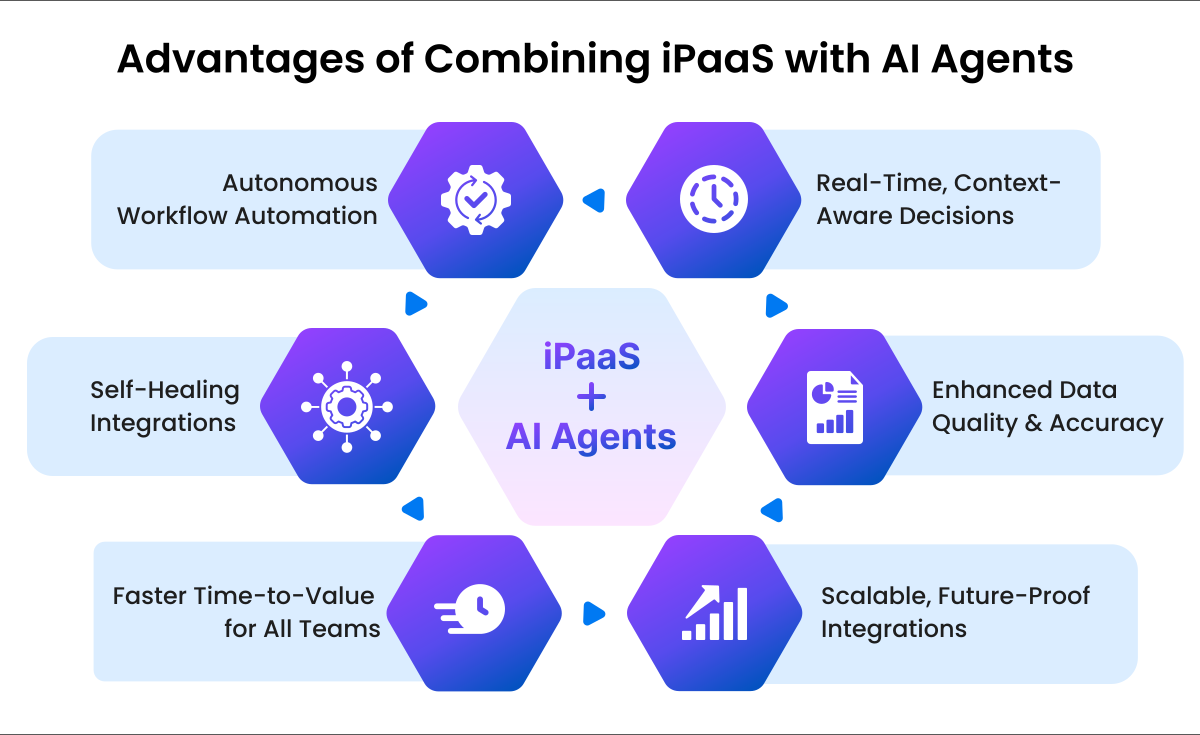
2. Real-Time, Context-Aware Decisions
Agents understand intent, urgency, risks, and business context, enabling smarter, faster decisions across integrated systems.
3. Self-Healing Integrations
AI continuously detects errors, anomalies, and failures, and resolves them through auto-retries, rerouting, or corrective actions, ensuring higher reliability.
4. Enhanced Data Quality & Accuracy
AI-driven mapping, cleansing, and enrichment produce cleaner, more consistent data across CRM, ERP, finance, and analytics platforms.
5. Faster Time-to-Value for All Teams
With natural language prompts and AI-generated flows, teams across Sales, Marketing, Support, HR, and Finance can automate without heavy technical skills.
6. Scalable, Future-Proof Integrations
AI agents adapt to system changes, API updates, and new business processes, keeping integrations resilient and scalable with minimal maintenance.
Choose the Right Agentic iPaaS Platform
Selecting an integration platform today means preparing for AI-driven workflows tomorrow. We help you evaluate iPaaS platforms based on your architecture and agentic AI goals.
Schedule a Free Discovery CallLeading iPaaS Platforms Leveraging AI Agents
Modern iPaaS platforms are rapidly evolving into AI-driven orchestration layers, where agents don’t just automate tasks but actively make decisions and execute workflows. Platforms like Boomi, Workato, Celigo, Microsoft Azure Integration Services, MuleSoft, and Google Cloud are embedding agentic AI to enable intelligent automation at scale.
These platforms combine real-time data access, AI-driven reasoning, and governed execution to transform integration from a backend function into a strategic layer for enterprise operations, powering adaptive workflows, multi-agent collaboration, and continuous optimization.
| Capability | Boomi | Workato | Celigo | Azure Integration Services | Google Cloud |
| AI Mapping & Intelligent Design | Boomi GPT auto-builds maps, flows, and transformations using ML and context. | AI recommends recipes, auto-builds workflow steps, and generates integrations from natural language. | Celigo Ora uses natural language to design, map, and manage integrations with full dependency awareness. | Azure Logic Apps integrates with AI to design workflows using LLM-driven interpretation and adaptive logic. | GCP uses natural language and low-code designer to build integrations with AI-assisted configuration. |
| Agentic Automation | Boomi AI Agents autonomously analyze data, make recommendations, and fix broken flows. | Workato Genies act as domain-specific AI agents that reason, execute, and optimize tasks across systems. | Celigo Agent Builder creates autonomous agents that execute multi-step workflows. | Supports autonomous and conversational agents that interpret inputs, make decisions, and execute workflows. | Gemini agent stack enables autonomous agents to act across systems using ADK and Vertex AI Agent Builder. |
| Workflow Orchestration | Adaptive workflows powered by AI-driven insights and anomaly detection. | Agentic orchestration with Deep Action-multi-step, AI-decided actions across apps without manual design. | Multi-agent orchestration via MCP-powered connectivity with full visibility into dependencies and flow impact. | Advanced multi-agent orchestration with nested workflows, real-time adaptation, and human-in-the-loop control. | Orchestration engine supports complex, long-running workflows across systems with asynchronous execution. |
| Error Handling & Self-Optimizing | Self-optimizing integrations to auto-detect, auto-correct, auto-retry infrastructure issues. | Autonomous remediation by Genies and AI models resolve process failures and operational blockers. | Automated error resolution with AI-driven exception management for always-on operations. | Built-in monitoring, retries, and AI-assisted diagnostics. | AI-assisted monitoring and workflow resilience with intelligent retries and execution tracking. |
| Natural Language Automation | Users describe integrations in English → Boomi GPT generates flows instantly. | Workato AI enables natural language “describe and build” automations and conversational execution. | Enables conversational automation build, modify, and troubleshoot integrations via chat. | Natural language-driven agent workflows powered by Azure OpenAI and conversational agents. | Natural language integration design supported via Gemini and Vertex AI Agent Builder. |
| Governance & Observability | Smart alerts, predictive diagnostics, and data quality recommendations. | Agent Trust™, observability, and real-time policy enforcement ensure safe automation. | Enterprise MCP Server enforces governance and policy-driven agent execution. | Compliance controls, human approvals, and full audit trails across workflows. | Apigee acts as an MCP bridge, enforcing API governance, and security. |
Practical Use Cases of Agentic iPaaS: Where AI + iPaaS Deliver Immediate Value
AI-driven iPaaS platforms unlock new possibilities by automating complex workflows, enriching data insights, and enabling autonomous system coordination.
Check out how AI + iPaaS deliver measurable, immediate business value.
1. Automated Customer Onboarding
Agentic AI in iPaaS streamlines customer onboarding by automatically syncing data from web forms, CRM systems, and billing systems. It captures prospect details from web forms into CRM and ERP systems, cross-checks customer data against third-party verification services, applies rules to determine account types, triggers email campaigns, and documents requests based on customer attributes.
2. Predictive Maintenance Integration
Manufacturers can leverage iPaaS by combining IoT sensor data with ERP and CRM systems to predict equipment failures, and by using AI models to analyze historical maintenance logs, real-time sensor readings, and purchase histories to schedule proactive service calls. Leverage ML models to detect patterns indicating imminent breakdowns, automatically generate maintenance tickets in ERP, and send alerts to technicians with recommended actions.
3. Real-Time Inventory Synchronization
Retailers and distributors often struggle with overselling and stockouts. AI iPaaS enables real-time synchronization of inventory across e-commerce channels, warehouses, and POS systems. Analyze sales velocity and market demand to inform demand forecasting, automatically adjust reorder thresholds, notify customers about stock shortages, and keep suppliers updated in real time.
4. Intelligent Financial Reconciliation
AI-powered iPaaS automates reconciliation by pulling transactional data from banking, ERP, and invoicing platforms into the AI iPaaS. AI matches payments to invoices using fuzzy logic and historical patterns, flagging discrepancies for human review. Automatically logs reconciliation steps and verifies correct tax codes before booking entries.
5. Enhanced Marketing Personalization
Marketing teams can leverage Agentic AI in iPaaS to combine CRM, web analytics, and email platforms. AI processes behavioral, purchase history, and engagement data to segment audiences, forecast churn, and suggest personalized offers in real time.
Traditional iPaaS v/s Agentic iPaaS
| Features | Traditional iPaaS | Agentic iPaaS |
| Setup | Manual workflow design using rules and static configurations | AI-generated workflows built from natural language instructions and goal-based prompts |
| Triggers | Basic application-level events | Context-aware signals that understand intent, urgency, risk, and business impact |
| Flexibility | Fixed logic that requires manual updates | Adaptive, autonomous decision-making that adjusts flows in real time |
| Who uses it | Primarily IT and Ops teams | Accessible to everyone – Sales, Support, Marketing, Finance, and non-technical users |
| Maintenance | Requires consistent optimization and troubleshooting | Self-healing flows with continuous learning and automated error recovery |
The Future of iPaaS with Agentic AI
iPaaS has already evolved significantly, from basic point-to-point connectors to cloud-based middleware, to low-code integration platforms. The Agentic AI in iPaaS represents the next and arguably most consequential evolution in this journey. Here’s where the market is headed.
1. iPaaS as Agentic Orchestration Layer
iPaaS is evolving from a backend integration tool into the central execution layer for enterprise AI. Platforms like Workato and Microsoft Azure Integration Services are already positioning themselves as systems where agents don’t just connect apps, but actively drive decisions and actions across the business.
2. Multi-Agent Enterprise Architectures
Enterprises are moving beyond isolated AI agents toward coordinated multi-agent systems that collaborate across functions. Platforms such as MuleSoft and Google Cloud are enabling this shift by providing orchestration layers where multiple agents can interact, share context, and execute complex workflows together.
3. Open Protocols (MCP and A2A)
Standards like MCP and A2A are making agent ecosystems interoperable across platforms and vendors. Leading iPaaS providers, like Celigo and Google Cloud are adopting these protocols to ensure agents can securely connect, communicate, and operate across diverse enterprise environments.
| Recommended Read: Why iPaaS Platforms Can Be Used Enterprise MCP? |
4. Governance and Trust
As AI agents gain autonomy, governance becomes critical, not optional. Platforms like Microsoft Azure and MuleSoft are embedding guardrails, audit trails, and human-in-the-loop controls to ensure transparency, compliance, and safe decision-making at scale.
5. AI-Native iPaaS Platforms
The market is clearly favoring platforms built for AI-first operations rather than retrofitted capabilities. Innovations like Celigo Agent Builder, MuleSoft Agent Fabric, and Google Cloud Gemini stack signal a structural shift toward AI-native integration ecosystems.
Why Choose NeosAlpha?
With over 8+ years of certified iPaaS expertise, NeosAlpha stands out as the leading integration and automation expert in the UK. Being a trusted Boomi and Workato Partner allows us to help enterprises unlock the full power of Agentic AI and next-generation integration platforms.
- 8+ years of proven experience with iPaaS platforms such as Boomi, Workato, etc.
- Developed our own Marketing and Testing AI agetns.
- From architecture to deployment, we build secure, high-performance workflows.
- We leverage the full capabilities of AI and Agentic orchestration to deliver reliable solutions.
- Trusted by finance, retail, healthcare, and manufacturing leaders for enterprise solutions.
Conclusion
Agentic iPaaS represents the next significant evolution in enterprise integration. Agentic AI is here, changing the basic connectivity between systems into intelligent autonomous orchestration powered by AI agents that can reason, adapt, and act across your digital ecosystem.
As enterprises adopt more SaaS applications, AI-powered iPaaS becomes essential for building scalable, future-proof digital operations. Whether you’re modernizing legacy systems, enabling hyperautomation, or building AI-ready architecture, the combination of AI and iPaaS is the foundation for resilient, intelligent enterprise integration. The future of integration is autonomous, and now is the time for businesses to embrace it.

