
What happens when APIs are no longer called by applications only, but also by autonomous AI agents making decisions on their own? The shift is no longer hypothetical; APIs are expected to sit at the center of AI-driven systems, powering intelligent workflows, agent economies, and real-time digital decision-making. According to Gartner, by 2026, more than 30% of the increase in API demand will come from AI tools using Large Language Models. This data shows that a new API trend is underway, prompting businesses to change how and where they call these API endpoints.
Modern API trends are also being shaped by AI integration, hybrid cloud environments, and the growing need for scalable API gateway solutions. Apart from this, the API landscape is growing rapidly, with public and private API counts continuing to rise year over year, as businesses manage thousands of APIs across hybrid and multi-cloud environments. APIs must evolve from static request-response interfaces into intelligent, observable, governed, and interoperable capabilities.
Explore the latest API trends, learn how API management platforms like Google Apigee, Kong, and Boomi are shifting the approach, and how APIs are transforming from technical connectors into strategic assets for the next generation of digital and AI-powered ecosystems.
Growth of APIs in 2026
The Application Programming Interface in 2026 is undergoing a massive shift. Now, they are no longer optimized primarily for application-to-application communication but are redesigned to support LLM-driven traffic, autonomous agents, and AI-native workloads. Here are the three new shifts that will stand out for API:
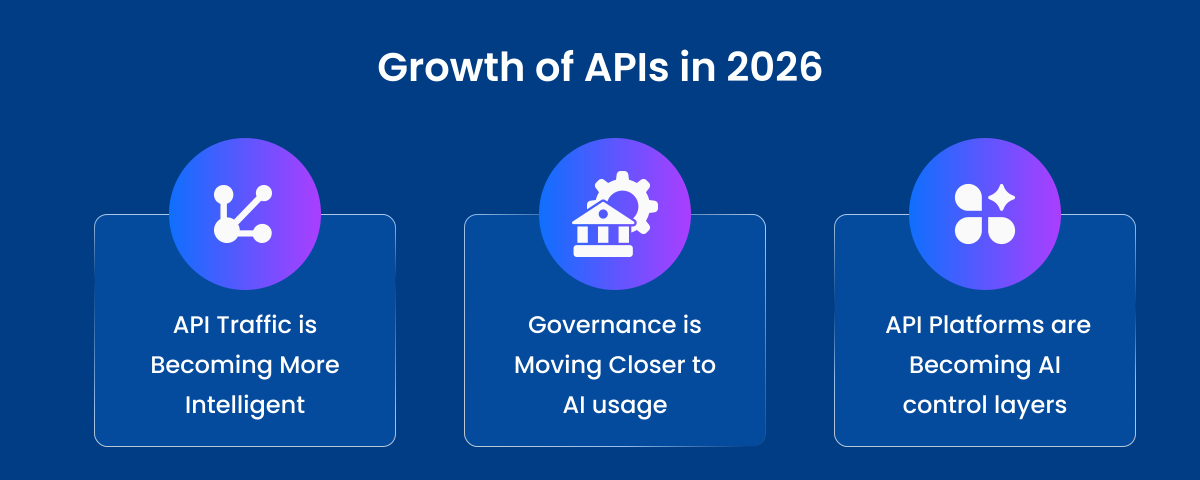
1. API Traffic is Becoming More Intelligent
APIs are no longer handling only fixed requests from applications. They now receive dynamic requests from AI systems that rely on intent, context, and usage patterns, not just URLs and data formats.
2. Governance is Moving Closer to AI usage
Managing APIs now means understanding how AI models and agents use them. Cost control, security, and policies increasingly depend on monitoring AI prompts, token usage, and automated behavior, not just access credentials.
3. API Platforms are Becoming AI control layers
API gateways and integration platforms are assuming greater responsibility. They now help manage how AI systems find APIs, access data safely, and use services without losing visibility or control.
This evolution is visible across leading platforms, each approaching the challenge from a different angle.

Platform Specific API Updates and Evolution
1. Google Apigee
Google has clearly pivoted Apigee to secure and govern LLM-driven API traffic management, operating more closely with its broader AI ecosystem.
- Manage LLM Token Quotes
Apigee supports quota based on LLM token consumption, helping to control costs when APIs front generative AI backends, where a single request can vary dramatically.
- Semantic Caching & Model Armor
Apigee can cache responses based on the semantic meaning of prompts, reducing latency and the number of LLM calls for similar queries, rather than caching only identical requests.
- Extension Processor API
The Apigee Extension Processor enables Apigee customers to seamlessly apply API management capabilities, such as security, governance, and traffic control, to Google Cloud services and to external services fronted by Cloud Load Balancing.
- APIs as MCP Servers
The new flow variable helps prevent server-side request forgery attacks by validating dynamically constructed target URLs, a growing risk in AI-driven API flows.
- Govern MCP Access Control as API Products
Allows exposing certain MCP tools as a scoped API product within Apigee.
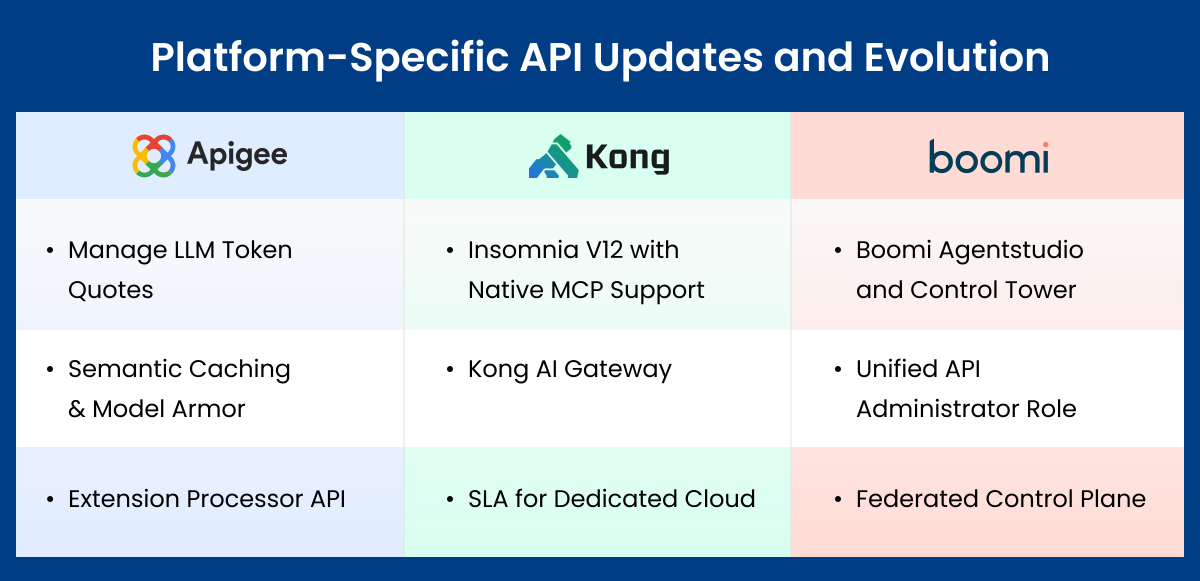
2. Kong
Kong is focusing on agentic architectures and the Model Context Protocol, positioning the gateway as a first-class control layer for AI agents.
- Insomnia V12 with Native MCP Support
Developers can now test MCP servers directly using native MCP client support in Insomnia.
- Enterprise MCP Gateway
Kong now offers a production-ready gateway specifically designed to govern MCP traffic, applying security, rate limits, and observability to agent-accessed data.
- SLA for Dedicated Cloud
99% SLA for Konnect to focus on mission-critical AI workloads where downtime directly impacts intelligent systems.
3. Boomi
Gartner named Boomi as the leading API management platform in 2025. This reflects Boomi’s advanced API features and their orchestration within autonomous systems.
- Boomi AgentStudio and Control Tower
Boomi AgentStudio is a dedicated environment for designing, governing, and orchestrating AI agents, turning integrations and APIs into agent-driven workflows. Boomi Agent Control Tower provides centralized visibility, monitoring, and governance across all deployed agents.
- Unified API Administrator Role
Simplifies lifecycle management by removing fragmented permission models, making governance more scalable as API counts grow.
- Federated Control Plane
Boomi can now discover and govern external gateways like MuleSoft, highlighting a move toward multi-vendor API governance and MCP support for integrations.
Ready to Future-Proof Your API Strategy?
Emerging trends such as AI-powered APIs, event-driven architectures, and API security are reshaping how organizations build and scale digital ecosystems. Ensure your API strategy is prepared for what's next.
Talk to Our API ExpertsWhat Are the Biggest API Trends in 2026?
The role of APIs is undergoing a significant transformation as AI models, autonomous agents, and intelligent workflows become core to modern digital architectures. In 2026, APIs are no longer built solely for application integration; they are becoming AI-consumable capabilities that must be discoverable, governed, observable, and secure at scale. These seven trends capture how API platforms are evolving to support agent-based systems, AI-driven traffic, continuous governance, and automated quality, while laying the foundation for a more interoperable and intelligent API ecosystem.
1. APIs Exposed as MCP Servers
APIs are rapidly evolving from being built only for developers to being directly consumable by AI models and autonomous agents. In 2026, this shift was formalized by exposing APIs as Model Context Protocol (MCP) servers.
APIs exposed via MCP clearly define:
- What actions is an AI agent allowed to perform?
- What data can be accessed and under what conditions?
- How should responses be interpreted and used?
MCP servers remove the need for AI tools to scrape documentation or rely on brittle custom integrations. Instead, they provide a standardized, structured way for AI models to discover, understand, and safely invoke API capabilities.
Apigee and Kong are already investing in machine-readable API contracts, structured metadata, and strict policy enforcement, foundational capabilities required for exposing APIs as controlled MCP-based interfaces that AI agents can reason about and invoke.
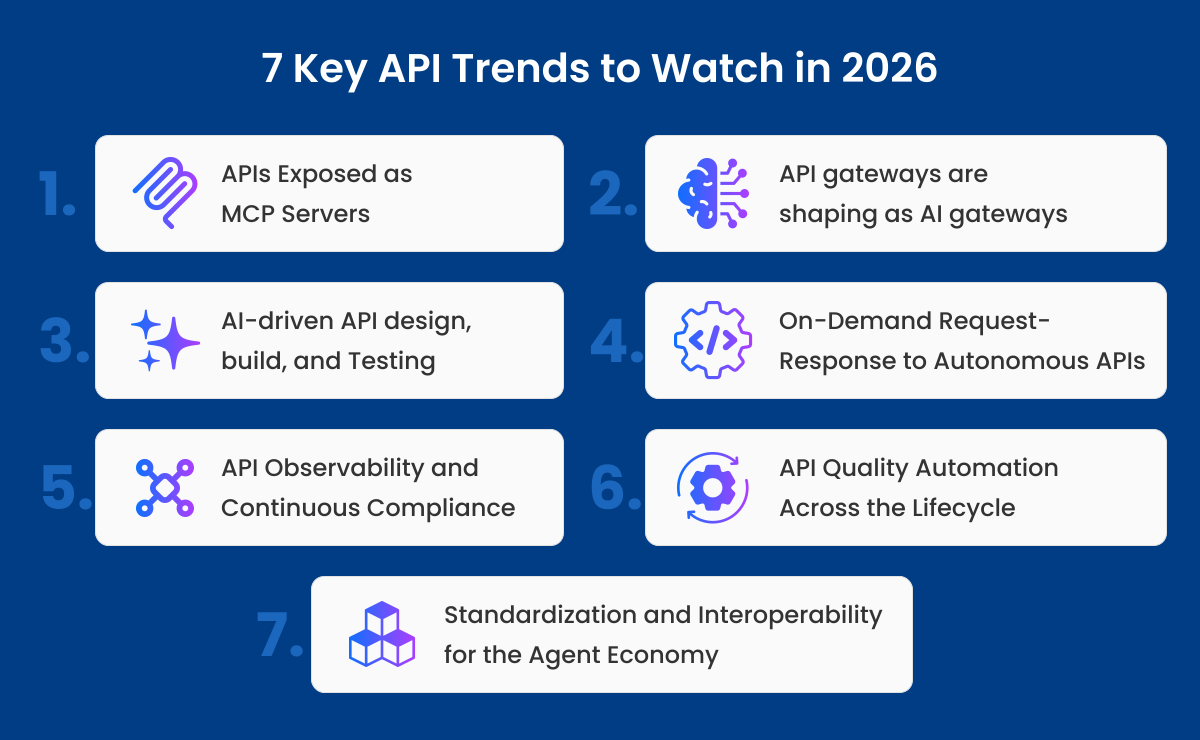
2. API gateways are shaping as AI gateways
Traditional API gateways were designed to handle routing, authentication, rate limiting, and basic security controls. However, that role is now expanding as API gateways increasingly function as AI gateways.
AI-powered applications introduce new challenges, such as autonomous agents making independent decisions, unpredictable traffic patterns, and highly dynamic API usage. As a result, gateways must understand who or what is calling an API, whether it is a human-driven application, an automated service, or an AI agent acting autonomously.
AI gateways are expected to:
- Handle contextual API invocation requests from AI agents
- Enforce fine-grained policies and agent permissions
- Monitor and audit AI-initiated actions
- Apply dynamic throttling and guardrails based on behavior and risk
According to API gateway trends, the gateways become active control points for intelligent traffic, rather than passive routers. They help organizations scale AI-powered systems safely, without losing governance, security, or visibility.
Platforms like Kong leverage extensible plugin ecosystems to enforce advanced policies and perform contextual security checks. At the same time, Apigee continues to evolve beyond basic traffic management into a more analytics-driven, governance-focused platform.
3. AI-driven API design, build, and Testing
AI tools are not only consuming APIs but also assisting API teams in managing the entire lifecycle.
- Designing consistent and standards-compliant API contracts
- Generating OpenAPI specifications and examples
- Creating automated test cases, including edge cases
- Identifying security gaps and design flaws early
This shift dramatically reduces manual effort while improving quality and consistency. Instead of relying on tribal knowledge or manual reviews, teams can use AI to enforce best practices by default.
As delivery cycles accelerate, AI-driven API design and testing will become a competitive advantage, helping teams ship faster without sacrificing reliability or security.
Platforms like Apigee and Boomi are also moving toward more intelligent automation, using analytics and pattern recognition to identify API misuse, performance bottlenecks, and potential design flaws.
| Recommended Read: APIs, AI, and Integration: How Google Cloud Is Redefining the Connected Enterprise |
4. On-Demand Request-Response to Autonomous APIs
The classic request-response API model is no longer sufficient for modern systems. APIs are increasingly designed to support autonomous behavior.
Autonomous APIs don’t just wait for a request. They can:
- Trigger actions based on events
- Participate in long-running workflows
- Collaborate with other APIs through AI agents
- Make decisions using context and historical data
This shift is driven by agent-based architectures, in which systems are expected to act independently to achieve goals. APIs become building blocks in larger, intelligent workflows rather than isolated services.
For API teams, this means designing APIs that are state-aware, event-friendly, and resilient, supporting complex interactions without constant human intervention.
5. API Observability and Continuous Compliance
As API ecosystems grow more complex, visibility becomes non-negotiable. Organizations are moving beyond basic monitoring toward deep API observability combined with continuous compliance.
API observability now includes:
- Tracking how APIs are actually used in production
- Understanding performance and failure patterns
- Monitoring agent-driven behavior and anomalies
- Tracing API dependencies across services
At the same time, compliance is shifting from periodic audits to always-on enforcement. Policies related to security, governance, and regulatory requirements are continuously validated across API specifications and runtime behavior.
6. API Quality Automation Across the Lifecycle
API quality is no longer a concern for the final stage. It’s embedded throughout the lifecycle, from design to deployment and beyond.
Automation plays a central role in enforcing API quality by:
- Validating API specifications against standards
- Ensuring backward compatibility
- Detecting breaking changes early
- Continuously testing performance and reliability
- Flagging inconsistencies and anti-patterns
By automating quality checks, teams can maintain high standards at scale, even as the number of APIs and releases grows. This reduces rework, improves developer experience, and builds trust with API consumers.
7. Standardization and Interoperability for the Agent Economy
The rise of AI agents is driving the need for API interoperability by design. Intelligent agents interact with multiple APIs across organizations, platforms, and domains. Without standardization, this quickly becomes brittle and expensive.
Businesses will see the adoption of
- Standard API contracts and metadata
- Shared protocols for AI and agent interaction
- Consistent security and identity models
- Interoperable discovery and capability descriptions
Standardization reduces friction and unlocks ecosystem-level innovation, allowing APIs to plug into agent workflows seamlessly, without custom integrations for every use case.
Platforms like NetSuite expose standardized APIs that allow external systems, and increasingly AI-driven tools, to interact reliably with core business data.
Conclusion
APIs are no longer just integration plumbing, but are becoming the control fabric of the AI-driven digital ecosystem. The rise of LLMS, autonomous agents, and intelligent workflows is significantly changing how APIs will work in the next few years.
API traffic is becoming more semantic and machine-driven, governance is moving closer to the model and prompt layer, and API platforms are expanding beyond traditional gateways into full AI-aware control planes.
Platform directions from Apigee, Kong, and Boomi reinforce this reality. For organizations, the takeaway is strategic rather than technical. Preparing for 2026 means treating APIs as long-lived, intelligent assets rather than short-term integration artifacts. Talk to NeosAlpha API experts to know more about APIs.


