Introduction
There is a version of the Databricks vs Snowflake question that wastes everyone’s time, and it usually starts with someone asking which one is better. The honest answer is that they are not interchangeable, and treating them as two brands of the same thing leads to expensive mistakes. They were built on different architectural assumptions, optimized for different workloads, and priced in ways that make direct cost comparisons genuinely difficult.
What makes the decision harder, not easier, is that both platforms have spent years expanding into each other’s territory. Databricks began as a compute engine for data engineering and machine learning, and later expanded into warehousing. Snowflake began as a SQL-first data warehouse and grew toward data science and AI. Snowflake has added streaming ingestion, Python procedures, model inference, and native Iceberg support. Databricks has added BI-optimized SQL warehouses, Unity Catalog governance, serverless compute, and now Lakebase for transactional workloads. The marketing makes them sound the same. The architecture underneath does not.
The useful framing is not which platform wins, but which fits your workloads, your team, and your trajectory. That requires looking past the headlines at how each is built, how the pricing actually works, and where the real trade-offs appear.
| The practical summary
For SQL analytics and warehousing, the two platforms are closer than ever. The differences become material when you push into heavy data engineering, streaming, open formats, or serious machine learning and AI, where Databricks’ lakehouse heritage shows, while Snowflake leads on simplicity and predictable SQL performance. |
Two Different Starting Points in Architecture
The clearest way to understand the platforms is to understand where each began, because that heritage still shapes their strengths.
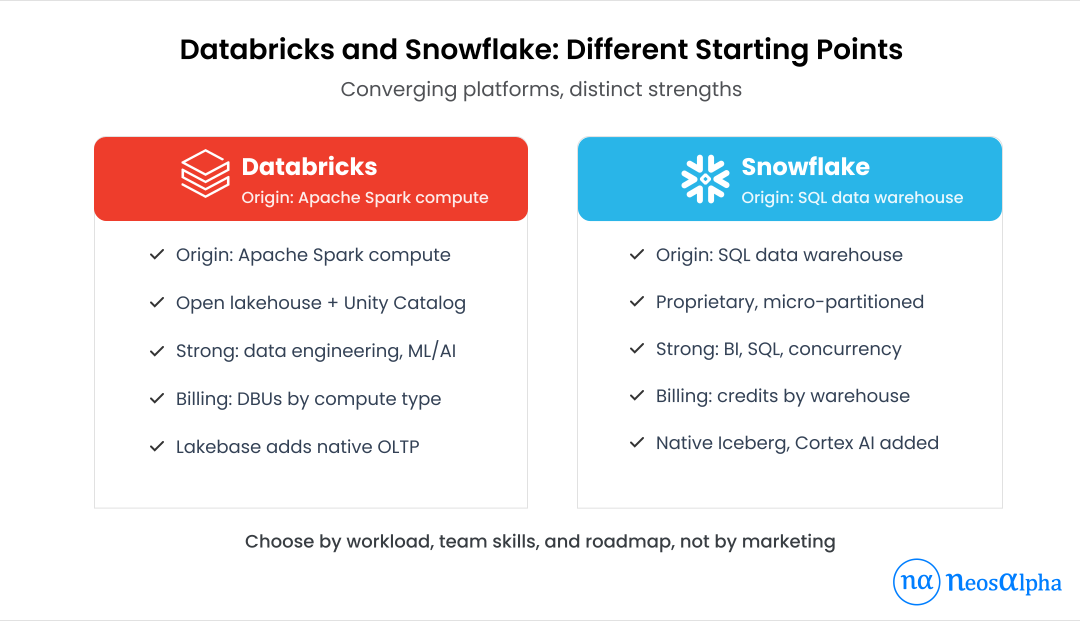
Databricks was created by the original authors of Apache Spark, so at its core it is a large-scale distributed compute engine that expanded into warehousing. Its lakehouse model keeps data in open formats in your own object storage, with Unity Catalog providing governance across formats, clouds, and engines. That openness and compute flexibility is why it excels at petabyte-scale pipelines, unstructured data, and machine learning.
Snowflake is a proprietary, cloud-native data warehouse built on three layers: a storage layer, a compute layer of virtual warehouses, and a cloud services layer that handles query optimization and metadata. Workload isolation is a built-in design choice, so a runaway query in one virtual warehouse does not affect others, which matters in high-concurrency BI environments. Snowflake handles semi-structured data natively and automatically organizes data into micro-partitions with metadata pruning, which is a large part of why it is so easy to operate.
How the Pricing Works: DBUs Versus Credits
Both platforms use consumption pricing, but they meter it differently, and that difference is where cost surprises come from.
| Aspect | Databricks | Snowflake |
|---|---|---|
| Billing unit | Databricks Units (DBUs), priced by compute type, tier, and cloud | Credits, priced by virtual warehouse size and edition |
| Cost driver | Compute type is the biggest lever; All-Purpose runs far higher than Jobs Compute | Warehouse size and uptime; auto-suspend and right-sizing are the main levers |
| Operational model | More tuning levers and more expertise required to optimize | More automatic optimization, simpler to operate |
| Where it gets costly | Misconfigured clusters and running jobs on interactive compute | The simplicity premium for fully managed automatic optimization |
The honest framing is that neither is universally cheaper. Industry comparisons generally find that Databricks runs large-scale ETL more cheaply, often cited at 20 to 40 percent for equivalent engineering workloads, while Snowflake delivers faster response times for typical BI queries. Snowflake’s automatic optimization carries a simplicity premium, with organizations reporting higher costs for equivalent workloads compared to a well-optimized Databricks deployment. The key phrase is well-optimized: Databricks requires more expertise to tune, and poorly configured clusters can burn money quickly. If a team lacks deep Spark expertise, Snowflake’s predictability may be worth the cost.
Performance and Workload Fit
Performance depends entirely on the workload, so the useful question is not which is faster but which is faster at what.
- BI and SQL analytics: Snowflake typically delivers faster response on typical business intelligence queries and is the easier choice for high-concurrency reporting.
- Large-scale data engineering: Databricks delivers heavy ETL and petabyte-scale processing more cost-effectively by drawing on its Spark heritage.
- Machine learning and AI: Databricks operates in a different league for serious ML and AI development, with MLflow, model serving, and a unified workflow from data to model.
- Streaming and real-time: Databricks has deep streaming capabilities, while Snowflake has added streaming ingestion, closing the gap in many use cases.
- Open formats and multi-engine: Databricks favors open formats and multi-engine flexibility via Unity Catalog, which matters for organizations seeking to avoid lock-in
Book a free platform evaluation with NeosAlpha. We will assess your workloads and team, then give you a clear, defensible recommendation on Databricks, Snowflake, or the right combination of both.Get a vendor-neutral platform recommendation for your stack.
What Changed in 2026?
Two developments are reshaping the comparison. The first is that the architectural gap is narrowing as each platform adopts the other’s strengths, including Snowflake’s native Iceberg support and Databricks’ BI-optimized SQL warehouses. The second is Lakebase, the serverless Postgres offering that lets Databricks serve transactional workloads natively alongside analytics and machine learning. For the first time, Databricks positions itself as a genuine full-stack platform that can train models, run pipelines, serve analytics, and handle transactions within a single system, directly challenging the traditional separation between operational databases and analytical platforms.
Growth tells part of the story too. Databricks reached a multi-billion-dollar revenue run-rate, growing well above 60% year over year in early 2026, while Snowflake grew more slowly but remained at significant scale. The takeaway is not that one is winning. It is that AI and machine learning workloads, where Databricks’ heritage is strongest, are the fastest-growing segment, while Snowflake remains an excellent fit for many analytical workloads.
A Decision Framework You Can Take to Leadership
Rather than picking a winner, match the platform to your priorities. These questions lead to a defensible choice.
- Is your roadmap dominated by SQL analytics and BI? Snowflake’s simplicity and query performance are hard to beat, especially for high-concurrency reporting.
- Do you need serious machine learning, AI, or large-scale data engineering? Databricks’ unified lakehouse and Spark heritage give it a clear edge.
- How much platform expertise does your team have? Databricks rewards deep tuning skills; Snowflake offers predictability with less hands-on optimization.
- Do you value open formats and multi-engine flexibility? Databricks with Unity Catalog leans more open; Snowflake is more managed and proprietary.
- Are you Microsoft-centric? Some 2026 evaluations also weigh Microsoft Fabric as a third option for Azure-heavy organizations.
It is also worth remembering that this is not always an either-or decision. Many enterprises run both, using each where it is strongest, with a governance and integration strategy that lets data move cleanly between them. The right answer depends on your workloads, your team, and your trajectory, not on which platform has the louder marketing.
How NeosAlpha Helps You Make the Right Platform Decision
Choosing between Databricks and Snowflake, or deciding how to run both, carries long-term cost and architectural consequences. As a Databricks and Snowflake partner, NeosAlpha brings vendor-aware, workload-led guidance to help enterprises make the right call and execute it well.
- Platform evaluation: We assess your workloads, team skills, cost profile, and roadmap to recommend Databricks, Snowflake, or a considered combination, with a defensible business case.
- Databricks implementation: As a Databricks consulting partner, we design and build lakehouse architectures, data engineering pipelines, and ML workloads that capture the platform’s strengths.
- Integration and coexistence: Where both platforms are in play, we design the governance and integration strategy so data flows cleanly and each platform is used where it is strongest.
- Cost and performance optimization: We tune compute, queries, and storage so your chosen platform delivers performance without runaway spend.
With deep cross-platform expertise spanning Databricks, Snowflake, and the wider cloud ecosystem, NeosAlpha helps enterprises cut through vendor noise and build a data platform strategy aligned to real business outcomes.
Conclusion
Databricks and Snowflake are converging in capability but still diverge in character. Snowflake remains the smoother path for SQL analytics, high-concurrency BI, and teams that value predictability over tuning. Databricks remains the stronger foundation for large-scale data engineering, streaming, open formats, and serious machine learning and AI, and with Lakebase, it now extends to transactional workloads as well. The right decision is rarely about which platform is objectively better. It is about which one fits the work you actually do, the skills your team actually has, and where your data strategy is actually heading. Make that match well, and either platform can be an excellent choice.