If your organization already runs Kong to manage APIs, the conversation about governing AI has likely already landed on your desk. Models are being called, token bills are arriving, and someone has asked the obvious question: can we not just put this AI traffic behind the same gateway we already trust for everything else?
That is essentially the bet Kong AI Gateway makes. Rather than asking you to bolt on a separate, unfamiliar tool, Kong extends its established gateway to handle traffic to large language models and adds a set of AI-specific controls on top. For teams already running Kong in production, that is a compelling starting point. But an AI gateway isn’t just an API gateway with a new label, and it is worth understanding what Kong actually does under the hood before you commit.
What Is Kong AI Gateway?
Kong AI Gateway runs on a hybrid model that separates the control plane from the data plane, and understanding that split is the key to understanding the whole platform.
Kong fully manages the control plane inside Konnect, its cloud platform. This is where your team configures everything through a central interface: which AI providers and models to use, which policies to enforce, who can call what, and how to route traffic. The control plane takes all of that configuration and distributes it to your data plane nodes, along with the security certificates those nodes use to prove their identity. Crucially, the control plane stays out of the traffic path. By default, it never sees the actual prompts and responses flowing through your gateway.
The data plane consists of proxy nodes that run in your own infrastructure. These are the workhorses. They receive the AI traffic, check each request against the policies the control plane has handed down, and forward approved requests on to the model. Each node keeps a live connection to the control plane to stay in sync when configuration changes, and it streams telemetry, usage, cost, and latency back to Konnect for analytics.
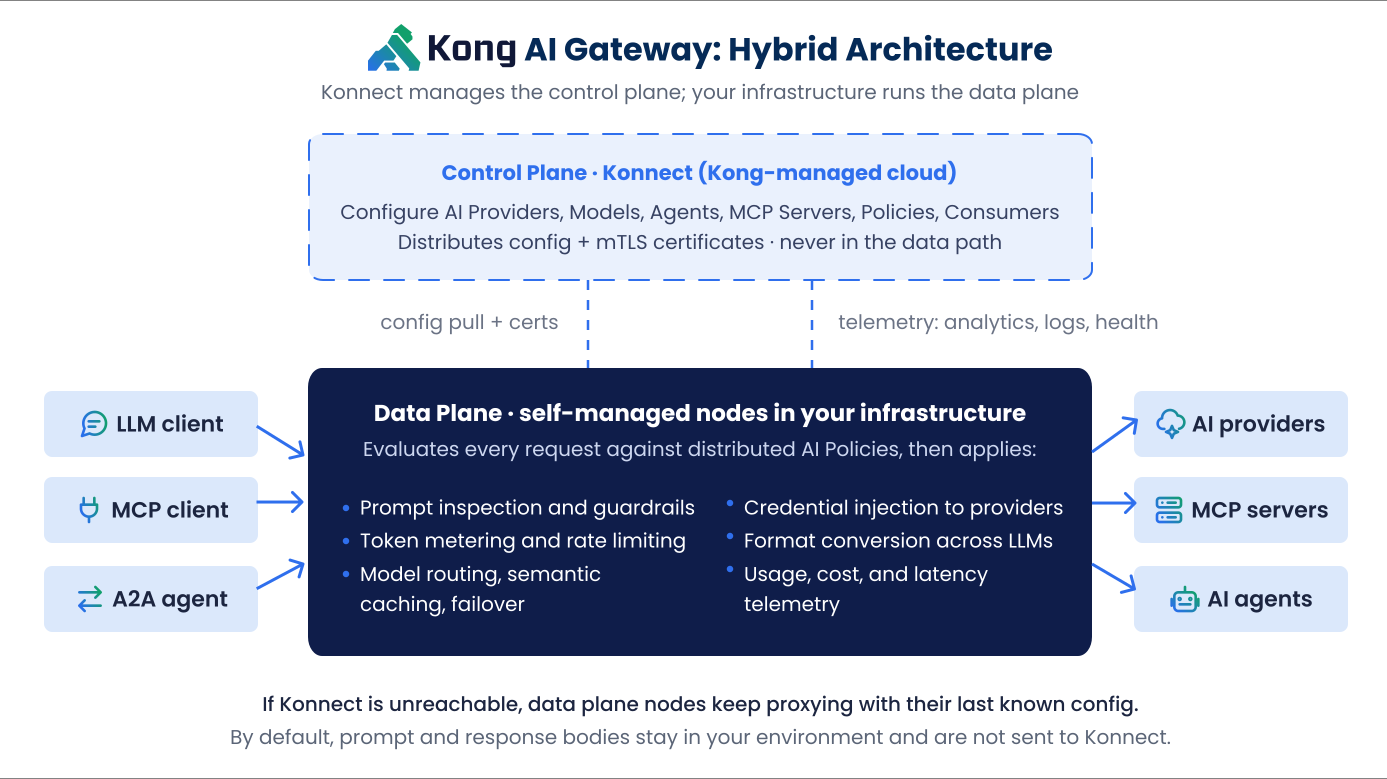
This separation has two practical benefits worth calling out. First, your sensitive data stays with you. Because the data plane runs in your environment and the control plane is deliberately kept out of the data path, prompts and responses do not leave your infrastructure unless you explicitly opt in to sending them. Second, it keeps you running even when the connection drops. If Konnect becomes unreachable, your data plane nodes keep proxying traffic using their last known configuration, and only configuration updates pause until the link is restored.
Note that Kong AI Gateway currently runs only in this hybrid mode, with a Konnect-managed control plane. There is no fully self-hosted control plane for the AI Gateway entity model today, though Kong’s traditional gateway does support other deployment styles. If a completely air-gapped setup is a hard requirement, confirm that early.
Ready to Put Kong AI Gateway to Work?
NeosAlpha helps enterprises design, implement, and govern AI gateways that bring cost, security, and observability under control, built on deep API management and integration expertise.
Schedule a consultation with our teamThe Three Types of Traffic Kong Handles
One of the more forward-looking parts of Kong AI Gateway is that it does not just handle calls to language models. It governs three distinct kinds of AI traffic through the same data plane, which matters as AI systems grow more agentic.
- The first is LLM traffic, the familiar case: requests to models for chat, text generation, embeddings, image generation, audio, and more. Kong handles the format conversion between providers, injects the right credentials, balances load across models, and tracks token cost.
- The second is MCP traffic. The Model Context Protocol is a standard for how AI agents connect to external tools and data, and Kong can act as the gateway for it. It can proxy an existing MCP server, turn your existing REST APIs into MCP tools, or aggregate tools from several sources into a single endpoint, all with session management and tool-level access control.
- The third is A2A traffic, or agent-to-agent communication, where one AI agent talks to another. Kong can proxy these agent endpoints with protocol awareness and emit structured telemetry tied to agent activity.
Handling all three through one gateway is a deliberate design choice. As enterprises move from simple chatbots toward networks of agents that call tools and each other, having a single governed layer for every kind of AI interaction becomes a real advantage.
The Kong AI Plugin Family
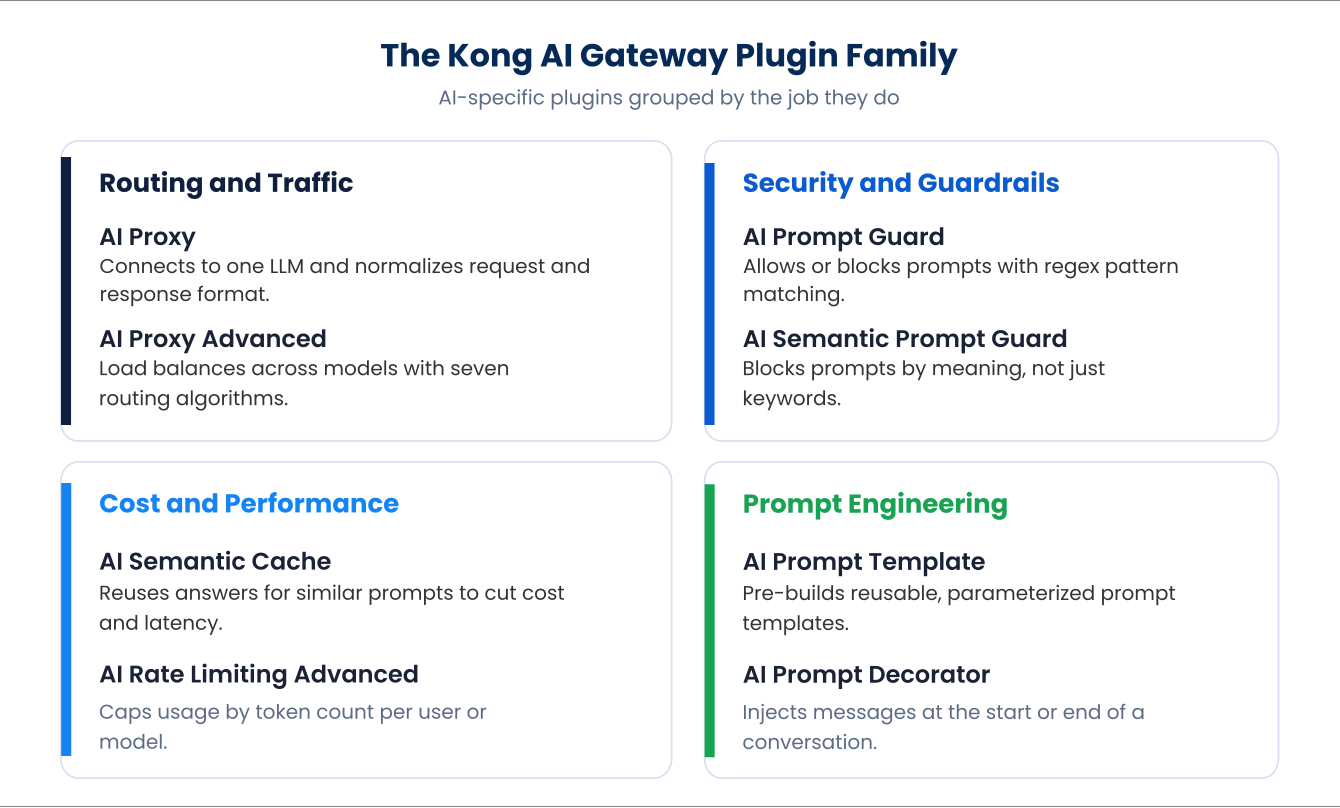
Kong has always been built around plugins, small units of functionality you switch on as needed, and its AI capabilities follow the same pattern. Rather than one monolithic feature, Kong AI Gateway is a family of AI plugins, each doing a specific job. You can group them by what they are for.
Routing and Traffic
Routing and traffic is handled by two plugins. AI Proxy connects to a single model and normalizes the request and response format so your application does not have to care which provider is behind it. AI Proxy Advanced takes this further, load balancing across many models with a choice of routing algorithms, including the ability to route based on the meaning of the prompt.
Security and Guardrails
Security and guardrails come from the prompt-guarding plugins. AI Prompt Guard lets you allow or block prompts using pattern matching, useful for keeping certain words, phrases, or request shapes out. AI Semantic Prompt Guard goes deeper, blocking prompts based on their meaning rather than exact wording, which catches manipulation attempts that a simple keyword filter would miss.
AI Semantic Cache
AI Semantic Cache earns its place on cost and performance. It stores responses and, when a new prompt is close enough in meaning to one it has seen before, returns the saved answer instead of paying for a fresh model call. Kong reports that cache hits can dramatically cut response latency. Alongside it, AI Rate Limiting Advanced caps usage based on the tokens a model actually returns, letting you set precise per-user or per-model limits.
Prompt engineering
Prompt engineering rounds out the set. AI Prompt Template lets you pre-build reusable, parameterized prompts, and AI Prompt Decorator automatically injects messages at the start or end of a conversation, handy for enforcing a consistent system prompt.
Because these are Kong plugins, you can layer Kong’s existing plugins for authentication, logging, and traffic control on top of AI traffic too, which is part of what makes the platform feel cohesive rather than bolted together.
How a Request Flows Through Kong AI Gateway
It helps to see how these pieces work together on a single request. The whole thing happens in the data plane, in milliseconds, and the user never sees any of it.
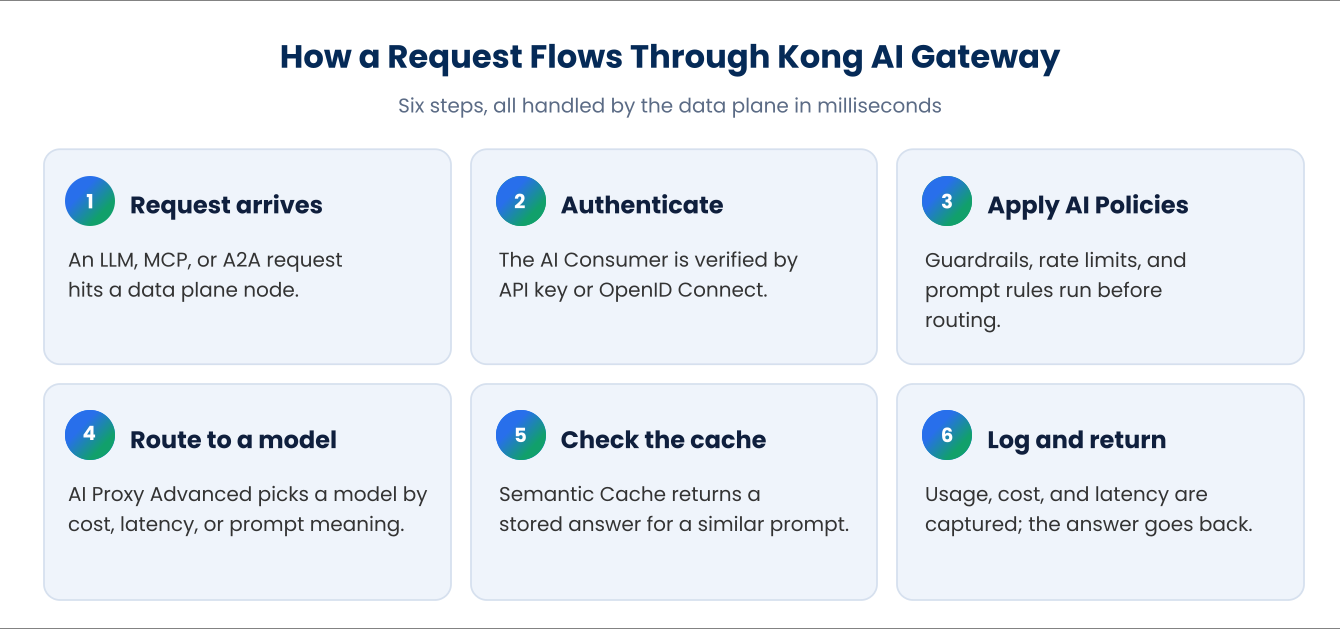
When a request arrives at a data plane node, Kong first authenticates the caller, verifying the consumer through an API key or OpenID Connect. It then applies the AI policies you have configured, running guardrails, rate limits, and prompt rules before anything reaches a model. Next, it routes the request, using AI Proxy Advanced to select a model based on your chosen strategy, whether that is cost, latency, or the meaning of the prompt itself. Before making an expensive call, it checks the semantic cache and, if a similar prompt has been answered before, returns that stored response instantly. Finally, once the model responds, Kong logs the usage, cost, and latency, and passes the answer back to the application.
Every step is governed by a policy you set centrally, applied consistently to every request, without changing your application code.
Routing and Load Balancing
Routing is one of Kong’s real strengths and a major lever for cost and reliability. When a request targets a model, Kong decides where to send it based on the load-balancing strategy you choose; beyond the familiar round-robin and consistent-hashing options, it includes strategies built specifically for AI. Lowest-latency routing sends traffic to whichever model is responding fastest. Lowest-usage routing balances by token count or cost to spread spend. Semantic routing reads the prompt and picks the best-suited model, so a simple query and a complex reasoning task can go to different models automatically. And priority routing gives you weighted, ordered failover, moving traffic to the next provider in line if your first choice fails.
On top of this, Kong retries failed requests and fails over automatically, with an optional circuit breaker that pulls a consistently failing target out of rotation. For teams running AI in production, this resilience is often the difference between a demo and a dependable service.
Where Kong AI Gateway Fits, and Where It Does Not
No platform is right for everyone, and being honest about fit is more useful than a sales pitch.
Kong AI Gateway is a natural choice if you are already running Kong. The architecture, plugin model, and operational tooling all carry straight over, so your team extends something they know rather than learning a new system. It is also a strong fit if you want a single governed layer for more than just LLM calls, given its native handling of MCP and agent-to-agent traffic, which positions it well for agentic systems. Because the data plane runs in your own infrastructure and keeps prompts local by default, it suits organizations with real data-sensitivity requirements.
In some cases, you might weigh other options. Some of Kong’s more advanced AI capabilities sit within Konnect and its enterprise tiers, so if you need everything in the open-source core, check the licensing carefully. If you need a fully self-hosted control plane with no managed cloud component, Kong’s current AI Gateway hybrid model may not meet that need yet. And if you are not already a Kong user and want the deepest possible set of AI-native features out of the box, a purpose-built AI gateway may cover more ground for a pure-AI use case. The right answer depends on where you are starting from, which is exactly the kind of assessment worth doing properly before you commit.
Read Case Study: Wood Mackenzie API Platform Migration to Kong Konnect with Zero Downtime
How NeosAlpha Helps You Implement Kong AI Gateway
Choosing Kong AI Gateway is one decision. Making it work inside a real enterprise, wired into your systems, governed by policies that reflect how your business actually operates, and adopted by the teams who depend on it, is a larger piece of work. That is where our experience is directly relevant.
NeosAlpha has spent years helping enterprises design and run API management and integration platforms, and API governance is core to what we do. An AI gateway is, underneath, an API and integration challenge with AI-specific requirements layered on top, which is precisely the intersection we work in. Our teams help organizations assess where their AI traffic flows today and where it is ungoverned, design the right routing, security, and cost-control policies, and implement the gateway so it does real work rather than simply sitting in the stack.
Because our expertise spans API management, integration, and agentic AI, we can also connect the gateway to the enterprise systems your models and agents need to reach, and do it in a way that is secure, observable, and built to scale. The outcome isn’t just Kong AI Gateway switched on; it’s a governance layer that genuinely puts you in control of your AI.

