
Ask an API team how well their APIs are tested and the answer usually splits in two. The functional tests exist, written when the API was first built, covering the paths the developer had in mind that week. The security tests are someone else’s job, scheduled as a penetration test once or twice a year. The team ran performance tests before the first release and never again. Nobody is happy with this, and everybody recognizes it.
The reason is arithmetic. A single API with 20+ endpoints, each with several methods, request variations, error conditions, and authorization rules, produces hundreds of test cases if tested properly. An enterprise with a hundred APIs is looking at tens of thousands. Writing those cases by hand is slow, and maintaining them as specifications change is even slower, so teams write tests that cover the obvious paths and move on. Coverage becomes whatever time allows, and the gaps stay invisible until something fails in production or an auditor asks a question nobody can answer.
NeosProbe is NeosAlpha’s answer to that arithmetic. It reads an API specification, validates the specification itself, and uses AI to generate comprehensive test suites covering functional behavior, security scenarios aligned to the OWASP API Security Top 10, and performance characteristics. The suites are stored centrally, versioned, and shared; when the specification changes, NeosProbe regenerates the affected cases rather than letting them rot. Testing stops being the step that delivery waits for.
Why API Testing Falls Behind API Delivery
API delivery has accelerated considerably over the past decade. Gateways, iPaaS platforms, and specification-first design have compressed the time from requirement to deployed endpoint from months to days. Testing has not accelerated at the same rate, because test creation remains a manual, human-authored activity while API creation has been steadily automated. The result is a widening gap between how fast an organization can ship an API and how fast it can be confident in one.
That gap shows up in three distinct forms of incomplete coverage. The first is shallow functional testing: the positive path is tested because it is the path the developer was thinking about, while negative cases, malformed payloads, boundary values, and schema violations are tested inconsistently or not at all. The second is deferred security testing. Security scenarios require adversarial thinking that most functional test authors aren’t trained in, so API security gets pushed to a specialist exercise on the calendar rather than on every change. The third is abandoned performance testing, which is treated as a pre-launch gate rather than a continuous measure, so response-time regressions accumulate quietly between releases.
A fourth problem makes the first three permanent: specification drift. Even where good tests exist, API specifications change as fields are added, responses are restructured, and endpoints are versioned. Each change invalidates some portion of the existing test suite. Because updating tests is unrewarded work, teams update suites late, partially, or not at all, and a test suite that doesn’t match the API it tests is worse than no suite because it produces false confidence.
Here, NeosAlpha Introduce NeosProbe
NeosProbe builds its tests from the sources your team already works with. It can start from an API specification, from API acceptance criteria written as a Jira ticket or supplied as a document, or from an existing API collection such as a Postman collection. That flexibility matters, because knowledge about an API rarely lives in one place. The specification describes the contract: endpoints, methods, request and response schemas, required and optional fields, data types and formats, status codes, and the authentication scheme. Acceptance criteria describe the behavior the business expects. An existing collection captures what the team has already tested. A human reading all of this can derive a thorough test plan. The work isn’t conceptually difficult; it is just large, repetitive, and easy to do incompletely. That combination is exactly what AI handles well.
So NeosProbe reasons over whatever inputs it’s given to produce test scenarios, in three categories rather than one. Functional scenarios exercise the behavior the specification and acceptance criteria promise, including cases they imply but don’t state, such as what should happen when a required field is absent or a value falls outside its declared range. Security scenarios probe the API against the risk categories in the OWASP API Security Top 10, including authorization and authentication weaknesses that functional testing doesn’t cover. Performance scenarios measure load handling and response times per endpoint, so performance becomes a routine check rather than a launch-day event.
Teams that already have test collections don’t have to start over. NeosProbe can take an existing collection, such as a Postman collection, and enhance it with the test cases it’s missing, extending coverage into negative paths, boundary conditions, security, and performance while keeping the tests the team has already built.
The output is a set of structured, runnable test suites written into a central repository, where they are version-controlled, reviewable, and available to everyone who needs them. Runs can start manually when a developer wants coverage for an API they are building, or automatically from a delivery pipeline, so test generation keeps pace with deployment.
How NeosProbe Works
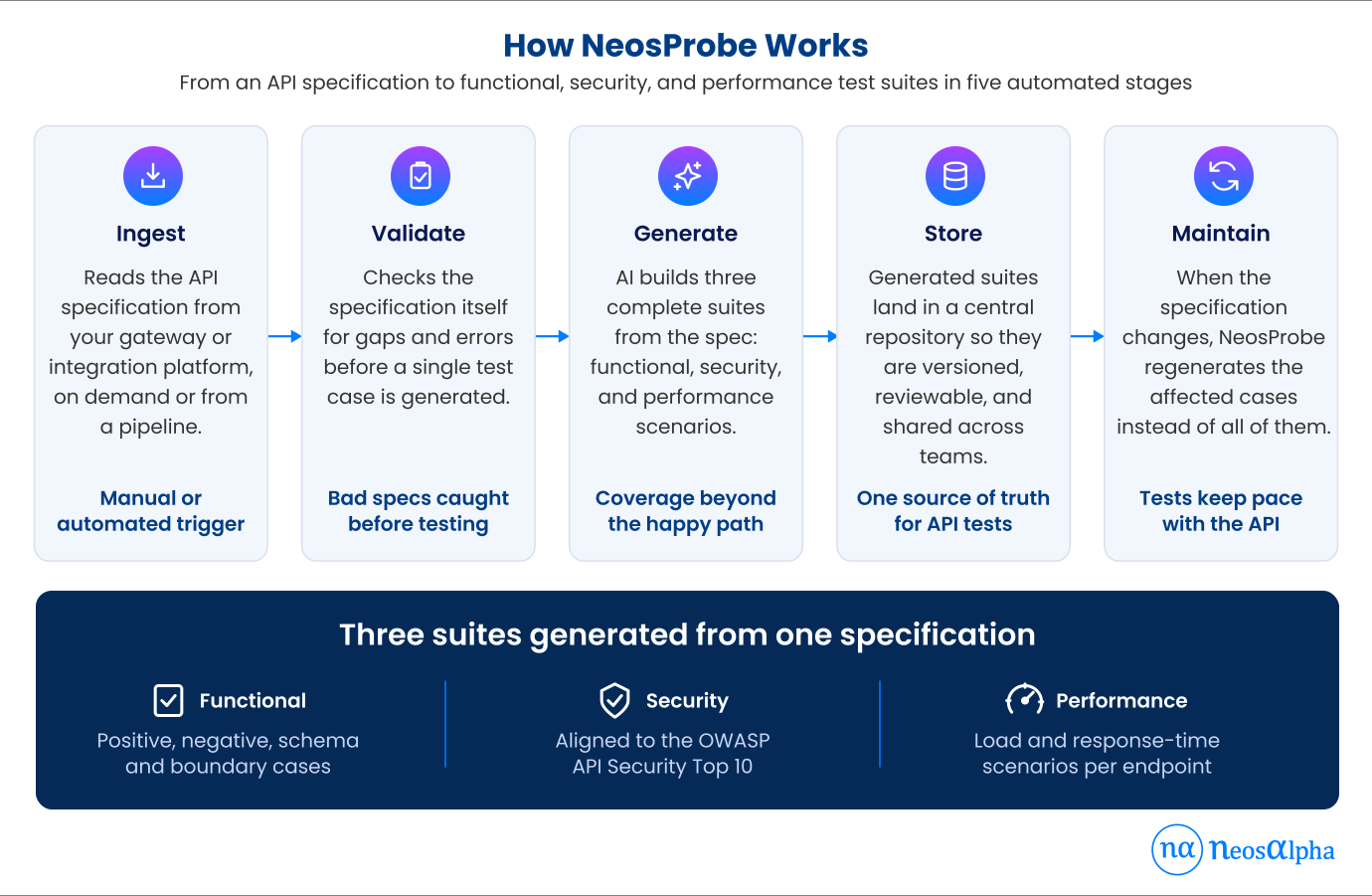
The pipeline runs in four automated stages, with a fifth that keeps the suites aligned to the API over time.
1. Ingest
NeosProbe reads the API specification for the in-scope interface, sourced from the gateway or integration platform where the API is defined. A developer can trigger a run manually or automatically from a delivery pipeline, so the same engine supports ad-hoc work and continuous delivery.
2. Validate
Before generating anything, NeosProbe checks the specification itself. Missing schemas, undefined response codes, absent authentication definitions, and incomplete field constraints all reduce the quality of any test suite derived from them, and they are also defects in their own right. Catching them at this stage prevents the common failure of generating thorough-looking tests from a specification that was never accurate.
3. Generate
The engine reasons over the validated specification to produce the three suites. This is where AI earns its place: deriving the full matrix of functional, security, and performance scenarios from a specification is precisely the kind of exhaustive, pattern-driven work that humans do inconsistently under time pressure.
4. Store
Generated suites are written into a central repository rather than left on the machine that produced them. That makes coverage visible across teams, puts test assets under version control alongside everything else, and lets teams review suites like any other engineering artifact.
5. Maintain
When the specification changes, NeosProbe regenerates the affected test cases. Coverage tracks the API instead of decaying away from it, turning a one-time generation exercise into a durable testing practice.
What NeosProbe Generates
The three suites are deliberately separate because they answer different questions and are usually owned by different people. Generating all three from one specification is what distinguishes NeosProbe from a functional test generator with security as an afterthought.
1. Functional Suite
Covers what the API is supposed to do and how it should behave when it is used incorrectly. Positive paths confirm the documented behavior. Negative cases exercise missing required fields, wrong data types, malformed payloads, and invalid enumeration values. Schema validation confirms responses match their declared structure rather than merely returning a success code. Boundary testing pushes values to the edges of their declared ranges, where defects concentrate and manually written suites are thinnest.
2. Security Suite
Covers the risk categories in the OWASP API Security Top 10, the industry reference list for API-specific security risks. The 2023 edition remains the current version, and its top entries concern authorization rather than the injection flaws that dominate application-level security thinking. Broken object-level authorization, where an API exposes an object by identifier without verifying the caller is entitled to it, has held the top position since the list was first published, and it is exactly the class of weakness functional testing never finds, because a functional test uses a valid identifier belonging to the right user. Generating these scenarios from the specification brings security testing into every run instead of leaving it for an annual exercise.
3. Performance Suite
Covers load and response-time behavior per endpoint, so performance becomes a routine part of testing rather than a milestone before go-live. Treating it continuously means response-time regressions surface while the change that caused them is still fresh, instead of accumulating unnoticed across releases.
Testing That Keeps Pace With the Specification
The maintenance stage deserves particular attention, because it addresses the failure that undermines most test automation efforts. Generating a comprehensive suite once is valuable but perishable. An API that changes monthly will drift materially from its original suite within two quarters, and the suite will keep reporting green on scenarios that no longer describe the API while saying nothing about the endpoints and fields added since.
NeosProbe regenerates the cases a specification change affects, keeping maintenance cost proportional to the size of the change rather than the size of the API. A new field on one endpoint doesn’t require regenerating an entire suite, and it also doesn’t get silently skipped. Over time, this is what separates a testing accelerator from a testing project: the coverage does not need a person to remember it.
See Your API Tests Generated Automatically
To see NeosProbe generate suites from one of your own API specifications, book a walkthrough with our team.
Schedule a CallCoverage Across Your API and Integration Platforms
NeosProbe works against API specifications, which makes it platform-agnostic in practice. Today it supports APIs and integrations built on Apigee, Boomi, Workato, and Apache Camel, the four platforms across which NeosAlpha delivers most enterprise integration and API management work. Because the engine consumes specifications rather than platform-specific internals, the same generation, validation, and maintenance pipeline applies wherever the API is defined.
For organizations running more than one of these platforms, which is common in enterprises that have grown through acquisition or migrated gateways over time, this matters more than it first appears. It means one testing standard and one coverage model across a mixed estate, rather than a different testing practice per platform depending on which team built the interface.
Under the Hood
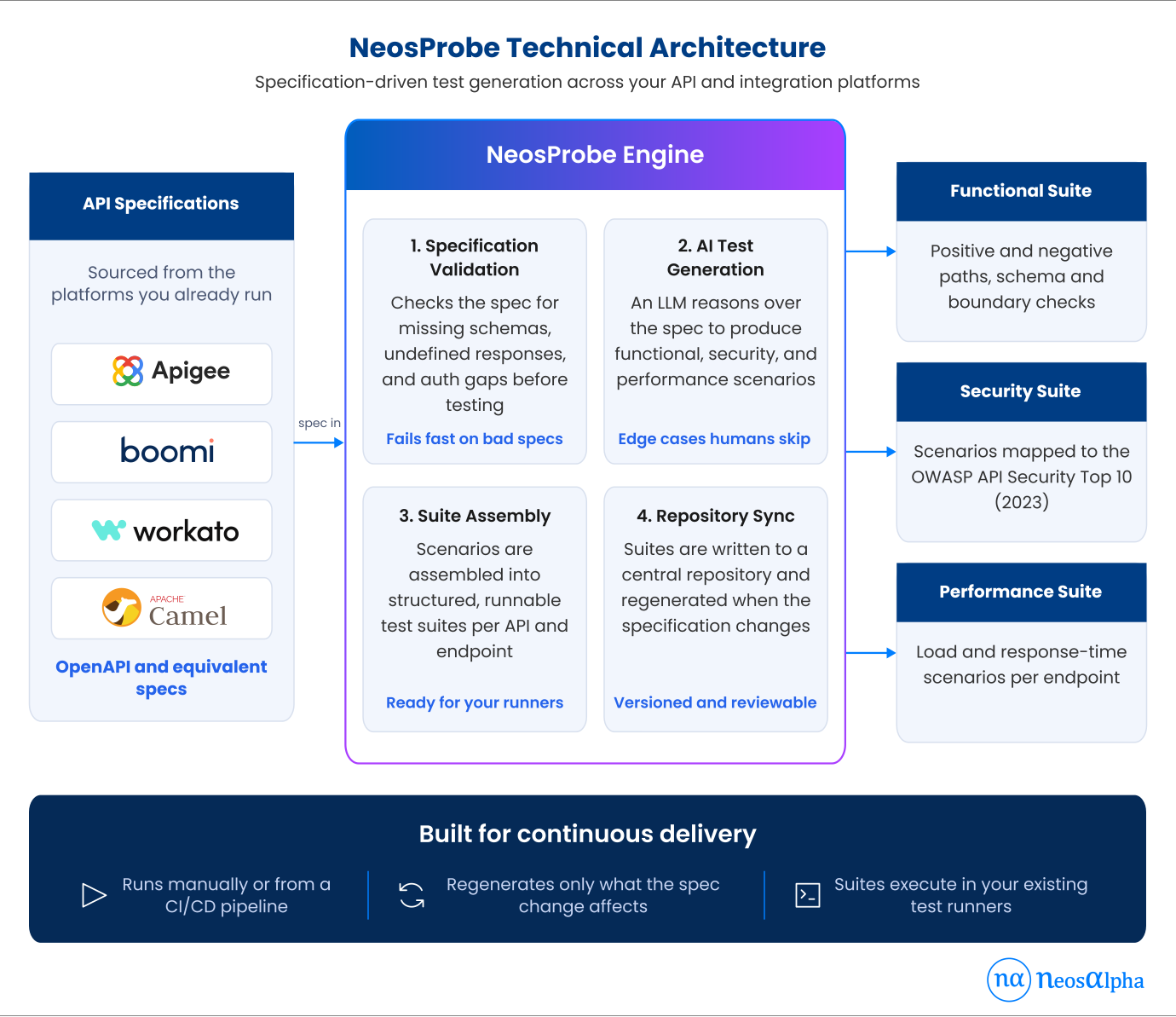
Architecturally, NeosProbe is a four-module engine sitting between your API specifications and your test repository: specification validation, AI test generation, suite assembly, and repository synchronization. It consumes OpenAPI and equivalent specification formats and produces structured suites that run in your existing test runners and pipelines, without requiring a proprietary execution environment. Keeping generation and execution separate is a deliberate design choice, because it means NeosProbe improves the coverage your current toolchain runs instead of asking you to replace it.
What NeosProbe Does Not Replace
Some scope clarity is worth stating. NeosProbe generates thorough coverage from what the specification declares. It does not know your business rules when those rules aren’t expressed in the specification, and it cannot tell you that a discount calculation should cap at a certain percentage or that a particular field combination is commercially invalid if nothing in the specification says so. Those tests still come from the people who understand the domain.
Automated security scenario generation also doesn’t replace penetration testing by qualified specialists. It raises the floor considerably by ensuring that well-documented, well-understood API risk categories are tested on every run rather than once a year, freeing specialist time for the creative, context-dependent work that genuinely needs a human adversary. The division of labor is the point: automation covers the exhaustive and the known; people cover the novel and the contextual.
Why This Matters for Enterprise API Teams
The compounding effect of generated test coverage shows up across the delivery lifecycle. Developers get meaningful test coverage for a new API in the time it takes to run a command, rather than deferring test authoring to a later sprint that may not come. Security reviews start from evidence that the documented risk categories were tested on the current version of the specification. Performance regressions surface early, while the responsible change is still easy to identify. And audit conversations shift from reconstructing what was tested to showing a versioned repository of suites that track the APIs they cover.
There is a cultural benefit as well, and it is the one teams notice first. When generating thorough tests costs a command rather than a week, nobody has to argue for the time to test properly. The trade-off between delivery speed and test coverage, which teams have been managing with judgment and guilt for years, largely stops being a trade-off.
Rethinking API Testing with NeosProbe
API testing falls behind not because teams undervalue it, but because the volume of cases required to test an API properly has always exceeded the time available to write them. NeosProbe removes that constraint. It validates the specification, generates functional, security, and performance suites from it, stores them centrally under version control, and regenerates them as the specification evolves, on demand or as part of a delivery pipeline.
NeosProbe was built inside NeosAlpha’s integration and API management practice, which delivers Apigee, Boomi, Workato, and Apache Camel programs for enterprise clients across the UK, USA, India, and Australia. It reflects the testing standard our engineers want to follow.

