- Unity Catalog is Databricks' unified governance solution, providing access control, lineage, auditing, discovery, and sharing across Delta Lake and Apache Iceberg.
- Its three-level namespace of catalog, schema, and object gives every asset a consistent path regardless of the underlying cloud or table format.
- Fine-grained controls include attribute-based policies, row filters, and column masks, and automated lineage supports impact analysis and audit demonstrations.
- External engines such as Trino, Spark, Flink, and Dremio can read governed Delta and Iceberg tables, with policies enforced server-side.
Governance is the problem that grows quietly until it becomes the only problem. In the early days of a data platform, a handful of engineers know where everything lives and who should see it. Two years later, the same organization has data spread across three clouds, two table formats, dozens of workspaces, and hundreds of users, and nobody can answer a simple question with confidence: who has access to this sensitive table, where did this number come from, and can we prove it to an auditor?
This is the gap Databricks Unity Catalog is built to fill. Without a unified governance layer, access control fragments into per-workspace settings, lineage becomes guesswork, and every cloud and format brings its own silo. For regulated industries such as finance and healthcare, that fragmentation is not just inconvenient. It is a compliance risk because demonstrating control over sensitive data under regimes such as GDPR and HIPAA depends on having a single, consistent, auditable source of truth.
Unity Catalog provides the source of truth. It acts as a single control plane for data, analytics, and AI assets, enforcing consistent governance across formats, clouds, and engines.
| Unity Catalog in one line Unity Catalog is Databricks’ unified governance solution for data and AI, providing fine-grained access control, data lineage, auditing, discovery, and secure sharing across Delta Lake and Apache Iceberg, and across AWS, Azure, and Google Cloud, from a single interface. |
Inside the Unity Catalog Object Model
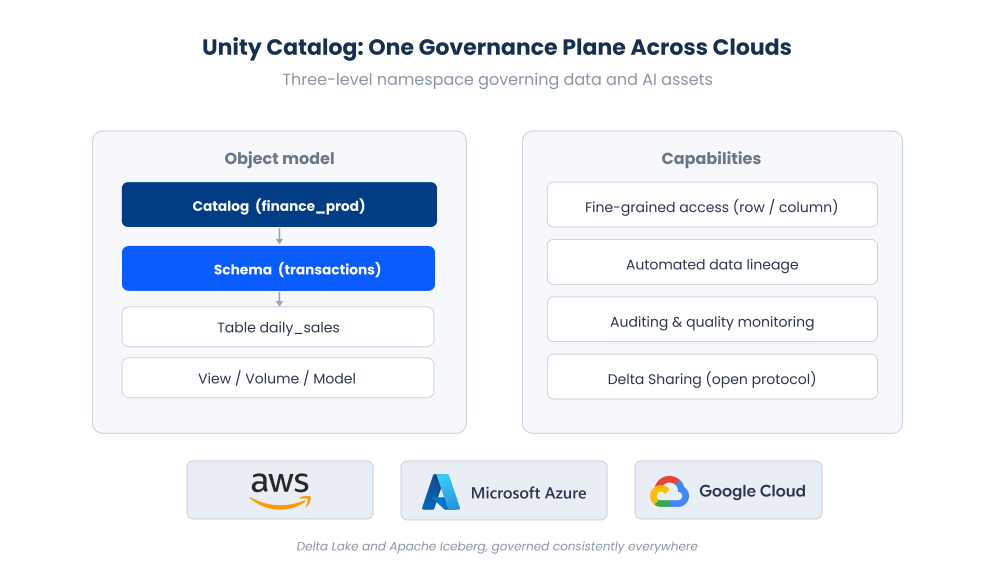
Unity Catalog organizes assets into a three-level namespace, which is the foundation for access and discovery. Understanding this hierarchy is the key to designing governance that scales.
| Level | What it represents | Example |
|---|---|---|
| Catalog | The top-level container, typically aligned to a business domain or environment | finance_prod, retail_analytics |
| Schema | A grouping of related objects within a catalog, also called a database | transactions, customer |
| Securable objects | Tables, views, volumes, models, and functions that hold or produce data | transactions.daily_sales |
Assets are referenced as catalog.schema.object, a single consistent path regardless of which cloud or format underlies them. Beyond tables, Unity Catalog governs volumes for unstructured files, machine learning models, functions, and increasingly business metrics as first-class assets, so governance extends across the full data and AI estate rather than stopping at structured tables.
The Core Capabilities That Make Governance Work
Unity Catalog brings several governance functions into one place. The combination is what makes it powerful, because each capability reinforces the others.
1. Fine-Grained Access Control
Unity Catalog enforces access at the level of catalogs, schemas, tables, rows, and columns. Attribute-based access control lets you define policies based on attributes rather than maintaining long lists of individual grants, which scales secure data management across a large enterprise. Row filters and column masks restrict what each user sees within a single table, so sensitive fields can be hidden without duplicating data.
2. Automated Data Lineage
Lineage is captured automatically, tracing how data flows from source through transformations to downstream tables, dashboards, and models. This answers the “where did this come from” question directly, which is essential for impact analysis when a source changes and for demonstrating control during an audit.
3. Auditing and Data Quality
Unity Catalog records access and changes for audit and adds data quality monitoring so teams can trust the assets they discover. Together, these turn governance from a static set of permissions into an active, observable system.
4. Discovery and Secure Sharing
A searchable catalog and a curated internal marketplace help teams find high-value, governed data organized by domain, reducing duplicate datasets created simply because nobody could find the original. For sharing beyond the organization, Delta Sharing is the most widely adopted open protocol for data and AI sharing, supporting both Databricks-to-Databricks and Databricks-to-open sharing without copying data.
Governing Both Table Formats Across All Three Clouds
The defining strength of Unity Catalog in 2026 is that it eliminates the governance-related choice between Delta Lake and Apache Iceberg. It unifies both formats so teams are not forced into format-specific silos, and it works seamlessly across clouds and engines. Managed tables in both Delta and Iceberg are fully governed and optimized by Unity Catalog.
This reach now extends beyond Databricks itself. External engines can read Unity Catalog-managed tables, in both Delta and Iceberg, with attribute-based access controls, row filters, and column masks enforced server-side. Through the Iceberg REST Catalog and credential vending, engines such as Trino, Spark, Flink, and Dremio can access governed data while inheriting the privileges of the requesting principal. The practical effect is that governance follows the data wherever it is read, rather than stopping at the platform boundary.
Why Unified Governance Matters
It is worth being concrete about what unified governance actually prevents, because the cost of not having it is easy to underestimate. Without a single control plane, access is granted per workspace, so the same user can have different permissions for the same logical data depending on where they connect. Lineage is reconstructed manually during incidents, turning a five-minute question into a multi-day investigation. Sensitive columns are protected in one pipeline and exposed in another because no consistent policy is applied across the data. Each of these is a small gap, and together they form exactly the kind of control weakness that auditors are trained to find.
A unified catalog closes those gaps by making governance a property of the data itself rather than of the place it happens to be accessed. When access control, lineage, masking, and audit all derive from one model, the answer to a sensitive question is the same no matter which engine or cloud asks it. For an enterprise operating under GDPR, HIPAA, or sector-specific regulation, that consistency is the difference between asserting control and proving it.
How Unity Catalog Plays Out by Industry
The value of unified governance looks different depending on the data involved, which is why the same capabilities resonate across very different sectors.
- Financial services: Row and column-level controls protect transactional and customer data, while automatic lineage supports regulatory reporting and model risk governance, where proving how a number was derived is mandatory.
- Healthcare and life sciences: Fine-grained access and masking keep clinical and claims data compliant with patient privacy rules, while a governed catalog lets research teams discover data without exposing protected fields.
- Retail and consumer: Secure sharing through Delta Sharing lets brands collaborate with partners and suppliers on demand and share inventory data without copying sensitive datasets out of the platform.
- Manufacturing and energy: A unified catalog brings operational, sensor, and supply chain data under a single governance model, so analytics and AI teams can work from trusted, well-described sources.
| Case Study: Leading Retail Company Builds a Governed Product Analytics Platform Using Databricks & Unity Catalog |
Best Practices for Rolling Out Unity Catalog
Adopting Unity Catalog well is as much about design as configuration. These practices help it scale cleanly.
- Design catalogs around domains and environments: A clear catalog strategy, such as separating production from development and aligning catalogs to business domains, prevents sprawl later.
- Prefer attribute-based policies over individual grants: Policies based on attributes scale far better than maintaining thousands of one-off permissions.
- Use managed tables: Managed tables let Unity Catalog optimize storage and performance and apply the latest platform features automatically.
- Standardize governance before optimizing formats: Decide where governance lives first, then make format choices underneath that consistent layer.
- Treat lineage and auditing as first-class: Make lineage part of change management and audit reporting, not an afterthought consulted only during incidents.
How NeosAlpha Helps You Make Unity Catalog a Real Governance Backbone
Unity Catalog is powerful, but its value depends entirely on how it is designed and rolled out across an enterprise. A poor catalog structure or inconsistent access model can be as limiting as having no governance at all. As a Databricks partner, NeosAlpha helps organizations implement Unity Catalog as a genuine, scalable governance backbone.
- Governance architecture: We design your catalog and schema structure around business domains, environments, and compliance requirements so governance scales cleanly as your estate grows.
- Access control and compliance: We implement fine-grained and attribute-based access controls, row filters, column masks, and data masking aligned to GDPR, HIPAA, and your internal policies.
- Lineage, auditing, and quality: We enable automated lineage, audit reporting, and data quality monitoring so you can prove control and trust the data your teams consume.
- Multi-cloud and multi-format rollout: We unify governance across Delta Lake, Iceberg, and AWS, Azure, and Google Cloud, including secure sharing with Delta Sharing for partners and external platforms.
Conclusion
Unity Catalog turns governance from a collection of per-workspace settings into a single, consistent control plane that follows your data across formats, clouds, and engines. Its three-level namespace, fine-grained and attribute-based access, automatic lineage, auditing, and open sharing combine into something more valuable than any one feature: the ability to prove control rather than merely assert it. For enterprises in regulated industries especially, that is not a nice-to-have. It is the foundation that lets a data platform scale without governance debt eventually becoming what holds everything back.

