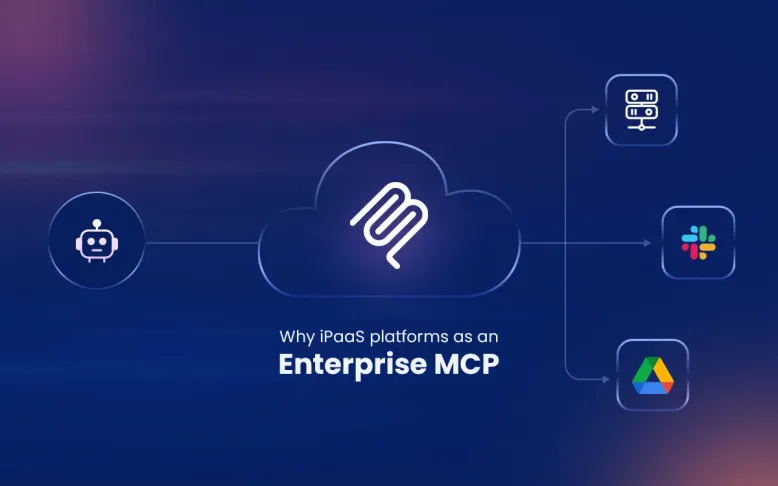
Are your AI agents ready to act within an enterprise system, or are they stuck on what and how to do it? As enterprises plan to deploy AI agents powered by the Model Context Protocol, a critical gap is emerging. MCP enables AI models to request actions, but it doesn’t provide execution, governance, or system connectivity for real-world use cases. That’s where many AI and agent integrations fail.
Integration Platform as a Service (iPaaS) naturally fills this gap by serving as an Enterprise MCP execution layer. It offers integration, enforces security, and orchestrates workflows at scale to transform MCP from a promising protocol into a production-ready foundation for AI agents to interact and for data flows.
By using iPaaS as an Enterprise MCP, organizations ensure that AI-driven actions are discoverable, authenticated, governed, observable, and scalable, without rebuilding integrations or bypassing IT controls. This combination allows enterprises to move from experimental AI agents to trusted, enterprise-grade intelligent automation.
What Is a Model Context Protocol (MCP)?
Model Context Protocol (MCP) is a standardized way for AI models and agents to interact with external systems, tools, and data sources in a secure and structured manner. Instead of hardcoding integrations into AI applications, MCP defines how models request context and actions, making AI systems more flexible and scalable.
For enterprises, MCP reinforces a clean separation between AI intelligence and execution logic. AI models focus on reasoning and decision-making, while iPaaS manages other integration and connectivity for the system.
Core Components of MCP
MCP is built with a simple yet robust architecture that enables AI models to operate consistently across the tools and systems. MCP has three components: clients, server, and structured definitions for context, tools, and permissions.

- MCP Clients
MCP clients are the agent framework or AI models that initiate requests. Based on user intent or reasoning, these clients determine what information or action is needed. Instead of calling APIs directly, MCP clients use the protocol to request tools or context in a standardized format. This allows the same AI logic to work across different enterprise environments without modification.
- MCP Servers
MCP servers serve as the execution-facing layer, exposing tools, data sources, and capabilities to MCP clients. These servers are responsible for defining what tools are available and how requests should be handled.
When you use iPaaS and MCP for enterprise setups, these combinations ensure all AI-driven requests follow enterprise security, workflow, and compliance standards.
- Context, Tools, and Permissions
Context represents the information an AI model needs to make accurate decisions, such as system state, customer data, or business rules. MCP ensures the context is delivered in a structured, controlled manner.
Tools are the capabilities the AI model can invoke, such as fetching records, triggering workflows, or updating systems. Permissions define what AI is allowed to access or execute; they ensure strict governance and prevent unauthorized actions.
What are Some Other Use Cases for MCP?
Model Context Protocol enables a wide range of enterprise use cases beyond AI, including tool-to-tool communication. It ensures how AI agents interact with different systems, data, and workflows. MCP helps move from isolated AI experiments to coordinated intelligent systems.
1. Agents
MCP is a natural foundation for AI agents that can reason, plan, and act across enterprise environments. Using MCP, agents can discover available tools, request the proper context, and execute actions without hardcoded integrations.
This enables use cases such as virtual assistants, autonomous operations agents, and decision-support systems that operate consistently across departments and platforms.
| Recommended Read: Agentic AI Workflows and Architectures Explained: Components, Frameworks, and Future Impact |
2. Ease of Connecting Various Systems
MCP simplifies system connectivity by removing the need for custom AI integrations per application. AI models use a standard protocol to request access, while enterprise platforms handle the underlying connections.
This approach reduces integration effort, improves maintainability, and allows new systems to be added or removed without retraining or rewriting AI logic.
3. Connect Multiple Systems via Agents
Businesses can use MCP to coordinate actions in multiple systems with a single AI agent. For instance, an agent can take data from one system, apply business logic, and then trigger workflows in another, all within the required governance.
This practice simplifies cross-system automation, ensures faster decision-making, and enables more intelligent end-to-end business processes.
Benefits of Model Context Protocol
Model Context Protocol (MCP) delivers significant advantages for organizations looking to scale AI adoption in a secure, flexible, and enterprise-ready manner. By standardizing how AI models interact with systems and tools, MCP helps bridge the gap between intelligent reasoning and reliable execution.
1. Standardized AI Integration
MCP provides a consistent framework for how AI models request data, tools, and actions. This eliminates fragmented, custom integrations and allows AI logic to be reused across different systems and environments.
2. Faster AI Deployment
By decoupling AI intelligence from backend integrations, MCP accelerates development and deployment. New AI use cases can be introduced without rebuilding or modifying existing enterprise connections.
3. Improved Security and Governance
MCP enables controlled access to tools and data through defined permissions. When paired with enterprise platforms like iPaaS, it ensures that AI actions comply with security, compliance, and audit requirements.
4. Scalability Across Use Cases
MCP supports the growth of AI from single applications to enterprise-wide agent ecosystems. It allows multiple AI agents to operate consistently across departments and systems without added integration complexity.
5. Flexibility and Future Readiness
Because MCP is protocol-based, it adapts easily to new AI models, tools, and enterprise systems. This future-proofs AI investments as technologies and standards evolve.
6. Reduced Operational Complexity
With MCP handling AI interaction standards, integration teams can focus on reliability and performance, while AI teams focus on intelligence and outcomes. This clear separation improves collaboration and operational efficiency.
What is iPaaS?
iPaaS (Integration Platform as a Service) is a cloud-based platform that connects applications, data sources, and systems across an organization. It provides tools for building, managing, and monitoring integrations without heavy custom code.
How MCP and iPaaS Work Together?
Model Context Protocol and iPaaS work together by separating AI decision-making from enterprise execution and control. MCP defines how AI models understand context while iPaaS manages the execution of those requests.
- MCP acts as an intelligence interface between the enterprise system and AI agents. When any AI model needs to retrieve data, trigger a process, or interface with a system, MCP describes what it wants to do in a consistent, machine-readable format.
- Behind MCP, iPaaS provides enterprise-grade capabilities, leveraging API connectivity, data transformation, workflow orchestration, error handling, and more. Instead of AI models directly connecting to systems like ERP, CRM, or SaaS applications, iPaaS provides data flow and connectivity, enabling scalability and governance.
- Together, the architecture of iPaaS and MCP ensures safe deployment of AI agents. MCP enables flexibility and intelligence, while iPaaS ensures operational stability and control. The result is an intelligent integration model where AI can act autonomously without bypassing IT standards, security controls, or regulatory requirements.
Why are iPaaS Platforms Well-Suited as Enterprise MCP?
iPaaS platforms are naturally positioned to act as Enterprise MCP because they already provide the critical capabilities MCP requires at scale. While MCP defines how AI models discover tools, request actions, and receive context, iPaaS delivers the execution layer that enterprises depend on for reliability and control.
As Enterprise MCP, iPaaS platforms like Boomi and Workato handle discovery, authentication, governance, observability, and remote system access, capabilities that MCP alone does not provide. This makes iPaaS the missing link between AI agents and real enterprise operations.
At scale, enterprises need more than protocol-level intelligence. They need integration maturity, security enforcement, and operational visibility, areas where iPaaS platforms have already proven themselves.
| Recommended Read: What is Agentic iPaaS? The Next Big Leap In Enterprise Integration |
Workato as Enterprise MCP
Workato iPaaS provides a concrete, mature example of how an iPaaS can function as an Enterprise MCP by making integrations and automations agent-ready.
Workato’s MCP architecture enables AI agents to interact with recipes, APIs, and integrations via secure runtime channels that enforce governance, observability, and traffic control. Configurable QoS policies add rate limits, quotas, scoped access, and PII protection, while agent skills enable safe interaction with internal and third-party systems.
Workato Enterprise MCP Capabilities:
- API Collections as MCP Servers
Existing API collections can be exposed as MCP servers, allowing AI agents to discover and execute actions without rebuilding integrations or writing custom code.
- Expose Any Integration or Automation
Workato recipes and workflows can be made accessible to AI agents, enabling intelligent execution across business systems.
- Dev API MCP Server
AI agents can deploy recipes, check connections, and manage Workato operations programmatically, bringing intelligence into platform operations.
- Instant Connectivity to Applications
Agents gain access to SaaS and enterprise systems through Workato’s prebuilt connectors, no adapters required.
- LLM-Agnostic Execution
Any LLM, such as Claude, GPT, Gemini, or others, can discover and execute actions via MCP without platform lock-in.
- Built-In Security and Governance
Workato controls what agents can see and execute using enterprise-grade security, permissions, and runtime governance.
Boomi as Enterprise MCP
Boomi’s iPaaS architecture aligns well with the requirements of an Enterprise Model Context Protocol by offering a mature integration, API, and governance foundation. While MCP is managing the AI agents and how they react, Boomi provides an operational backbone that makes those actions enterprise-ready.
Boomi MCP Capabilities:
- Discovery and Tool Exposure
Boomi lets you publish APIs and integration services that are discoverable by AI agents via MCP. This allows the MCP models to understand which actions are available without any coding.
- Authentication and Access Control
Features such as built-in identity management, role-based access control, and API security ensure that AI-driven requests comply with enterprise authentication policies. MCP requests routed through Boomi inherit these controls automatically.
- Governance and Observability
As an Enterprise MCP layer, Boomi provides monitoring, logging, and error handling across all AI-triggered integrations. This ensures traceability of AI actions and supports compliance and audit requirements.
- Remote System Access at Scale
By connecting the cloud and on-premise systems, Boomi ensures that AI agents using MCP can safely interact with distributed enterprise environments without requiring direct network access.
| Success Story: How Marketing Automation Agent Transformed Lead Generation for a Global Education Group? |
Challenges of Using iPaaS as Enterprise MCP
iPaaS as an enterprise MCP is a powerful approach, but it also introduces several scalability challenges that need to be addressed.
- Not all iPaaS are ready for AI-driven, dynamic decision-making. Using iPaaS as an MCP requires alignment among AI intent, context modeling, and deterministic enterprise workflows.
- MCP relies heavily on rich, real-time context for AI agents. iPaaS platforms must efficiently manage contextual data, ensuring AI requests are accurate, relevant, and up to date across distributed systems.
- AI agents operate differently from human or application users. Mapping AI-driven MCP requests to existing identity, role-based access, and policy enforcement mechanisms within iPaaS requires new governance models and tighter security controls.
- Monitoring becomes more challenging when AI-driven requests flow through iPaaS. Enterprises must enhance their monitoring, logging, and error-handling capabilities to track AI decisions, actions, and downstream system impacts.
- To use iPaaS as an Enterprise MCP, you need an iPaaS partner who has extensive knowledge of AI, integration, and security. Many organizations fail due to skill gaps, as using iPaaS as MCP requires dynamic expertise.
How to Choose the Right iPaaS Partner?
Choosing the right iPaaS partner determines your success in using iPaaS as an enterprise MCP. Not all iPaaS platforms are designed to support complex AI-based integrations, and the right partner ensures you choose the best solution for your business needs.
1. Proven Experience with Dynamic iPaaS Platforms
Find a partner with experience working with different iPaaS platforms, such as Boomi and Workato, delivering scalable, event-driven, and API-first enterprise integrations.
2. Strong Expertise in AI Agent-Driven Integrations
Extensive experience designing and implementing AI agent–based workflows that rely on real-time context, autonomous decision-making, and MCP-style interaction patterns across enterprise systems.
3. Deep Knowledge of Enterprise Integration Architecture
Vast understanding of complex enterprise landscapes, including APIs, microservices, data synchronization, security layers, and orchestration patterns required to operationalize AI at scale.
4. Team of Certified Integration & AI Experts
We have a dedicated team of experienced integration architects, AI engineers, and solution specialists who work collaboratively to deliver governed, reliable, and future-ready solutions.
5. Enterprise-Grade Delivery & Future Ready Approach
Proven ability to deliver mission-critical integrations with strong governance, observability, and scalability, ensuring enterprises are ready for evolving AI standards and MCP-driven architectures.
Conclusion
As enterprises move from experimenting with AI to deploying intelligent agents at scale, the challenge is no longer model capability; it is enterprise execution. Model Context Protocol (MCP) provides a powerful standard for how AI agents discover tools, request actions, and use context. Still, it is not designed to operate alone in complex enterprise environments.
This is where iPaaS platforms emerge as the natural Enterprise MCP. By providing proven integration, security, governance, and observability, platforms like Boomi and Workato transform MCP from a conceptual protocol into a production-ready foundation. They ensure AI-driven actions are executed reliably, securely, and in compliance with enterprise standards.
Using iPaaS as an Enterprise MCP allows organizations to scale AI agents without rebuilding integrations, bypassing IT controls, or increasing operational risk.
Frequently Asked Questions
1. What is the difference between MCP and iPaaS?
The Model Context Protocol (MCP) focuses on how AI models access tools, data, and context at runtime securely. While iPaaS manages enterprise system integrations, data flows, orchestration, and governance across applications. They solve different but complementary layers of integration.
2. What does “iPaaS as Enterprise MCP” mean?
iPaaS as an enterprise MCP is about using an iPaaS platform like Boomi or Workato as the operational backbone on which MCP relies. The iPaaS manages connectivity, security, scalability, and lifecycle management, while MCP decides how AI interacts with other enterprise capabilities.
3. Why can’t MCP work alone in enterprises?
The Model Context Protocol lacks built-in features for enterprise-grade integration, such as system orchestration, data flow, monitoring, and compliance. If there is no iPaaS, MCP might not be able to connect AI models to complex enterprise ecosystems.
4. What enterprise problems does MCP solve?
MCP standardizes how AI models access tools, APIs, and business context consistently and securely. It reduces the need for custom AI integrations and enables faster deployment of intelligent agents across enterprise use cases. Contact us to get the scalable MCP solution for your business.
5. Is MCP a replacement for iPaaS?
No, Model Control Protocol is not going to replace iPaaS. iPaaS ensures integration among different systems, while MCP defines AI interaction standards. Together, MCP and iPaaS form a strong, intelligent integration architecture rather than competing against each other.