
Every employee who joins, changes roles, or leaves your organization creates a security decision point, and most organizations don’t realize how exposed they are to each one. Delayed onboarding, excessive access after role changes, and forgotten accounts after exits raise security risks that attackers actively exploit.
As organizations expand and adopt more SaaS applications, cloud platforms, and hybrid environments, managing identity access manually becomes unsustainable. That’s where Identity Security Posture Management and well-defined Joiners, Movers, and Leavers steps in. Without visibility into identity data and lifecycle events, organizations struggle with privilege creep, audit failures, and growing compliance pressure. Boomi Master Data Hub and integration capabilities strengthen JML outcomes, helping enterprises translate identity strategy into real, measurable outcomes.
This blog will help you understand why JML is essential in the modern identity landscape and critical to an identity security posture, and how organizations can swiftly manage access management with the right governance.
What is Joiners, Movers, and Leavers (JML)?
Joiners, Movers, and Leavers is a structured identity lifecycle framework that governs how user access is given, modified, and revoked within an organization. It ensures that individuals receive the appropriate level of access when they join, that their permissions are updated as their roles evolve, and that they are fully deprovisioned when they exit.
Understanding the Joiners, Movers, and Leavers (JML) Lifecycle
Joiners, Movers, and Leavers is about the complete journey of an individual’s digital identity from hiring event, continuing through role changes, department transfers, and ultimately termination or contract completion.
In large enterprises, identity data flows from HR systems to Identity and Access Management (IAM) platforms, directories, business applications, and, sometimes, data management systems.
A well-defined JML lifecycle:
- Reduces manual intervention and human error
- Prevents access gaps and orphaned accounts
- Supports audit and compliance requirements
1. Joiners
Joiners include new employees, contractors, temporary staff, and business partners entering the organization. Onboarding is a critical process in which identity is created, and access provisioning must be accurate.
Access decisions are typically based on role, department, job level, location, and reporting structure, information sourced from HR systems. Without automation, onboarding can result in delayed access, incorrect permissions, or inconsistent provisioning across systems.
An effective Joiner process ensures:
- Timely account creation across required systems
- Role-based access aligned with least-privilege principles
- Day-one productivity for new hires
2. Movers
Movers include individuals whose job roles, departments, or organizational attributes change during their period of employment. These changes may include promotions, lateral transfers, manager updates, or changes in business units.
Mover events are often the most complex part of JML. If not properly managed, organizations risk “privilege creep,” where users accumulate access over time without old permissions being revoked.
Effective Mover management requires:
- Monitoring role and attribute changes in real time
- Automatically revoking outdated access.
- Granting new permissions based on updated responsibilities
3. Leavers
Leavers are individuals who leave the organization (voluntarily or involuntarily). Offboarding is one of the most security-sensitive processes for identity lifecycle management. Failure to revoke access can result in orphaned accounts, unauthorized data access, and potential insider threats.
In organizations with cloud-heavy environments with numerous SaaS applications, incomplete offboarding is a common vulnerability.
A strong Leaver process ensures:
- Immediate deactivation of primary accounts
- Removal of access across all connected systems
- Revocation of privileged and shared credentials
- Audit documentation of access removal

Risks of Mishandling Permissions in Joiners, Movers, and Leavers
Without strong management and identity access, JML can quickly lead to compliance and operational risks.
| Lifecycle Stage | Key Risks | Impact on Organization |
| Joiners | Manual provisioning, role misalignment, overprovisioned access, and delayed onboarding | Excessive permissions increase fraud risk; productivity loss due to missing access; IT bottlenecks and operational delays |
| Movers | Privilege creep, outdated permissions not revoked, lack of visibility into changing responsibilities | Accumulated access beyond job needs; higher insider threat risk; audit and compliance violations |
| Leavers | Incomplete deprovisioning, orphaned accounts, delayed access removal, and retained third-party access | Unauthorized data access, insider threats, regulatory penalties, and exposure to cyberattacks |
Identity Lifecycle Management in JML Automation
In modern enterprises, effective Joiner, Mover, and Leaver (JML) automation depends on a well-defined identity lifecycle management process. This ensures that user access is provisioned, updated, and revoked securely and in a timely manner across all systems. By connecting HR systems, IAM platforms, and applications, organizations can maintain consistency, compliance, and operational efficiency throughout the employee lifecycle.
- HR as the source of truth: All identity events such as hiring, role changes, and exits originate from the HR system, triggering downstream actions.
- IAM-driven access control: Identity and Access Management systems provision, update, and revoke user access based on roles and policies.
- Integration as the backbone: Integration platforms like Boomi connect HR, IAM, and business applications, enabling seamless and real-time data flow.
- End-to-End lifecycle coverage: The process ensures smooth handling of joiner, mover, and leaver events across hybrid environments, including Active Directory and SaaS applications.
- Improved security and compliance: Automated identity lifecycle management reduces manual errors, enforces governance, and ensures audit readiness.
Step-by-Step Identity Lifecycle Management: JML Process
The Joiners, Movers, and Leavers process begins when HR triggers a Joiner, Mover, or Leaver event. This action creates, modifies, or deactivates an identity. The system provisions, updates, or revokes access based on role and policy. Each step governs, monitors, and logs activity to ensure secure onboarding and offboarding enterprise-wide.

Role of Master Data Hub in Joiners, Movers, and Leavers (JML)
Master Data Hub plays a significant role in enabling reliable, scalable, and data-driven JML by ensuring that identity-related data is trusted, governed, and consistently shared across enterprise systems.
At its core, successful JML execution depends on accurate person and employment data flowing seamlessly between HR systems, Identity and Access Management (IAM) platforms, directories, and business applications. Boomi MDH strengthens this foundation by acting as a centralized master data layer that manages and governs identity-centric data domains.
Why Use Boomi Master Data Hub for Joiners, Movers, and Leavers (JML) Automation?
Boomi’s Master Data Hub, the data management capability, creates a single source of truth and enforces compliance at each stage of identity management. Here is how Boomi MDH helps with successful JML implementation:
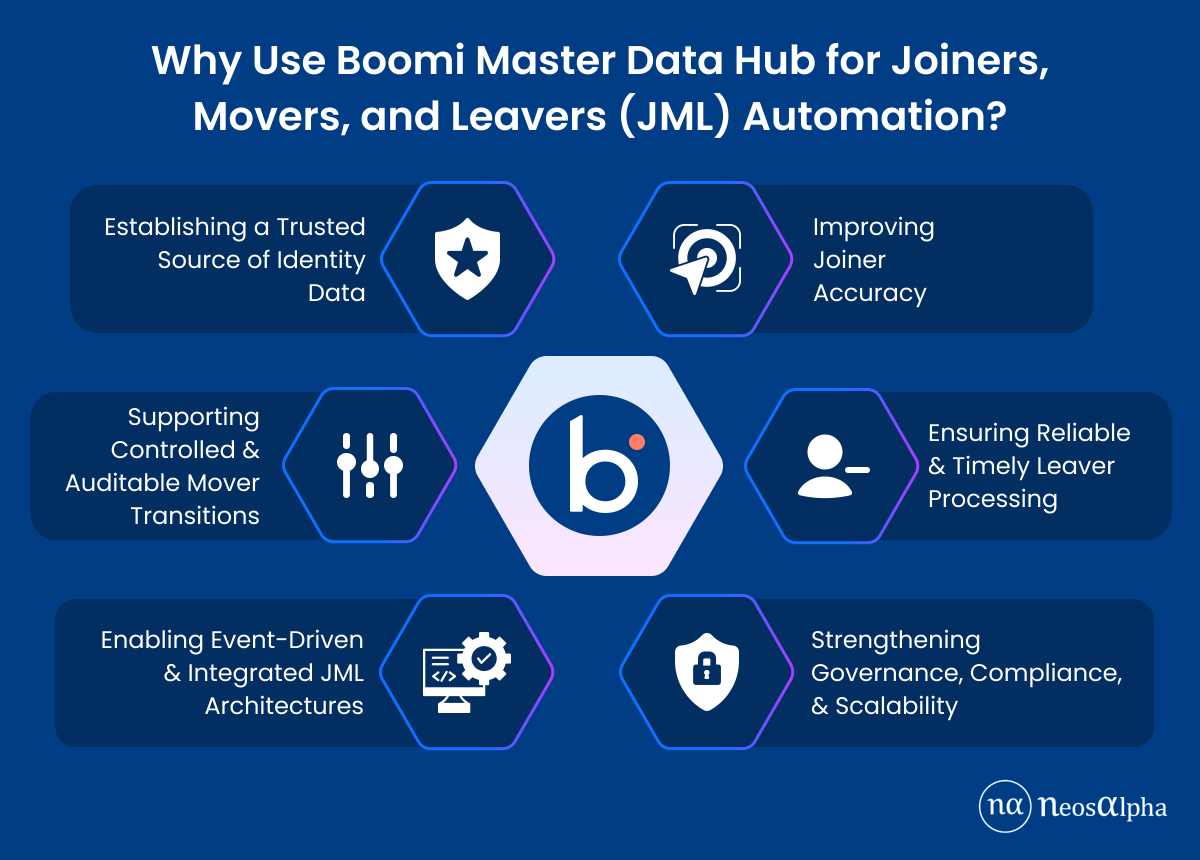
1. Establishing a Trusted Source of Identity Data
Boomi MDH creates a golden record and single source of truth for person and employee data by consolidating data from multiple core systems, such as HR systems, contractor databases, and external identity sources. Through matching, merging, and survivorship rules, MDH ensures that Joiner, Mover, and Leaver events are triggered based on consistent and validated data rather than conflicting system records.
2. Improving Joiner Accuracy
For Joiner events, Boomi MDH ensures that new employee data – such as name, job role, department, manager, and location is complete and standardized before it reaches IAM systems. MDH validates and enriches data upstream to help Identity and Access Management (IAM) tools provision the right access on day one, improving productivity and reducing onboarding delays caused by data errors.
3. Supporting Controlled and Auditable Mover Transitions
Boomi MDH helps manage Movers by tracking changes in roles, organizational structures, and reporting lines over time. Its data governance and workflow capabilities ensure that changes are reviewed, approved, and synchronized correctly, helping prevent privilege creep when employees change positions.
4. Ensuring Reliable and Timely Leaver Processing
For Leaver events, Boomi MDH ensures that termination data is accurate, timely, and consistently propagated to downstream systems. By serving as a reliable data source, MDH helps IAM and application systems deprovision access completely, reducing the risk of orphaned accounts and security exposure.
5. Enabling Event-Driven and Integrated JML Architectures
MDH works closely with Boomi integration capabilities to support event-driven JML processes. When a change occurs in master identity data, such as a hire, role change, or termination, MDH can publish these updates to connected systems through APIs and integrations.
6. Strengthening Governance, Compliance, and Scalability
Boomi MDH adds strong data governance, stewardship, and quality controls to JML processes. These capabilities help organizations demonstrate compliance with security and regulatory requirements while scaling JML operations across complex, hybrid IT environments.
Use Cases of JML
Joiners, Movers, and Leavers (JML) are foundational to identity security, operational efficiency, and compliance across organizations of all sizes.
1. Automated Employee Onboarding
A structured JML framework ensures new employees receive the right access on day one, based on role, department, and location.
2. Role-Based Access Adjustments
Employees frequently change roles, departments, or managers. When an employee moves internally, their access rights are automatically updated according to their new responsibilities, enforcing least-privilege principles and preventing privilege creep.
3. Secure and Timely Offboarding
When employees leave – voluntarily or involuntarily, their system access must be revoked immediately. A robust JML process ensures termination events trigger complete deprovisioning across all connected systems, preventing orphaned accounts and reducing insider threat risks.
4. Contractor and Third-Party Identity Management
Many organizations rely on contractors, consultants, and vendors who require temporary access. JML processes help manage their onboarding, role changes, and timely access removal, ensuring third-party access is controlled, monitored, and revoked when contracts end.
5. Compliance and Access Certification Support
JML plays a vital role in supporting audits and regulatory compliance. By maintaining accurate records of who had access, when it was granted, and when it was removed, organizations can demonstrate adherence to security policies. Important for industries subject to regulations such as SOX, HIPAA, GDPR, and ISO standards.
Who needs Joiners, Movers, and Leavers (JML)?
Joiners, Movers, and Leavers (JML) is not just an Identity and Access Management (IAM) or HR concern; it is a cross-functional requirement for any organization that manages people, access, and data. As businesses grow, adopt cloud applications, and face stricter security regulations, the need for a well-defined JML process becomes essential.
1. Organizations with a Dynamic Workforce
Companies that frequently hire, promote, or transfer employees need JML to ensure access keeps pace with workforce changes.
2. Enterprises with Multiple Applications
Organizations using multiple SaaS, on-premises, and cloud applications must use JML to maintain access across systems and ensure that identity changes are applied everywhere.
3. Organizations Moving Toward Automation
As companies adopt automation and zero-trust security models, JML ensures access is always aligned with current roles and employment status, not on assumptions or manual processes.
| Recommended Read: How Can Hands-On Boomi Training Help Your Team Build Faster, and Scalable Integrations? |
How does NeosAlpha ensure successful JML implementation?
With 8+ years of experience, 1,000+ integrations delivered, and 50+ global clients across multiple industries, NeosAlpha helps organizations implement secure, automated, and future-ready Joiners, Movers, and Leavers (JML) frameworks that deliver real business value.
- We embed industry-proven JML best practices to ensure secure, scalable, and compliant identity lifecycle management from day one.
- As an experienced Boomi partner, our team delivers event-driven JML automation by seamlessly integrating HR, IAM, and enterprise applications.
- We leverage Boomi Master Data Hub (MDH) to establish trusted, golden records, eliminating identity inconsistencies and access errors.
- Our expertise across 1,000+ integrations ensures reliable JML execution even in complex, multi-system enterprise environments.
- Through Boomi Managed Services, we ensure continuous optimization and monitoring to maintain long-term JML efficiency and security.
Conclusion
Identity lifecycle management is no longer a background IT function; it directly impacts security, compliance, and operational efficiency. Joiners, Movers, and Leavers (JML) determines who gets access, when they get it, how it changes, and when it is removed. If this process is fragmented or manual, the result is delayed onboarding, privilege creep, orphaned accounts, and audit exposure.
A structured, automated, and data-driven JML framework ensures that access is always aligned with real business roles and employment status. By integrating, governing, and leveraging trusted master data through platforms like Boomi Master Data Hub, organizations can build a scalable, resilient identity foundation. With the right strategy and experienced implementation support, JML becomes more than a control mechanism; it becomes a competitive advantage that strengthens security while enabling growth.
Frequently Asked Questions
1. What is the joiners, leavers, and movers policy?
The Joiners, Movers, and Leavers policy defines how user access is granted and revoked during the hiring process, role changes, and exits. This policy ensures consistent access control, security, and compliance across systems.
2. What is the Joiners, Movers, and Leavers (JML) process in IAM?
Joiners, Movers, and Leavers in IAM (Identity and Access Management) is about identity lifecycle management. It ensures that the users get the right access when they join, it is updated when there is a role change, and it is completely removed when they leave the organization.
3. How can I automate my Joiners, Movers, and Leavers (JML)process?
You can automate the JML process by integrating HR systems, IAM tools, and downstream applications, using events like hire date or job change as triggers. You can use integration platforms like Boomi iPaaS, which also offers master data management capabilities.
4. What is the JML process document?
A JML process document consists of data such as roles, systems, triggers, approval steps, and controls involved in the management of Joiners, Movers, and Leavers. It is used for reference for operations, audits, and compliance.
5. Which MDM is best for supporting Joiners, Movers, and Leavers (JML) processes?
Boomi Master Data Hub is one of the most reliable solutions for managing person and employee master data, integrating it with HR and IAM systems while ensuring governance and compliance. The API driven integration model and its scalability make it an ideal choice for modern identity architectures. Contact us today to integrate Boomi MDH for secure, and automated JML management.
6. What tools offer real-time updates for joiner and leaver events?
Tools like Boomi, Azure AD, Okta, and Workday enable real-time or near-real-time updates by integrating HR systems with identity platforms. This ensures immediate provisioning and deprovisioning, improving security and reducing delays.
7. What should an identity lifecycle process look like in a hybrid AD and SaaS environment?
In a hybrid setup, the HR system acts as the source of truth, triggering identity creation in Active Directory or Azure AD. Access is then provisioned across SaaS applications based on roles, with integration platforms ensuring consistent and real-time updates.

