Introduction
Every legacy data warehouse migration starts with the same uncomfortable discovery. A team that believed it had a few hundred well-understood reports opens the hood and finds hundreds of jobs and thousands of SQL scripts accumulated over a decade, orchestrated by schedules nobody fully remembers, feeding dashboards whose owners have long since left. The technology is only part of the challenge. The real difficulty is that the warehouse has become a tangle of undocumented business logic that the organization still depends on every day.
This is why so many migrations stall or overrun. Legacy appliances such as Teradata, Netezza, and Exadata, and cloud warehouses such as Synapse and Redshift, were built for stable, predictable reporting. They struggle with today’s demands: experimentation, AI and machine learning, streaming, and ad hoc analytics, all without letting infrastructure costs spiral out of control. The pressure to modernize is real, but moving carelessly risks breaking the reports the business runs on. Gartner has predicted that through 2026, organizations will abandon a large share of AI projects that lack AI-ready data, which raises the stakes for getting the data foundation right.
The answer is not to replicate the old warehouse on a new platform. It is to migrate deliberately, deciding which workloads to move as-is, modernize, retire, or redesign.
| The guiding principle
The goal is not to recreate Teradata, Synapse, or Redshift on Databricks. It is to make deliberate choices about which workloads to migrate as-is, modernize, retire, or redesign, so the move becomes a modernization rather than a like-for-like lift. |
Migration, Modernization, and Consolidation
It helps to be precise about what a migration actually involves, because most enterprise programs blend three distinct activities. Migration moves existing workloads from one platform to another. Modernization improves the architecture, governance, performance, and operating model during the move. Consolidation reduces platform sprawl by bringing multiple fragmented environments into a unified lakehouse. Knowing where to simply move, where to redesign, and where to retire is the core judgment of any successful program, and it is what separates a clean modernization from an expensive copy.
Book a free migration assessment with NeosAlpha. We will profile your legacy estate, classify your workloads, and hand you a staged, validated plan to modernize without disrupting the business.Plan your move to Databricks with a phased migration assessment
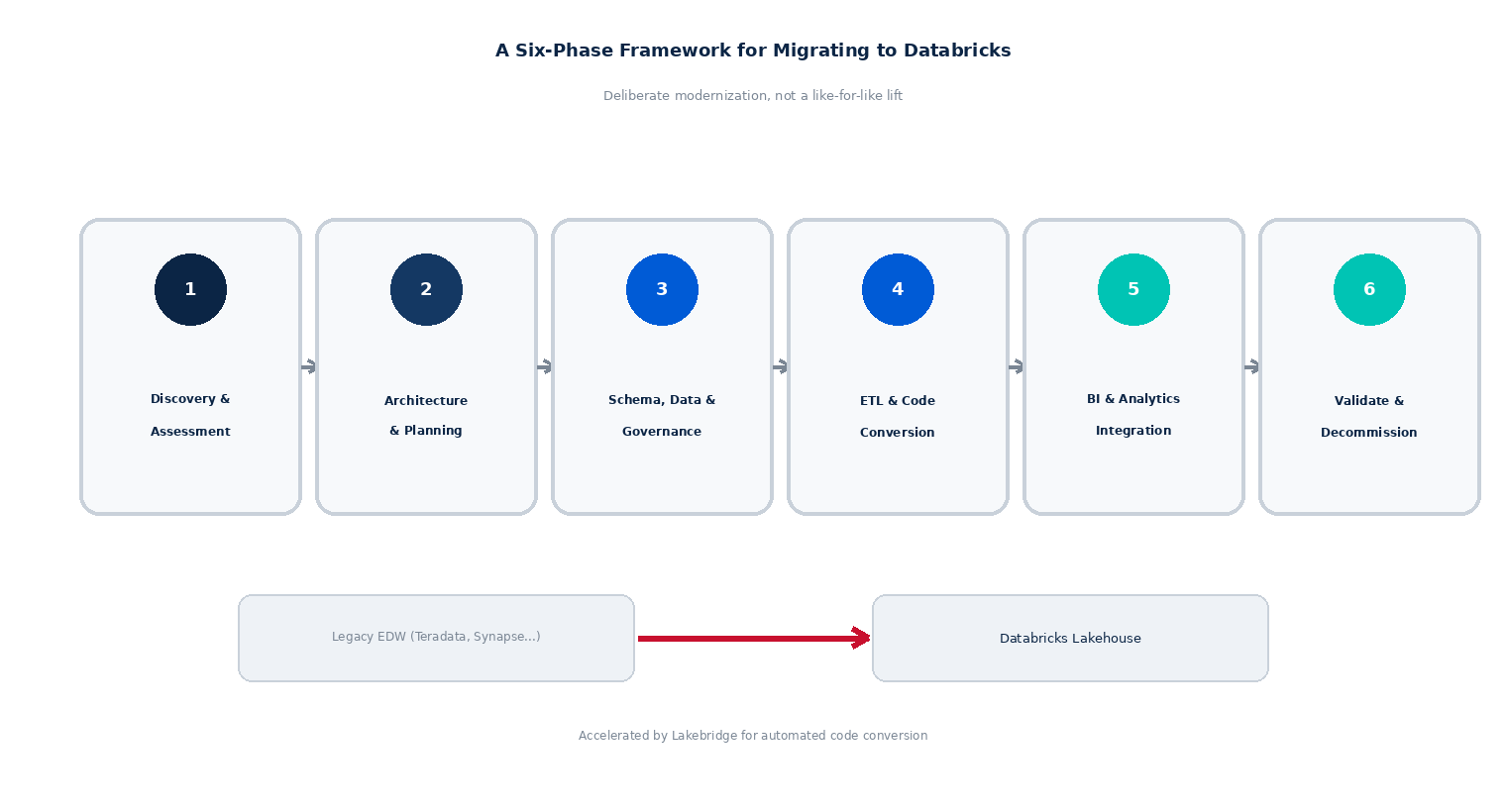
A Six-Phase Framework for Migrating to Databricks
The framework below mirrors the structure used in proven enterprise migrations. Each phase has a clear objective and a clear exit criterion, which keeps a complex program manageable.
Phase 1: Discovery and Assessment
You cannot migrate what you do not understand. This phase inventories the existing estate: tables, views, stored procedures, ETL jobs, orchestration scripts, BI dependencies, query patterns, and storage and compute utilization. Profiling the source system reveals which workloads are heavily used, which are dormant, and which are candidates for retirement. The output is a complete picture of scope and a workload-by-workload decision on whether to move, modernize, retire, or redesign.
Phase 2: Architecture Design and Planning
With the scope understood, the target architecture is designed: the lakehouse layout, the Unity Catalog object model for governance, storage organization, compute strategy, and data ingestion and transformation. This is the moment to design for the future rather than the past, mapping legacy structures to a modern medallion-style architecture and planning the governance model up front rather than retrofitting it later.
Phase 3: Schema, Data, and Governance Migration
Next, schemas and database objects are migrated, historical data is moved, and governance is established in Unity Catalog. This phase handles the details that quietly cause problems if ignored: slowly changing dimensions, data type mappings, and audit logging. Bulk data transfer uses scalable utilities appropriate to the source, and governance, including access controls and lineage, is set up as data lands rather than bolted on afterward.
Phase 4: ETL and Stored Procedure Conversion
The hardest technical work is usually translating stored procedures, ETL logic, and orchestration. Wherever possible, logic stays in SQL and orchestration moves to Databricks Workflows. Automated code conversion tools accelerate this substantially, and this is where Databricks Lakebridge, the free AI-powered migration tool for Databricks customers and partners, plays a central role by assessing the source and converting code with greater speed and predictability. Converted code is then optimized rather than translated line-for-line, so the new pipelines take advantage of the platform rather than carry over old inefficiencies.
Phase 5: BI and Analytics Integration
With data and pipelines in place, BI tools and downstream consumers are reconnected. Existing reports in tools such as Power BI, Tableau, and Looker are pointed at Databricks SQL, and reports are modernized where it adds value. The objective is continuity for business users, with existing reports producing identical results, alongside the option to unlock advanced analytics that the legacy warehouse could not support.
Phase 6: Validation, Decommissioning, and Optimization
The final phase proves correctness and retires the old platform. Results are validated against the legacy system to confirm parity; the legacy environment is then decommissioned, and the Databricks environment is tuned for cost and performance. Post-migration KPIs are tracked, governance is strengthened, and the operating model shifts from running a legacy appliance to operating a modern lakehouse.
| Case Study – Renowned Pharmaceutical Company Modernizes Commercial Analytics Platform Using Databricks |
The Tooling That De-Risks the Move
Migrations succeed faster when automation handles the repetitive, error-prone work. A few categories matter most.
- Assessment and profiling tools: Automated discovery of source topology, utilization, and object inventory, which turns a guessing exercise into a data-driven plan.
- Code conversion with Lakebridge: AI-powered translation of legacy SQL, stored procedures, and orchestration, available at no cost to Databricks customers and partners, with ongoing improvements to assessment and SQL validation.
- Parallel data transfer utilities: Scalable bulk movement appropriate to the source system, so large historical datasets move efficiently.
- Databricks Workflows: Native orchestration to replace legacy schedulers, coordinating notebooks, SQL, pipelines, and ML in one place.
Common Pitfalls That Derail Migrations
- Lift-and-shift without modernization: Copying the old warehouse verbatim carries forward its inefficiencies and misses the point of the move.
- Underestimating undocumented logic: The business rules buried in stored procedures are the riskiest part. Assess them early, not during cutover.
- Leaving governance until the end: Retrofitting access control and lineage onto a migrated estate is far harder than building it in from Phase 3.
- Skipping validation: Without rigorous parity testing against the source, business trust in the new platform never fully forms.
- Big-bang cutover: Phased migration with parallel running reduces risk far more than attempting everything at once.
How NeosAlpha De-Risks Your Migration to Databricks
A data warehouse migration is one of the highest-stakes programs a data team will run, because the business depends on the output every single day. As a Databricks partner, NeosAlpha brings a structured, phased approach and deep platform expertise to help enterprises migrate to Databricks without disrupting continuity or trust.
- Discovery and migration strategy: We profile your legacy estate, classify every workload as move, modernize, retire, or redesign, and produce a phased plan with clear milestones and exit criteria.
- Architecture and governance design: We design the target lakehouse and Unity Catalog governance model so the migration becomes a genuine modernization, not a like-for-like copy.
- Code conversion and pipeline rebuild: We use accelerators including Lakebridge to convert stored procedures and ETL, then rebuild pipelines on Databricks Workflows and optimize them for the platform.
- Validation and managed support: We validate results against the source for parity, support decommissioning of the legacy platform, and provide ongoing tuning and managed services after go-live.
Conclusion
A data warehouse migration is one of the highest-stakes programs a data team will run, precisely because the business depends on the output every single day. The teams that succeed treat it as a deliberate modernization rather than a copy: they discover before they move, classify every workload, design governance up front, lean on automation like Lakebridge for the heavy code conversion, and validate relentlessly before they switch anything off. Approached that way, the move to Databricks is not just a change of platform. It is the moment a fragmented, costly, reporting-era estate becomes a unified foundation ready for streaming, machine learning, and AI.