- Per-token prices are falling, but enterprise LLM spend is rising because cheap models drive far more usage, especially agentic workloads.
- Direct-to-provider API calls prevent cost attribution, spending caps, and model routing, so an AI gateway is placed between apps and model providers.
- An AI gateway enables four levers: visibility and attribution, budgets and rate limits, intelligent model routing, and semantic and prompt caching.
- Phased rollout starts with measuring costs through the gateway, then adding budgets, routing, and caching; one example case shows about a 60% reduction.
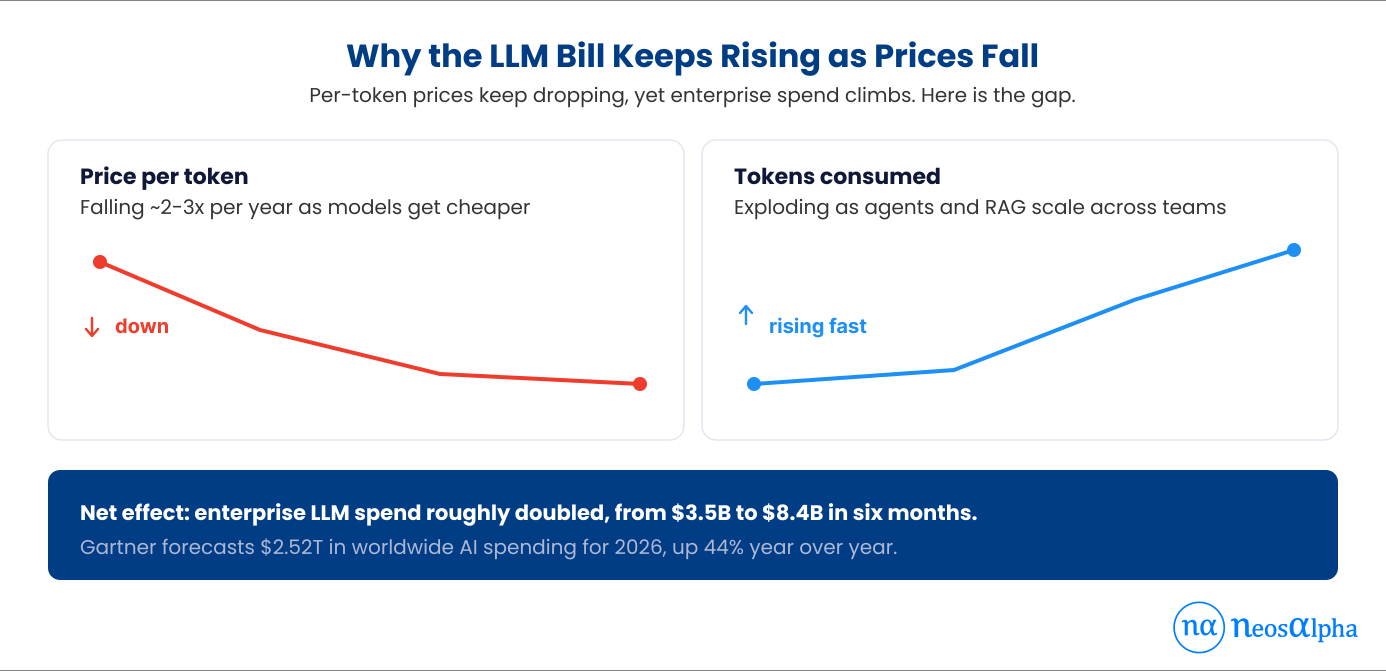
The cost of a single token has been declining steadily. Frontier model providers have cut per-token pricing by roughly 2-3x a year, and cheaper open and mid-tier models have lowered the floor even further. By every headline number, running a large language model in production should be getting cheaper.
Enterprise LLM spending roughly doubled over a recent six-month stretch, from around $3.5 billion to $8.4 billion, and Gartner now forecasts $2.52 trillion in worldwide AI spending for 2026, up 44% year over year. The unit got cheaper, and the invoice got bigger at the same time.
The reason is volume. As soon as a model is cheap and good enough, teams use it for far more: retrieval-augmented search across every document, summarization in every workflow, and, increasingly, agents that reason in loops and call tools dozens of times to finish one task. A single agentic session can burn 10 to 100 times the tokens of a simple chat completion. Lower prices did not reduce spend; they removed the brake that used to keep usage small.
So the question enterprises are now asking is not “which model is cheapest per token”, that race is already won and keeps resetting. It is “how do we govern consumption across dozens of teams and apps so that growth in AI usage does not mean uncontrolled growth in cost.” That is the problem an AI gateway is built to solve.
Where the Money Actually Leaks
Before reaching for a fix, it helps to see where the waste comes from. Across most enterprise deployments, a consistent pattern shows up: 40% to 60% of a token budget is spent on work that delivers no proportional value. It leaks in a few predictable ways.
- The biggest is over-provisioned intelligence – Routing every request to the most expensive frontier model, including the large share of prompts that a model costing a fraction as much would answer just as well. A classification task, a short rewrite, or a routine extraction does not need the same horsepower as multi-step reasoning, but without routing logic, they all get it.
- The second is re-billed repetition – The same long system prompt, the same retrieved documents, and the same boilerplate context get sent on every call and charged for every time, even when nothing about them changed between requests. Near-identical questions get answered from scratch rather than reused.
- The third is uncontained runaways – A test harness left running over a weekend, an agent stuck in a retry loop, or a misconfigured key quietly generating thousands of calls. Without caps, you only discover these on the invoice.
None of these are exotic failures. They are the default behavior of LLM usage that has grown faster than the controls around it.
Why Direct-to-Provider Calls Make Cost Control Impossible
Most of this waste traces back to a single architectural decision made early and rarely revisited: each application calls the model provider’s API directly. It is the fastest way to ship the first prototype, and it quietly becomes the production architecture. The problem is that it leaves no room for cost control.

When every service holds its own provider key and talks to the API on its own, four things become impossible. There is no attribution: the provider returns one aggregate invoice, not a breakdown of which team, app, or feature drove the spend, so no one can be held accountable for it. There is no prevention: nothing sits between the application and the meter to enforce a budget or stop a runaway before it bills. There is no leverage: each app is hardwired to one model, so no central place can decide that a cheaper model should handle easy traffic. And there is no flexibility: switching providers, or routing dynamically by cost, means changing and redeploying application code everywhere it makes a call.
You cannot optimize what you cannot see, cap, or redirect. That is why the first real step toward lower LLM costs is almost never a model change; it is an architectural one.
What an AI Gateway Actually Is
An AI gateway is a control layer that sits between your applications and every model provider they use. Instead of each app calling OpenAI, Anthropic, Google, or an open-source endpoint directly, they all call the gateway, and the gateway forwards the request to the right provider on their behalf.
That single architectural move changes what is possible, because now every request passes through one place. At that chokepoint, you can measure, tag, cap, route, cache, and swap models – centrally, consistently, and without touching application code. The gateway speaks a unified API to your apps and translates to each provider’s format behind the scenes, so “which model handles this” becomes a configuration decision rather than a code change.
It is the same principle that made the traditional API gateway indispensable a decade ago: put a smart, programmable layer at the edge, and governance stops being something you bolt onto each service and becomes something you apply once. The difference is that an AI gateway understands tokens, model costs, prompts, and semantic similarity – the dimensions that actually drive an LLM bill.
Where Does Your AI Program Stand?
Score your organization on use cases, platform, cost, security, and governance in about four minutes, and get a PDF report with the next steps for your weakest areas.
Check Your AI MaturityThe Four Levers of LLM Cost Optimization
With a gateway in place, cost optimization stops being a set of scattered tactics and becomes four levers you can pull in one place. They build on each other: you cannot route intelligently until you can see what you are spending, and caching compounds whatever routing is already saved.
Lever 1: Visibility and Attribution
Everything starts here, and most savings are impossible without it. The gateway tags every single call with the metadata that matters: which team, which application, which feature, which user, which model, how many tokens in and out, and what it cost. One opaque monthly invoice becomes a live, queryable cost ledger.
This is the lever that makes the others actionable. Once you can see that one internal tool is responsible for 40% of spend, or that a single feature’s prompts are three times longer than they need to be, you know exactly where to point the remaining levers. It also changes behavior on its own: teams that can see their own AI costs, broken out and attributed, almost always trim them without being told to.
Lever 2: Budgets and rate limits
With visibility in place, the next lever is containment. The gateway lets you set hard budget caps and rate limits per key, per team, or per application: a monthly ceiling you can’t breach, and a throttle on requests per minute. When a limit is reached, the gateway can slow, queue, or reject requests rather than letting them run up the bill.
This is the lever that kills the runaways. The weekend test loop, the stuck agent, the forgotten key, all of them hit a wall instead of a five-figure surprise. In practice, simply capping and containing obvious waste tends to cut 20-30% off a bill that has never had guardrails, before any clever optimization is applied.
Lever 3: Intelligent model routing
This is where the largest savings usually come from. Not every prompt needs the most capable, and most expensive model. Intelligent routing inspects each request and sends it to the cheapest model that can handle it well: simple classification and extraction to a small, fast model, genuinely hard reasoning to the frontier.
The research backing this is strong. RouteLLM, presented at ICLR 2025, showed that a well-trained router can preserve around 95% of top-model performance while sending only 14-26% of traffic to the expensive frontier model, a 75-85% cost reduction on the routed traffic, with quality that users do not notice slipping. Because the gateway owns routing, you tune these rules centrally and roll them out everywhere at once, rather than rewriting each application’s model choice by hand.
Lever 4: Semantic and prompt caching
The fourth lever attacks re-billed repetition, and it layers on top of everything above. Two techniques do the work. Semantic caching recognizes when a new prompt is close enough in meaning to one already answered and returns the stored response instead of paying for a fresh generation; this is useful anywhere the same questions recur, which in enterprise support and search is most of the time, typically saving 30-50% on cacheable traffic. Prompt caching, offered natively by the major providers, lets you cache the long static prefix of a request- the system prompt, the tool definitions, the retrieved context- so it is processed and billed once rather than on every call, cutting up to 90% off the cost of those cached input tokens.
The gateway is the natural place to manage both, because it sees every request and can apply caching policy consistently without each application reinventing it.
What The Levers Add Up To
Pulled together, these levers compound rather than merely add. Take a team spending $150,000 a month with no controls. Attribution and budgets clean up the obvious waste and bring it to roughly $120,000. Intelligent routing moves the bulk of traffic off the frontier model and brings it to around $75,000. Caching layered on top reuses repeated work and brings it to about $60,000.
That is a roughly 60% reduction – close to $90,000 saved every month, with no drop in output quality, because the expensive model still handles everything that genuinely needs it. The numbers will vary with your traffic mix, but the shape holds across real deployments: the savings are large, and they come from architecture and policy, not from accepting worse answers.
A Phased Path to a Lower Bill
The mistake teams make is trying to do all four levers at once, or starting with the clever one. The right order is to measure first and cut second; each phase depends on the visibility the previous one created.
In the first couple of weeks, route all traffic through the gateway and tag it, so you have a real cost breakdown before you change anything. In the next two, set per-key budgets and rate limits and kill the obvious waste. From weeks five to eight, introduce model routing on low-risk traffic and add caching, measuring quality alongside savings so you can prove nothing degraded. After that, it becomes ongoing: refine the routing rules, watch for drift, and fold cost into your broader AI governance so optimization is a standing habit rather than a one-off project.
How NeosAlpha Helps
An AI gateway delivers these savings only when it is implemented well – tagged correctly, routed sensibly, and wired into how your teams actually work. That implementation is where NeosAlpha focuses.
With deep roots in integration, API management, and now agentic AI, we help enterprises stand up and tune AI gateways end to end. That means putting the control layer in front of your existing applications without disruptive rewrites, designing the attribution model so costs map cleanly to teams and products, defining routing and caching policies tuned to your real traffic, and building the budgets and guardrails that keep spend predictable as usage scales.
Our work spans the full picture rather than a single tool: our Integration and API practice handles the connective tissue between your apps and the gateway, our Agentic AI practice designs the token-heavy workloads that make cost control urgent in the first place, and our Cloud Native and Data practices make sure the whole thing runs reliably and that the cost data flows into the reporting your leadership needs. With a decade of API and cloud delivery behind us and partnerships across the major platforms, we help you turn LLM cost optimization from a recurring budget fight into managed, governed, and measurable infrastructure.

