Getting an AI system into production is no longer the hard part. Keeping it governed once it is there is.
The warning signs are already in the breach data. IBM’s 2026 Cost of a Data Breach report found that 43% of breached organizations traced the incident back to shadow AI, more than double the share a year earlier. Behind that number is a pattern most enterprises recognize a few months into their AI rollout: the model works, but the surrounding operation is fragile. Costs run unpredictably because nobody is metering tokens. Security teams cannot see what is being sent to external providers. Compliance cannot produce an audit trail because none exists. And as one AI application becomes ten, then a fleet of agents, the whole thing sprawls beyond anyone’s line of sight.
The usual response is to slow down, but that is the wrong lesson. The problem is not speed; it is that governance gets retrofitted after an incident instead of designed in from the start. When guardrails are part of the architecture rather than a layer bolted on later, governance stops being a brake on innovation and becomes what lets teams ship AI safely across every environment.
Why Governance Has to Be Designed In, Not Bolted On
That shadow-AI figure is a symptom of a deeper shift, and it is worth sitting with the source. Shadow AI breach rate reflects teams adopting their own models and tools with no central oversight. And the scale of what needs governing is growing just as fast: Gartner projects that the average Fortune 500 company will operate more than 150,000 AI agents by 2028. Add regulatory pressure from the EU AI Act, which expects high-risk systems to maintain logs, enforce access control, and support human oversight, and governance stops being optional. The only real choice is whether you build it in by design or impose it later by cleanup.
The pattern that gets enterprises into trouble is always the same. The capability arrives first, spreads organically, and only later does anyone try to impose control on a system that was never built to be controlled. Retrofitting governance onto that mess is slow, expensive, and incomplete. Building it in from the start costs far less and works far better. What follows explains how to do exactly that.
Model Strategy: The Hybrid Baseline
Every AI deployment starts with a decision about where the models run, and it matters because it shapes everything downstream.
Teams often begin with locally hosted models and hit a wall. Self-hosting struggles to meet the computational demands of production-scale workloads, especially as reasoning complexity or request volume climbs, and it puts the burden of GPU infrastructure, auto-scaling, and model lifecycle management entirely on your team. Cloud-based model APIs solve much of that by offloading the infrastructure and its economics to the provider, which is why they often win on cost at scale.
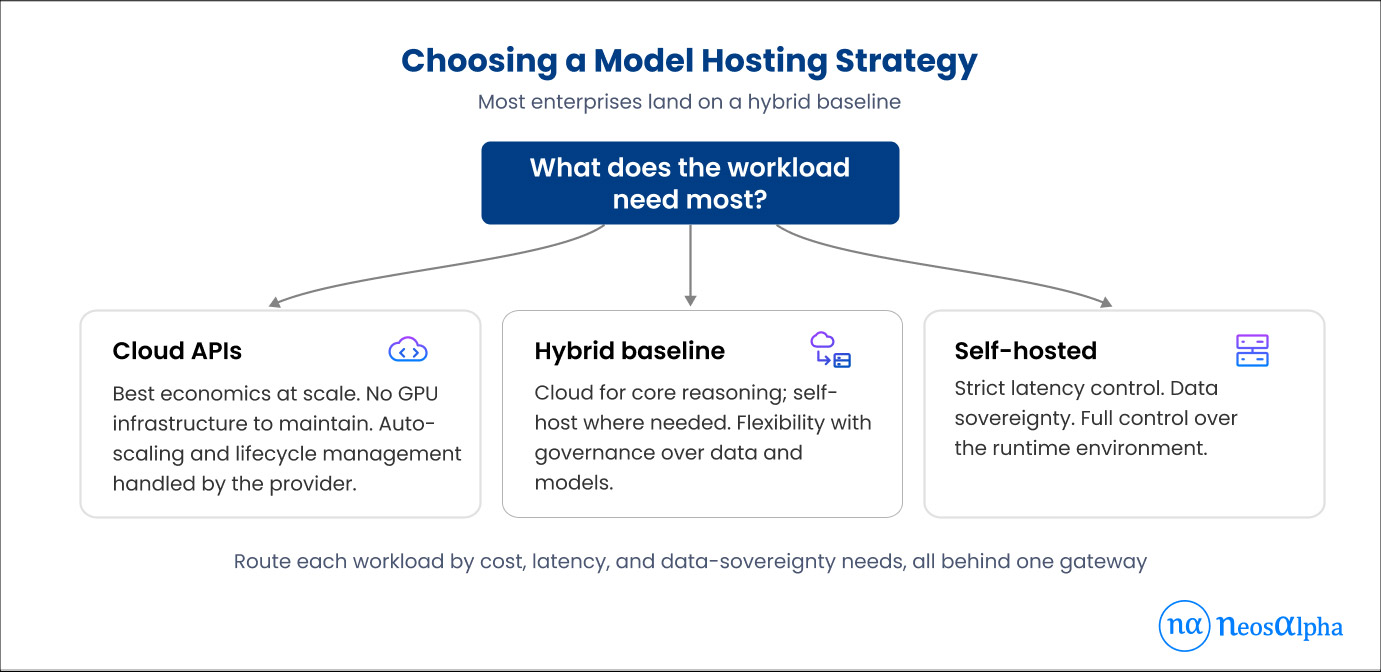
The debate over cost-per-token between local and cloud rarely has a clear winner, though, and the pragmatic answer for most enterprises is not to pick a side. It is a hybrid model strategy: use cloud APIs for core reasoning where they deliver the best economics and flexibility, and keep self-hosted deployments for the workloads that demand strict latency control or data sovereignty. This hybrid baseline gives you room to scale while preserving governance over where your data and models live. The key design principle is to choose per workload, routed by cost, latency, and data-sensitivity requirements, rather than committing the whole organization to one path.
Standardizing on Protocols, Not Frameworks
Once you know where models run, the next problem appears: the sheer number of AI frameworks. The ecosystem has expanded rapidly over the past two years, each framework optimized for a different use case or model type, and if you tie your architecture too tightly to any one of them, you inherit integration silos and operational friction that are painful to unwind later.
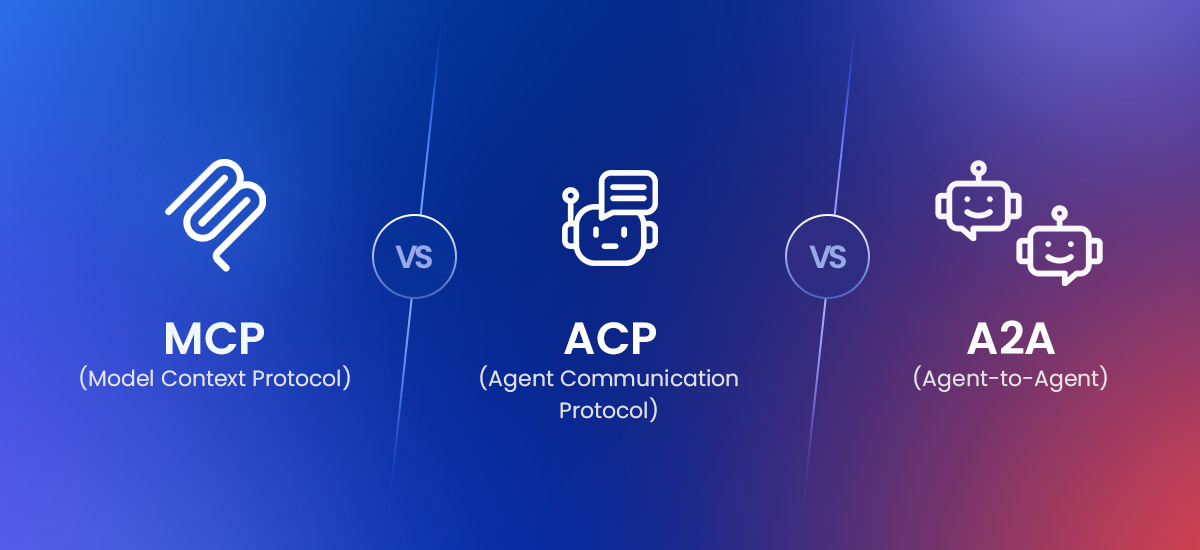
The way out is to standardize at the protocol layer rather than the framework layer. Two open protocols matter most here. The Model Context Protocol (MCP) standardizes how models and agents connect to external tools and data sources. Agent-to-Agent (A2A) standardizes how agents communicate with one another. Building on these decouples your long-term design from any single fast-moving framework, so you can swap frameworks or model providers underneath without tearing up your governance structure. This is the first real step toward future-proofing the stack, because it means your enforcement and observability layers keep working no matter what runs above them.
Recommended Read – ACP vs MCP vs A2A: The Complete Guide to AI Agent Protocols
The Control Plane and AI Gateway: Your Enforcement Layer
To let teams build AI freely while still enforcing governance, you need a place where policy actually lives and is applied. That is the job of the control plane, and it is the architectural heart of the whole design.
Think of the control plane as the policy and routing brain of your enterprise AI operations. It manages access controls, applies usage limits, and enforces compliance rules across teams and environments, all while still letting distributed teams innovate independently. It is what turns a scattered collection of AI projects into a governed system.
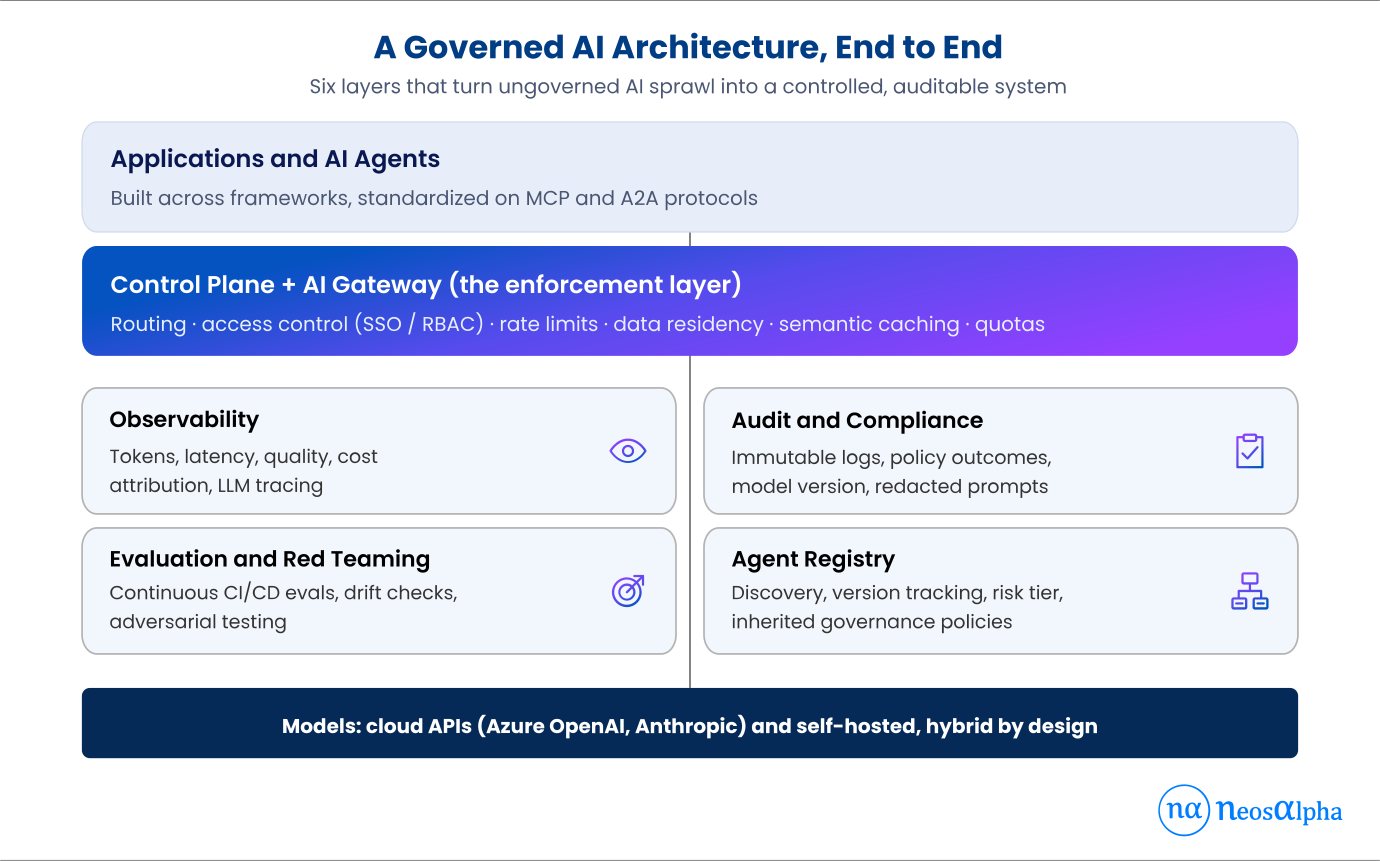
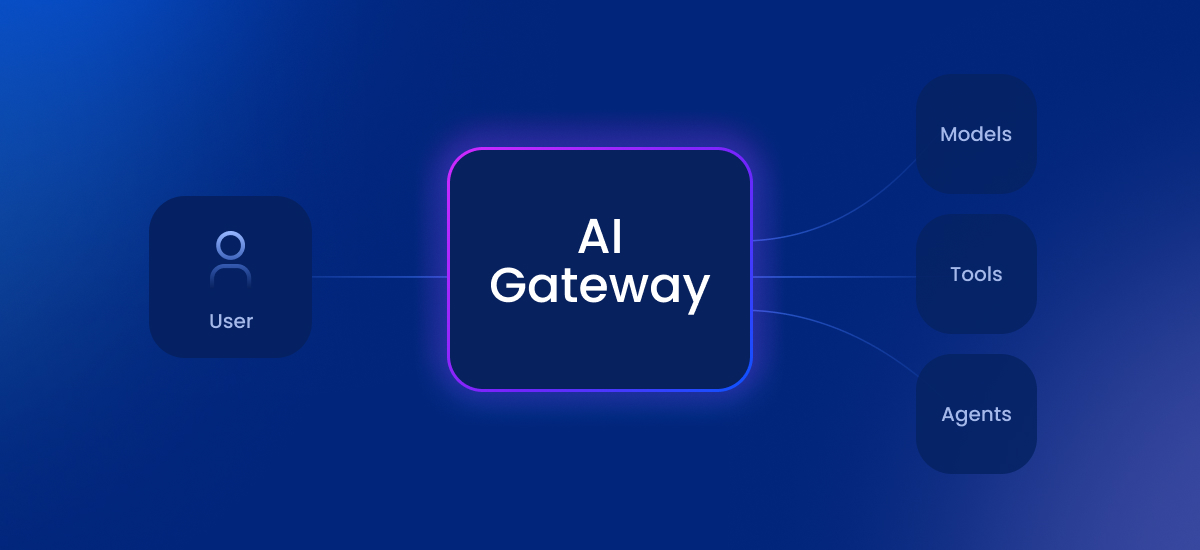
The control plane works with an AI gateway, which sits between your agentic applications and the underlying models. The gateway applies governance logic in real time: enforcing rate limits, ensuring data-residency compliance, and dynamically routing traffic based on performance, cost, or compliance parameters. Routing all model traffic through a central AI gateway, such as Kong, gives you a single policy enforcement point that can govern requests across Azure OpenAI, Anthropic, or self-hosted models through one consistent interface.
The payoff grows when you integrate the gateway with your enterprise identity systems. Wiring in SSO and RBAC means every request is traceable from the individual user through to the specific model call, which is exactly the chain of accountability that compliance and auditability depend on. Without that identity binding, you have traffic control but no real answer to who did what.
NeosAlpha helps enterprises design and implement governed, cloud-agnostic AI architectures, from control planes and gateways to observability, evaluation, and agent registries, built on deep integration and API expertise.Ready to Deploy AI You Can Actually Govern?
Observability: Seeing What Your AI Actually Does
With routing and enforcement in place, the next layer is visibility. AI observability has to go well beyond the infrastructure metrics traditional monitoring captures. It needs to record token usage, inference latency, and model-quality signals such as hallucination rate and response correctness, because those measures tell you whether the system is actually working, not just whether the servers are up.
Observability also opens the door to explainability. By tracing agentic flows, tool calls, and decisions through diagnostic spans, you gain real insight into how an output was produced, not just what it was. This is where conventional application observability extends into LLM observability, and the tooling has matured to match. Commercial platforms like Datadog now offer integrated LLM observability alongside traditional application performance monitoring through a single SDK. Teams that prefer an open-source, self-hosted stack often combine Langfuse for LLM tracing with Elasticsearch for logs, Prometheus for metrics, and Grafana for dashboards.
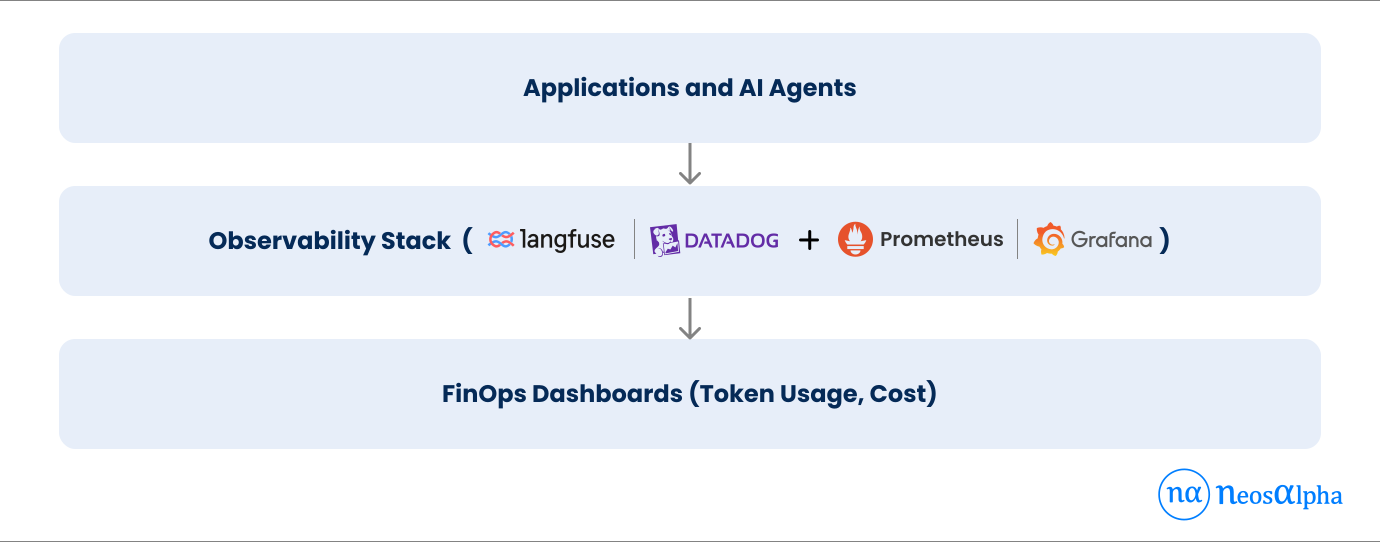
There is a financial dividend here too. Because the AI gateway sees every request, the same observability layer answers your FinOps questions, letting you monitor token usage, attribute cost to individual users, and split spending at the application level. And observability feeds optimization directly: with semantic caching at the gateway, repeated or similar queries can be served from cache with far lower token consumption, while quotas and throttling keep cost overruns from creeping up.
Auditing: Turning Traces Into Evidence
Observability data becomes genuinely powerful when tied to post-deployment auditing. The distributed traces you capture from agentic and model interactions, prompt context (securely redacted), token usage, latency, and the outcome of every policy check are exactly what you need for root-cause analysis when something goes wrong and to explain why an agent made a particular decision.
That last point matters more than it first appears. With LLM distributed tracing, you can reconstruct the reasoning path behind a specific output, achieving both explainability and a defensible audit trail. To hold up under compliance scrutiny, those records need to be immutable and capture the agentic flow, the model version in use, the policy checks that ran, and their results. Elasticsearch is well suited to this, particularly for on-premises deployments where regulatory or data-retention rules restrict external logging or cloud storage. The principle is simple: if you cannot prove what happened after the fact, you are not really governed, no matter how good your real-time controls are.
Continuous Evaluation and Red Teaming
Governance does not end at deployment, because AI systems degrade. Both cloud and fine-tuned models are subject to model drift, quality regression, and unexpected responses over time, and none of that shows up unless you are actively looking for it. Continuous evaluation, built into your CI/CD process, helps you catch regressions early instead of hearing about them from users.
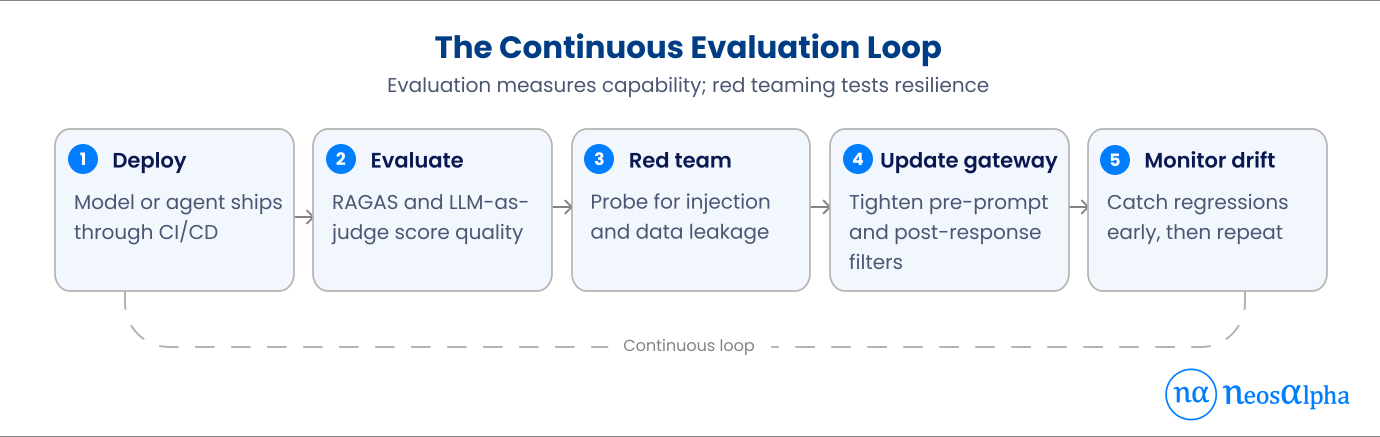
Low-code workflow tools such as n8n make it straightforward to build automated evaluation pipelines that run frameworks like RAGAS or other LLM-as-a-judge approaches on every change. But standard evaluation only measures typical performance, accuracy, fluency, and coherence against expected inputs. It tells you nothing about how the system behaves under attack. That is the job of red teaming.
Red teaming deliberately probes for the adversarial weaknesses that ordinary evaluation misses: prompt injection, sensitive-data exfiltration, jailbreak attempts, and policy circumvention, including indirect injection through documents retrieved in a RAG pipeline. Run these exercises on a regular cadence, and then operationalize what they find. The key move is to feed the findings straight back into the AI gateway, tightening pre-prompt and post-response filters across all traffic without touching application logic. This is what makes governance adaptive in production: evaluation confirms capability, red teaming confirms resilience, and both continuously harden the same enforcement layer. Together they turn safety from a policy statement into a living discipline.
The Agent Registry: Governing Sprawl at Scale
As the number of AI agents in an enterprise grows, managing them becomes a discipline in itself. Teams build agents with different frameworks and technology stacks, and without a central inventory, the situation quickly descends into chaos; you cannot govern what you can’t find.
A centralized agent registry is the answer. It standardizes discovery, version tracking, and policy enforcement across teams, giving you a canonical source of truth for every AI system in production. A well-designed registry captures each agent’s governance-relevant properties: its owner, deployment environment, model version, risk tier, and red-team history. Tying each entry to an EU AI Act risk classification (unacceptable, high, limited, or minimal) lets you apply control requirements and evidence obligations in proportion to actual risk, rather than governing every agent identically regardless of sensitivity.
Most cloud vendors offer registries within their own ecosystems, and on-premises options exist for private environments, such as the registry capabilities in Mistral AI Studio’s commercial suite. Whatever you choose, the registry should not stand alone. Its real value comes from linking directly to the control plane and gateway, so that every newly deployed agent automatically inherits enterprise-wide governance and visibility policies the moment it is registered. That automatic inheritance is what keeps governance from breaking down as you scale from ten agents to ten thousand.
Bringing It Together: A Cloud-Agnostic Blueprint
None of these layers does the job on its own. AI governance is no longer an afterthought; it is a design principle, and the architecture’s strength comes from how the pieces connect into a coherent whole. A hybrid model strategy gives you flexibility. Standard protocols keep you from being locked to a framework. The control plane and gateway enforce policy in real time. Observability makes the system visible, and auditing turns that visibility into evidence. Continuous evaluation and red teaming keep it honest over time, and the registry keeps the whole growing population of agents under consistent governance.
The reason to build it this way is that the same architecture then runs anywhere. Because it is assembled from cloud-agnostic components and open protocols, the same governance model applies across public cloud and on-premises environments, which lets a large enterprise operate AI consistently across a mixed estate. The path forward is continuous rather than one-and-done: start with standardized protocols, enforce consistent access through the gateway, instrument for observability, and iterate through evaluation. That end-to-end loop is what strengthens compliance and trust while still leaving teams free to innovate.
How NeosAlpha Helps
Designing this architecture is one thing. Making it real inside an enterprise, integrated with your systems, tuned to your compliance obligations, and adopted by the teams who depend on it, is another. That is where our experience fits.
NeosAlpha has spent years helping enterprises design and run the integration, API management, and data platforms that this kind of governed AI architecture is built on. An AI control plane and gateway are, underneath, integration and API governance challenges with AI-specific requirements layered on top, which is precisely the intersection we work in. Our teams help organizations choose the right model and protocol strategy, stand up the control plane and gateway as a real enforcement layer, wire in observability and auditing, and connect the agent registry so governance is inherited automatically rather than applied by hand. Because our expertise spans integration, API management, and agentic AI, we can build the whole loop as one coherent system, secure, observable, and cloud-agnostic by design, so you can scale AI without losing control of it.