- NeosMigrate is NeosAlpha's accelerator that automates repeatable API gateway migration work and flags risks early for human review.
- It converts proxies from Mashery, Akana, MuleSoft, and Apigee Edge into Apigee X or Apigee Hybrid bundles and maps their policies.
- Policies without a direct Apigee equivalent are flagged for engineering review rather than silently approximated.
- Generated test suites compare converted proxies against the original behavior and can serve as regression suites afterward.
API gateway migrations rarely run late because teams underestimate the number of proxies. They run late because each proxy carries years of accumulated complexity: custom policies, authentication flows, rate limits, integrations, and platform-specific behavior that does not automatically translate to a new gateway.
Whether an organization is moving from Mashery, Akana, MuleSoft, or Apigee Edge, rebuilding hundreds of APIs manually can become expensive, time-consuming, and risky. The challenge isn’t simply moving a proxy from one platform to another; it is preserving the behavior applications and customers already rely on.
NeosMigrate is NeosAlpha’s migration accelerator, designed to automate repeatable work and surface migration risks early. It inventories the source gateway estate, converts proxy definitions into Apigee-compatible bundles, maps policies, flags unsupported configurations, generates test suites to compare behavior, and helps establish CI/CD pipelines for Apigee X or Apigee Hybrid.
Instead of treating every proxy as a manual rebuild, teams can focus engineering effort on the exceptions that need human judgment, while gaining a clearer view of scope, validation needs, and the path to cutover.
Why API Gateway Migrations Take Longer Than Expected
Three challenges commonly push migration programs beyond their original timelines. They are related, but each requires a different response.
1. Fixed deadlines and large estates
Migrations often start with vendor roadmaps, contract renewals, platform consolidation, or end-of-life milestones. These deadlines may be outside the delivery team’s control. A large proxy count makes the program look straightforward to estimate, but volume alone does not reveal the work involved.
2. Similar concepts, different behavior
Most gateways have proxies, policies, targets, products, and consumers. The names may look familiar across platforms, but policy semantics, execution models, and extension points differ. A conversion that looks correct in configuration can still behave differently at runtime.
3. Incomplete inventories
Gateway estates often contain unused proxies, obsolete products, undocumented custom code, and applications with unclear ownership. If teams discover these during migration, the scope changes after the plan and deadline have already been agreed.
The Work Nobody Scopes
Even a migration between two generations of the same gateway can involve substantial changes. Google’s published guidance for moving from Apigee Edge to Apigee X documents feature differences and behavior changes that need assessment, not just copying across.
| What the existing estate relies on | What happens on Apigee X |
|---|---|
| StatisticsCollector policy | Not supported. The DataCapture policy takes its place. |
| MessageLogging writing to a file | File logging is no longer available. |
| OAuth v1 and OAuth v1.0a policies | Not supported, and not planned. |
| Node.js API proxies, Extensions, Trireme | Not supported. |
| Hosted Targets | Move to Cloud Run or Cloud Functions. |
| Companies and developers | Replaced by AppGroups. |
| Apigee Sense | Replaced by Advanced API Security. |
| Microgateway and the Istio adapter | Replaced by the Apigee Adapter for Envoy. |
| Monetization quotas set per proxy | Quotas move to the API product level. |
Behavior changes may also not be obvious from a converted proxy. For example, headers prefixed with X-Apigee- may be stripped before reaching targets and clients; HTTP/1.1 header names are lowercased on the way to a backend; JSONPath indexing differs; key value maps have different encryption, scope, and management characteristics; and tracing behavior changes.
Any one of these differences can affect a consumer that depends on the old behavior. When the source platform is Mashery, Akana, or MuleSoft, the translation challenge can be greater because the platforms have different policy models, execution patterns, and customization approaches. Migration therefore needs both a reliable conversion method and a way to validate the result.
Planning an API gateway migration?
Start by understanding what is in your current estate and where the most significant conversion risks lie.
Book a free assessmentIntroducing NeosMigrate
NeosMigrate was developed within NeosAlpha’s Apigee practice in response to recurring challenges across enterprise gateway migrations. It automates the repeatable parts of migration, highlights the parts that need engineering attention, and helps teams build the evidence needed to make informed cutover decisions.
The principle is straightforward: automation should make its limits visible. The accelerator can map policies with a suitable Apigee equivalent, while flagging policies without a direct equivalent for review rather than silently approximating them. This gives teams a more useful picture than a single completion percentage: what converted, what needs validation, and what requires a deliberate engineering decision.
How NeosMigrate Works
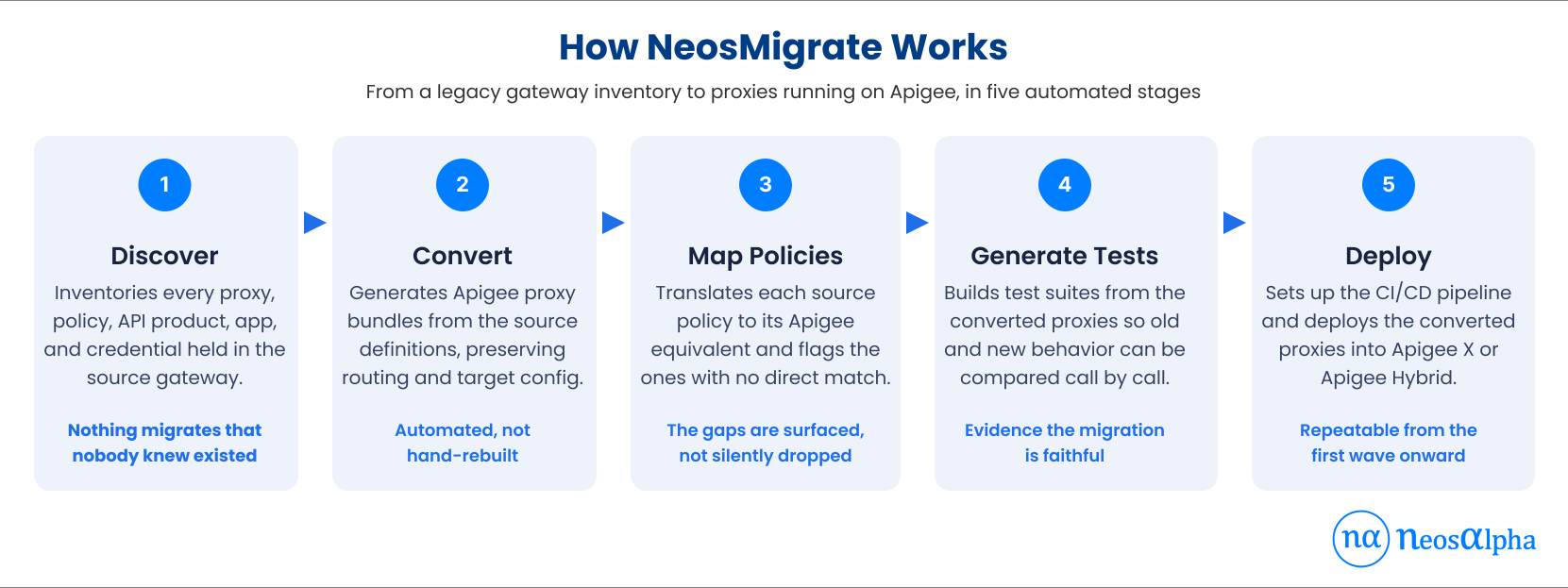
- Discover – The accelerator reads the source gateway and inventories what is actually deployed: proxies, policies, API products, applications, and the credentials attached to them. This stage often changes the scope of a migration before any conversion happens, because the real estate rarely matches the estate in the planning spreadsheet.
- Convert – Convert source proxy definitions into Apigee proxy bundles, preserving routing, target configuration, and the request and response flow structure. This is the volume work, and it makes a 400-proxy estate tractable.
- Map policies – Each policy in the source definition is matched to its Apigee equivalent. When a direct equivalent exists, the mapping applies it and carries over its configuration. Where one does not, the policy is flagged for review rather than approximated.
- Generate tests – Test suites are generated from the converted proxies so that behavior can be compared rather than assumed. This is what turns a converted bundle into something a team can defend in a go-live review.
- Deploy – The CI/CD pipeline is configured, and the converted proxies are deployed into Apigee X or Apigee Hybrid. The pipeline is a deliverable in its own right because a wave-based migration needs the same route to production every time.
Policy Mapping Is the Critical Step
Proxy structure is often the most visible part of a gateway, but policies carry much of its behavior. That is why policy mapping deserves close attention during migration.
- Maps cleanly – Common capabilities such as quota enforcement, spike arrest, API key verification, basic transformations, and standard OAuth flows may have suitable equivalents. Their configuration still needs validation in the target environment.
- Maps with conditions – Some policies have a counterpart but behave differently. A rate limit may use a different window, or a caching policy may interpret its key differently. These policies need behavioral checks even when conversion is possible.
- Requires engineering review – Custom JavaScript callouts, Java extensions, and platform-specific scripting hooks may have no direct equivalent. Engineers need to decide whether to reimplement, relocate, replace, or retire the logic.
NeosMigrate distinguishes these outcomes in a policy map, helping teams build a migration plan around known exceptions and validation requirements instead of relying on an overall completion score.
Proving the New Proxy Behaves Like the Old One
Automated conversion raises an obvious question, and any team being asked to approve a cutover will ask it: how do we know the converted proxy does what the original did? Reading the generated configuration is not an answer, because the differences that matter are behavioral rather than structural, and the silent changes listed earlier are exactly the sort that survive a code review.
Generating test suites from the converted proxies addresses this directly. The suites exercise the converted interface so you can compare its responses against the behavior of the system being replaced, turning the migration question from a matter of confidence into a matter of evidence. It also leaves something useful behind, because a test suite built during migration becomes a regression suite afterward, covering interfaces that many estates have never had automated tests for.
This is also where migration overlaps with the rest of the toolkit. Teams running NeosProbe for AI-driven API test generation already have a pattern for building coverage from a specification, and the same discipline applies to a converted proxy: generate the coverage, run it against both sides, and let the comparison decide whether the conversion is faithful.
Leave a Repeatable CI/CD Pipeline Behind
Gateway migrations are often delivered in waves. A first wave validates the approach on a contained group of APIs; later waves progressively include more critical interfaces. The deployment process used for the first wave should therefore be reusable, not rebuilt each time.
NeosMigrate includes CI/CD pipeline setup as part of the migration approach. This gives teams a repeatable path to deploy converted proxies and reduces avoidable effort across subsequent waves. The organization finishes with more than migrated proxies: it also has a deployment practice that can support ongoing Apigee changes.
Which Source Gateways Can NeosMigrate Support?
NeosMigrate supports Mashery (now TIBCO Cloud API Management), Akana under Perforce, MuleSoft Anypoint, and Apigee Edge in both public and private cloud forms. Each presents a different conversion problem.
- Mashery: A long-established platform with a strong developer portal heritage, so estates tend to carry significant product, package, and plan structure that has to land somewhere sensible in Apigee’s product model.
- Akana: Common in regulated environments, where estates are typically heavy on policy enforcement and governance configuration rather than on custom runtime code.
- MuleSoft: The boundary question dominates. Anypoint spans integration and API management, so the first decision is which behavior is gateway policy that should become an Apigee policy and which is integration logic that belongs somewhere else entirely.
- Apigee Edge: The closest lineage and still not a copy, for the reasons set out earlier. The advantage is that policy names and the proxy model are familiar, so attention goes to the differences rather than to relearning the platform.
Apigee X or Apigee Hybrid
The target environment influences deployment and operational design. Apigee X is managed on Google Cloud, while Apigee Hybrid separates the management plane from the runtime plane so the runtime can remain in the customer’s environment. Organizations may choose Hybrid when network placement, data residency, or regulatory requirements call for greater control over where API traffic runs.
NeosMigrate supports migration to either target. Policy mapping is largely shared, while deployment and environment configuration depend on the selected target.
What Still Needs Human Judgment?
Automation can reduce repetitive effort, but it should not replace decisions that depend on business context or require careful engineering review.
- Custom code – Platform-specific scripts and extensions may encode business logic. NeosMigrate identifies these areas for review; engineers must decide whether to rewrite the logic, move it upstream, replace it, or retire it.
- Gateway rationalization – Discovery may identify proxies with little or no traffic, obsolete products, or applications with no active owners. Business and technical stakeholders should decide what to retire rather than migrate.
- Production cutover – Moving traffic requires DNS changes, consumer communication, credential migration, rollback planning, and decisions about how long both gateways should run in parallel. These are delivery decisions that should be managed by the migration team with the relevant application owners.
Why This Matters for API Teams
Automating repeatable conversion work lets the migration timeline focus on genuinely complex interfaces, rather than treating every proxy as an equally manual task. For example, an estate of 400 proxies with 30 complex exceptions requires a different plan from one that assumes all 400 proxies must be rebuilt by hand.
The benefits can also continue after migration. A well-managed program can leave the organization with an inventory of its gateway estate, a documented policy-mapping record, test coverage for migrated interfaces, and a working deployment pipeline. These assets make future maintenance and platform changes easier to govern.
Conclusion
API gateway migrations overrun when teams estimate the visible work and discover the hidden complexity later. Rebuilding proxies is only one part of the job; preserving behavior, identifying custom code, mapping policies correctly, and proving the new implementation is production-ready are just as important.
NeosMigrate helps teams approach this work systematically. It supports proxy conversion from Mashery, Akana, MuleSoft, and Apigee Edge to Apigee X or Apigee Hybrid, maps policies while making gaps explicit, generates validation tests, and establishes a repeatable CI/CD pipeline for migration waves.

