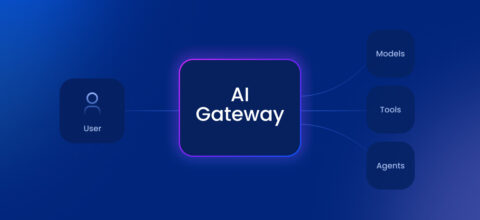
The AI feature shipped, and it worked. Users adopted it, the product team asked for three more, and everyone moved on to the next release. Then someone in security asked a series of uncomfortable questions. What is actually inside the prompts being sent to the model provider? Which models are being called, and by which teams? Is any customer data leaving the building? Where is the log that proves none of it did? For a surprising number of organizations, the honest answer to all four is the same: nobody knows.
This pattern has made AI gateways one of the most discussed pieces of enterprise infrastructure heading into 2026. Teams have become very good at building AI features and far less prepared for running them. Requests go out to large language models, responses come back, tokens are billed by the million, and it all happens across a growing sprawl of applications, providers, and API keys that no single system can observe or control. The capability arrives first, and the control layer arrives late, if it arrives at all.
An AI gateway closes that gap. It sits between your applications and the AI models they call, inspects every request and response, and enforces the rules your organization sets before anything reaches a provider. This guide explains what an AI gateway is, why the need for one has become urgent, how it differs from the API gateway you may already run, the capabilities that define it, and how the major options on the market compare. It is written for architects, platform leads, and technology decision-makers moving AI from pilot to production who need a governance story that holds up.
What Is an AI Gateway?
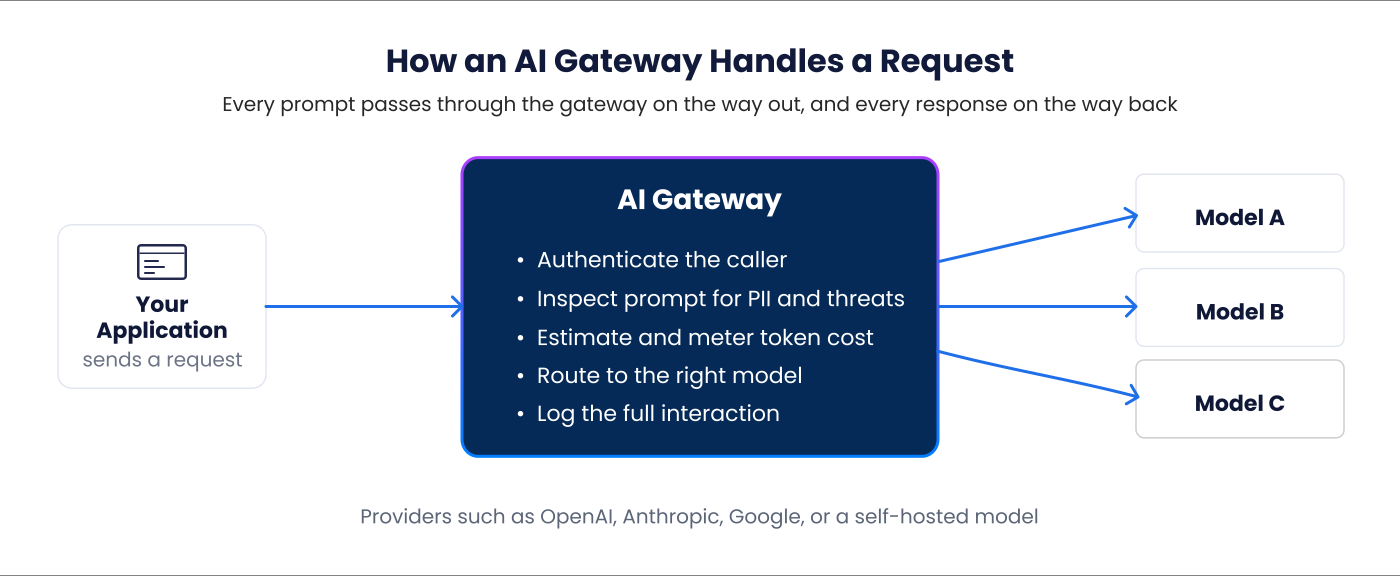
An AI gateway is software that manages traffic between your applications and the AI models they rely on. Every AI request goes out through it, and every response comes back through it. In that role, it checks who is making the request, scans the prompt for anything risky, picks the right model to answer it, estimates the request’s token cost, and logs the whole exchange for later.
What sets it apart from ordinary infrastructure is simple but important: it actually reads what passes through. Most networking components just move data from one point to another without looking inside. An AI gateway looks inside. That is what lets it catch sensitive data before it leaves the building, stop a manipulation attempt before it reaches the model, and tell you exactly which team spent what.
For any organization running more than a couple of AI features, the gateway becomes the one place where every model interaction is governed, whether those models come from OpenAI, Anthropic, Google, or something you host yourself. Instead of each application handling security and cost in its own way, the rules live in one place and apply everywhere.
Why Everyone Is Talking About AI Gateways Now
The short answer is that AI moved into production far faster than the controls around it. Gartner expects more than 80% of enterprises to have used generative AI or deployed generative AI applications by 2026, up from less than 5% in 2023. That is one of the fastest technology shifts businesses have ever seen, and it means many organizations are now running in production what they were only testing a year ago.
Cost is usually the first thing that bites
AI models charge by the token, and a single chatbot or agent conversation can burn through thousands of them. Without usage metering, the bill becomes unpredictable, and the finance team only finds out how big it is after it lands. Spread that across several applications and providers, and it stops being a rounding error.
Security is the sharper worry
AI applications open a kind of attack that older tools were never built to spot. The best-known example is prompt injection, where someone hides instructions inside an input to trick the model into misbehaving. It is serious enough that OWASP lists it as a top threat for AI applications. And this isn’t hypothetical: IBM’s 2025 research found that 13% of organizations had already suffered a breach involving an AI model or application, and 97% of those breaches lacked proper AI access controls. The pattern is hard to miss. The organizations getting hurt are the ones that put AI into production without a control layer in front of it.
Then there is shadow AI
When individual teams quietly adopt their own models and tools with no central oversight, nobody has a clear view of what data is going where. Every unofficial integration is another place something can leak, and another cost nobody signed off on.
Finally, the rules are catching up
The EU AI Act, which applies broadly from August 2026, expects high-risk AI systems to keep interaction logs, control access, and support human oversight. Other frameworks, like the NIST AI Risk Management Framework, point the same way. An AI gateway is the most practical way to meet those requirements because it can show, with real evidence, that the controls exist and are applied every time.
Case Study – Modernizing Cross-Border B2B Payment API with Kong API Gateway
AI Gateway vs API Gateway: What Is the Difference?
This question comes up in almost every planning meeting, so it is worth answering plainly. The easiest way to remember it: an API gateway moves traffic, and an AI gateway understands it. They are not rivals. Most teams running AI in production end up using both. The difference is in what each one can actually see.
An API gateway is built for normal web traffic. It routes requests, checks authentication, applies rate limits, balances load, and hides the messy backend from the developer. It does all of this without ever reading the request contents, and for regular API traffic that is exactly right. It has no reason to care what is inside.
AI traffic breaks that assumption in a few ways that really matter. It is billed by the token, so counting requests tells you nothing useful about cost. Responses often stream back in pieces rather than arriving all at once, which trips up standard monitoring. And the prompt itself, the part an API gateway never reads, is exactly where the risk lives. An AI gateway does everything an API gateway does, then adds the AI-aware layer on top: it reads prompts and responses, counts and budgets tokens, handles streaming, routes across several models, and enforces rules written specifically for AI.
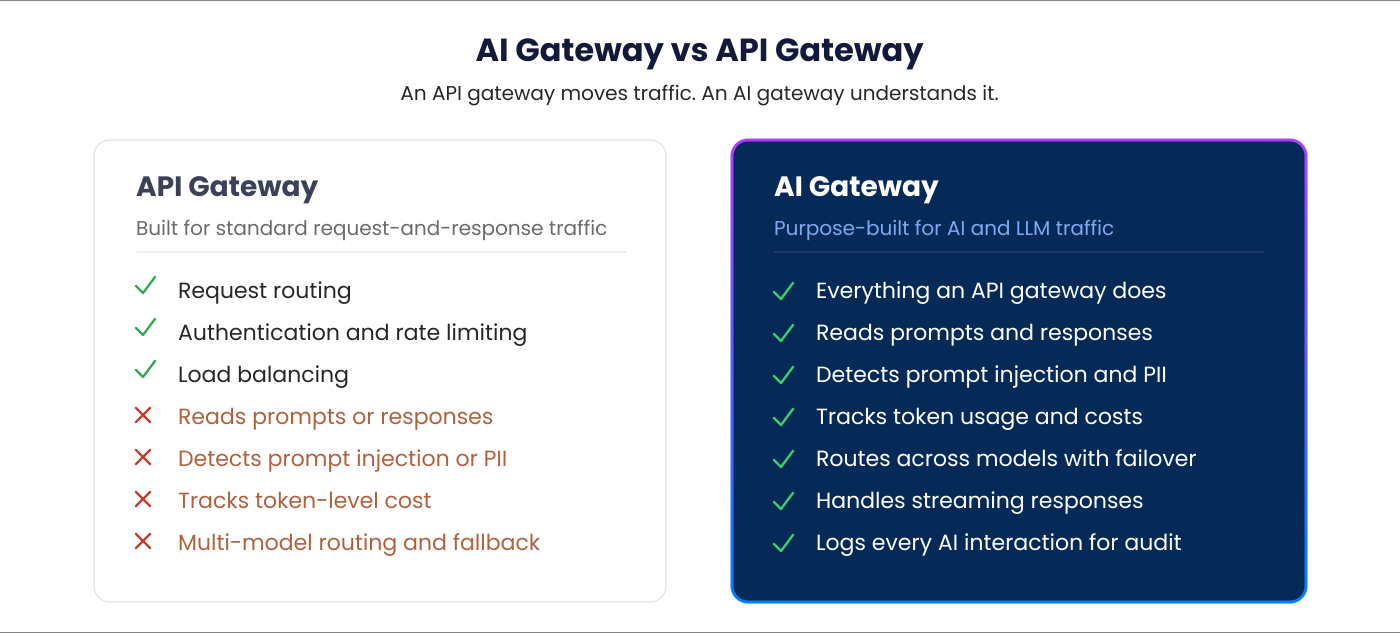
The takeaway is not that one replaces the other. It is that an API gateway was never meant to govern AI, and leaning on it to do so leaves gaps in exactly the places, cost, security, and audit, where you cannot afford them.
How an AI Gateway Works
All of this happens in the few milliseconds between your application asking a question and the model answering it. The exact steps vary by product, but the flow stays consistent.
It starts when your application sends its request to the gateway instead of straight to the model provider. The gateway checks whether the caller can use the requested model. It reads the prompt, looks for injection attempts, sensitive data, or anything that breaks a rule, and estimates the call’s token cost against the applicable budget. Once the request passes those checks, the gateway picks the best model for the job based on the rules you have set, whether that means the cheapest capable model, the fastest one, or a backup because your first choice is down.
The gateway then sends the request on to the chosen provider. When the answer comes back, it gets checked again, this time to make sure the model has not leaked anything sensitive or broken a content rule. The whole exchange is logged, including the time, the tokens
used, and the outcome of every check, and the finished answer is handed back to your application. Your users never see any of this. A well-built gateway adds only a sliver of round-trip delay.
AI Gateway Architecture Explained
Under the hood, most enterprise AI gateways are built around two parts that do very different jobs: a control plane and a data plane. Understanding the split makes the whole thing much easier to reason about.
The control plane is where you set the rules. This is the management side, where your team defines routing logic, security and PII policies, budgets and quotas, who can access which model, and how everything gets logged and displayed. It is the brain, and it is where an administrator spends their time.
The data plane enforces those rules live on every request. This is the part that sits directly in the path of your AI traffic, inspecting prompts and responses, metering tokens, applying rate limits, routing to models, caching answers, and capturing logs. It is the muscle, and it runs on every single call without a human involved.
Keeping the two separate matters for a practical reason. This means your AI traffic and data can stay inside your environment, handled by the data plane, while policy is managed centrally. For organizations with strict data residency or sovereignty rules, that separation is often the difference between being able to use a gateway and not.
Around those two planes sits the rest of the picture: your applications and agents feed requests in at the top, the gateway connects out to the enterprise systems and tools your AI needs to reach (increasingly through standards like MCP, which we will get to), and beyond it sit the model providers themselves. The gateway is the governed layer that ties it all together.

Core Capabilities of an AI Gateway
Products differ, but a capable enterprise AI gateway almost always offers the same core set of functions.
- Intelligent routing – Sends each request to the right model instead of pushing everything to the biggest, priciest one. A simple sorting task can run on a small, cheap model, while a hard reasoning task goes to a stronger one, with an automatic backup if a provider fails. This alone is one of the fastest ways to cut cost.
- Runtime security – Treats the prompt as something that can be weaponized. The gateway inspects every request against your security rules and blocks manipulation attempts like prompt injection before they ever reach the model.
- Observability – Finally gives you a clear view of what your AI is doing: how many tokens each request used, how fast each model and provider responded, error rates, cost per call, and which teams are driving the most traffic. It replaces guesswork from scattered logs with one honest picture.
- Cost control – The gateway tracks spending by team, application, model, and user, lets you set budget limits, warns you before costs spike, and can shift traffic to cheaper providers automatically. A trick called semantic caching helps too: when two questions mean the same thing even if they are worded differently, the gateway can reuse the earlier answer instead of paying for a fresh call.
- Rate limiting – Protects both your provider quotas and your own budget. It stops a runaway agent stuck in a loop, a misconfigured job hammering an expensive model, or a single user flooding the system, all without touching your application code.
- Access control – Decides who gets which model. Your data science team might get the most powerful model, while a customer-facing chatbot gets a cheaper, tightly scoped one. Because the gateway enforces this, the rules stay consistent no matter how many applications you add.
- Compliance enforcement – Ties it together for regulated teams. The gateway can spot and redact personal data before it reaches a model or leaves your walls, keep the audit logs regulations now expect, apply data residency rules, and feed into your existing security monitoring, so AI traffic is watched like everything else.
Ready to Put a Governance Layer in Front of Your AI?
NeosAlpha helps enterprises design, implement, and manage AI gateways that bring cost, security, and compliance under control, built on deep Boomi, Apigee, and agentic AI expertise.
Schedule a Free Consultation Call
Ready to Put a Governance Layer in Front of Your AI?
NeosAlpha helps enterprises design, implement, and manage AI gateways that bring cost, security, and compliance under control, built on deep Boomi, Apigee, and agentic AI expertise.
Schedule a Free Consultation CallDeployment Models
Where an AI gateway runs is as much a governance decision as a technical one, and you have options depending on how much control you need.
- A cloud deployment uses a provider’s global network to route requests to wherever they will run fastest, which suits teams that want managed simplicity.
- A self-hosted deployment keeps the gateway and its traffic entirely inside your own environment, which is often the deciding factor when data sovereignty or strict compliance is on the line.
- Edge deployments push lightweight gateways closer to where requests come from, which helps latency-sensitive work in areas like manufacturing or healthcare.
- In modern microservice setups, sidecar or two-tier deployments run smaller gateway instances next to individual services, while a central gateway still owns the overall policy. Plenty of enterprises mix these, and a good gateway hides the complexity so one consistent policy applies wherever it runs.
AI Gateways in Action: Real Use Cases
The clearest way to see why a gateway matters is to look at the kind of AI that actually needs one. At NeosAlpha, we build agentic AI systems, agents that plan, act, and work across your systems, and every one of them is a textbook case for gateway-level control. Here is why.
Use Case 1: A sales agent that reaches out to prospects
One of our agents watches how visitors engage with a site, then drafts personalized outreach emails based on the pages a prospect looked at and drops them into the business development team’s queue. That agent makes model calls throughout the day and touches customer engagement data. A gateway keeps token spend within budget, ensures no sensitive contact data leaks into a prompt, and logs every draft it generates.
Use Case 2: An autonomous QA agent that tests software
Another agent automatically generates, runs, and maintains test cases for APIs, microservices, and user interfaces, producing self-healing test scripts that adapt as the application changes. Because it runs constantly and at volume, it is exactly the kind of workload that can quietly rack up cost. The gateway meters that usage, caps runaway loops with rate limiting, and gives the team full visibility into what the agent is consuming.
Use Case 3: A database agent that answers questions in plain English
A third agent lets people query databases in natural language instead of SQL, inferring intent and generating safe, read-only queries. Here, the risk is data exposure, so the gateway’s ability to inspect prompts and responses, redact anything sensitive, and enforce strict access control does real protective work.
The common thread is simple. You could build each of these agents without a gateway. Running them safely, affordably, and with a clean audit trail was not.
Case Study: Centralized API Governance with Kong API Gateway for a UK Research Institution
AI Gateways, Agentic AI, and MCP
Agentic AI raises the stakes. An agent doesn’t just answer a single question; it calls models repeatedly, uses external tools, and takes action on your behalf. That multiplies both the cost exposure and the security surface. An agent stuck in a loop can burn a budget fast, and an agent that can actually do things is a much bigger problem if someone manages to manipulate it. These are precisely the risks a gateway is built to contain, through rate limiting, observability, access control, and live inspection of every call an agent makes.
This is also where the Model Context Protocol, or MCP, comes in. MCP is a standard, introduced by Anthropic and now widely adopted, for how AI agents connect to outside tools and data. As agents increasingly use it to reach into enterprise systems, the gateway becomes the natural place to govern those connections, making sure an agent’s access to a given tool or dataset is authenticated, permitted, and logged like any other AI request. Agents bring the autonomy, and the gateway is what makes that autonomy safe to put into production.
Case Study : API Gateway Consulting & Automation for Coadjute’s Real Estate Blockchain Network
Major AI Gateways: How They Compare
The market has grown quickly, and the options fall into a few clear groups. Knowing the categories helps more than memorizing product names because it shows the trade-off you are really making.
Extended API management platforms are the natural route if you already run an API gateway. Kong API Gateway has added AI-specific features to its established platform, including semantic caching backed by a vector store and routing that reads the prompt to pick a model, with support for providers like OpenAI, Anthropic, AWS Bedrock, and Google Vertex AI. Google’s Apigee similarly extends a mature API management platform into AI traffic, which is appealing if you are already standardized on it and on Google Cloud. The upside is consolidating onto tools and skills you already have. The trade-off is that some of the most advanced AI features sit in higher enterprise tiers.
Integration and automation platforms come at it from the enterprise data side. Boomi as a AI-first Integration platform offers an AI gateway as part of a wider platform that also handles integration, API management, and data management, so the gateway can govern AI and MCP interactions inside the same environment that already connects your applications and data. If you want AI governance to sit alongside your integration work rather than in a separate silo, this unified approach is compelling, and it fits neatly with how agents reach into enterprise systems.
Purpose-built AI gateways are designed from scratch for AI traffic. Tools like Portkey, Vercel AI, and various open-source options lead with AI-native features: deep prompt inspection, routing across many models, semantic caching, and security built specifically for AI. They tend to appeal to teams whose top priority is best-in-class AI governance. Cloud-native gateways from the big providers, such as those within AWS, Azure, and Cloudflare, round out the field with managed convenience for teams already committed to one cloud.
There is no single right answer. It comes down to where you already invest, how deep your AI governance needs run, whether data sovereignty pushes you toward self-hosting, and how much you value consolidation versus best-of-breed. The point is to choose on purpose, with a clear view of which group fits your priorities.
How NeosAlpha Helps
Picking a gateway is the easy part to talk about. Making it work inside a real business, wired into real systems, governed by real policies, and actually used by real teams, is what decides whether the investment pays off. That is where NeosAlpha’s background fits.
We have spent years helping enterprises design and run integration and API platforms, including deep hands-on delivery with Boomi and Apigee, the very platforms now extending into AI governance. Underneath, an AI gateway is an integration and API challenge with AI-specific requirements layered on top, and that intersection is exactly where we work. We also build agentic AI ourselves, so we understand firsthand what it takes to run these systems safely.
Our teams help you find where your AI traffic flows today and where it is ungoverned, choose the gateway approach that fits your existing setup and compliance needs, and put it in place with the routing, security, cost controls, and observability that turn a product into a working governance layer. Because our expertise spans integration, API management, and agentic AI, we can also connect the gateway to the enterprise systems your models and agents need to reach, in a way that is secure, auditable, and built to scale. The result is not just a gateway that is switched on, but one that genuinely puts you in control of your AI.


