- Enterprise AI traffic now spans LLM calls, MCP tool calls, and agent-to-agent traffic, so a gateway must cover all three.
- Gartner expects 70% of software engineering teams building multimodal applications to use AI gateways by 2028, up from 25% in 2025.
- Kong AI Gateway 2.0 covers LLM, MCP, and A2A traffic, but some newer features are not supported in fully on-premises deployments.
- Cloudflare AI Gateway offers free core features, but its governance is lighter and relies on wider Zero Trust products for per-team policies.
Until recently, choosing an AI gateway was a narrow decision. A team needed one endpoint in front of OpenAI or Gemini, a way to count tokens, and perhaps a cache. Almost any proxy could do that.
That is no longer the job. Enterprise AI traffic now comes from agents as well as applications, and those agents call MCP tools, query internal APIs, and hand work to other agents. A single request can touch two model providers, a self-hosted model, and a CRM before it finishes. A gateway built only for chat completions sees part of that traffic and governs even less of it.
Vendors have noticed, and almost every API, integration, and AI platform now offers an AI gateway. Gartner expects 70% of software engineering teams building multimodal applications to use AI gateways by 2028, up from 25% in 2025. With every vendor using the same label, the useful question is what each gateway actually enforces on a live request and which one fits the platform you already run. This comparison answers that, including where each option falls short.
What an Enterprise AI Gateway Does Today
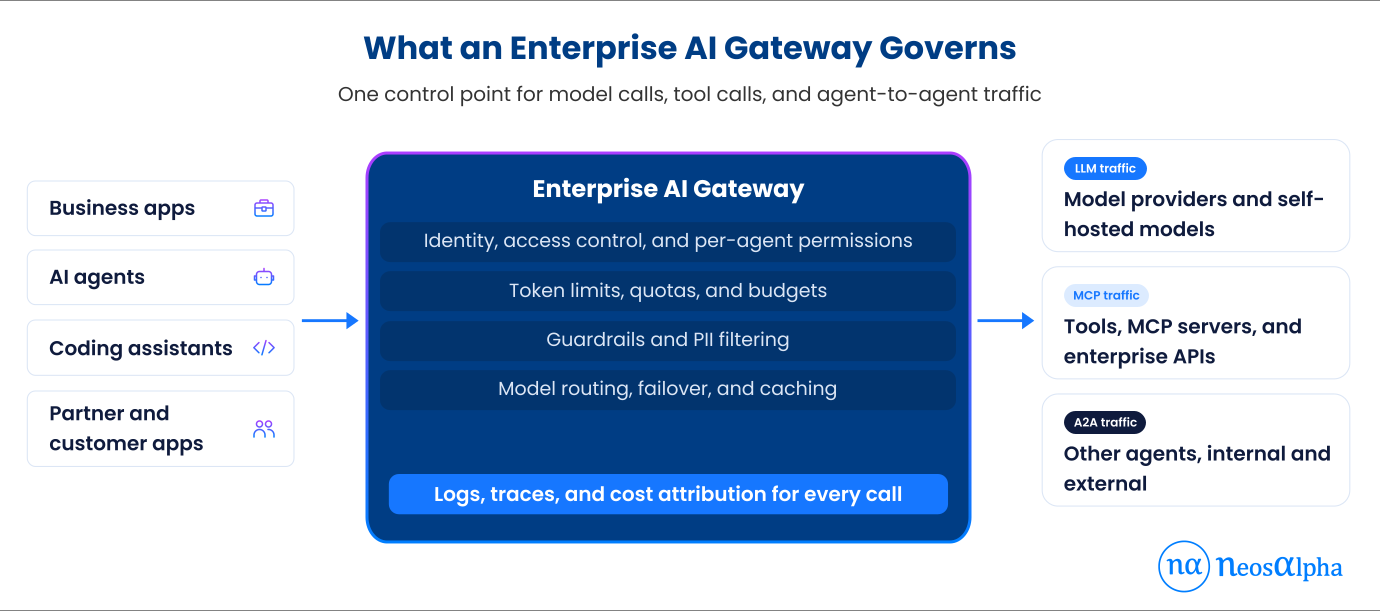
An AI gateway is a control point between the people and agents using AI and the models, tools, and agents they call. Because every request passes through it, it is the natural place to check identity, apply limits, screen content, pick a model, and record what happened.
What has changed is the scope. A modern enterprise AI gateway handles three kinds of traffic: LLM traffic to model providers and self-hosted models, MCP traffic to tools and enterprise APIs, and agent-to-agent (A2A) traffic between agents. A product that only covers the first will leave you shopping again for the other two.
AI Gateway vs. API Gateway
Much of an AI gateway will look familiar to anyone who runs API management: authentication, rate limiting, routing, and analytics. The difference is what the gateway has to understand. An API gateway counts requests, while an AI gateway counts tokens, because that is how model providers bill. It also reads prompts and responses to catch sensitive data or injection attempts, caches answers by meaning, and knows which MCP tools each agent may see. That overlap is why many enterprises extend their existing API platform instead of starting fresh.
How We Compared These Gateways
Feature lists blur together quickly, so we used eight questions that matter once real traffic arrives.

It also helps to know what kind of product you are looking at. Gartner groups this market into three types: API management platforms adding AI extensions, AI platforms with built-in gateways, and purpose-built open-source or open-core gateways. The first tends to be strongest on governance, the second on depth inside its own ecosystem, and the third on flexibility.
The Leading Enterprise AI Gateways Compared
Kong AI Gateway
Kong AI Gateway 2.0, generally available since September 2026, turned what used to be a set of plugins into a dedicated AI runtime managed through Kong Konnect. It covers LLM, MCP, and agent-to-agent traffic. Its MCP Server Bundling feature puts many MCP servers behind a single route and shows each caller only the tools it can use, while identity-aware policies let rate limits and cost reports follow the real user or agent instead of a shared key. The AI Management features added in November 2026 bring cost budgets, credential vaulting, and AI observability into the same control plane.
Watch out for: several of the newest 2.0 capabilities are built around Konnect, and some are not supported in fully on-premises deployments, so self-managed teams should check the documentation feature by feature.
Best fit: organizations already running Kong for APIs that want one data plane for API and AI traffic.
Google Apigee
Apigee does not ship a separate AI gateway product. Instead, it adds AI-specific policies to the same proxy engine that governs enterprise APIs: LLM token limits, Model Armor screening for prompts and responses, semantic caching, and model routing with failover. MCP support reached general availability in March 2026, and Apigee can turn existing API specs into governed MCP tools. For existing Apigee users, identity, analytics, and API products carry over as they are. We cover the details in our Apigee AI Gateway guide.
Watch out for: Model Armor is a separately billed Google Cloud service, so include it in your cost model from the start.
Best fit: Google Cloud customers and enterprises already standardized on Apigee.
Boomi Agent Control Plane
Boomi approaches the problem from integration. Its Agent Control Plane sits between AI agents and the business systems they act on. Agent Control Tower registers and monitors agents built on Boomi and on other platforms, and includes a kill switch that disables a compromised agent across the organization. Boomi completed its acquisition of AI gateway specialist Lunar.dev in July 2026 to add an enforcement layer for LLM and MCP traffic.
Watch out for: Model Armor is a separately billed Google Cloud service, so include it in your cost model from the start.
Best fit: organizations whose integration estate runs on Boomi and whose agents need governed access to those systems.
Cloudflare AI Gateway
Cloudflare runs its AI gateway on its global edge network, and the core features (analytics, caching, and rate limiting) are free on all plans. It adds guardrails, data loss prevention scanning, dynamic routing, spend limits, and one invoice for several model providers.
Watch out for: governance is lighter than on the API management platforms above. Per-team policies and agent controls rely on Cloudflare’s wider Zero Trust products, and some features have carried a beta label, so check their current status.
Best fit: teams that want a fast, low-operations start, especially those already using Cloudflare.
Open-Source and AI-Native Gateways
LiteLLM is the most common open-source starting point. It gives developers one OpenAI-compatible endpoint for many providers, with virtual keys, budgets, and fallbacks. AI-native platforms such as TrueFoundry go further, combining LLM, MCP, and agent gateways with deployment inside your own VPC or data center. Portkey, another popular choice, is now part of Palo Alto Networks’ AI security platform after an acquisition announced in 2026.
Watch out for: open-source gateways put upgrades, scaling, and support on your own team, and enterprise features such as SSO and audit logs often sit in paid tiers.
Best fit: engineering-led teams that want full control, or a specialist gateway that runs alongside an existing API platform.
Side-by-Side Comparison
| Gateway | Deployment Options | MCP and Agent Traffic | Standout Control | Best Fit |
|---|---|---|---|---|
| Kong AI Gateway | Konnect control plane with cloud, hybrid, or self-managed data planes | LLM, MCP, and A2A | Per-caller MCP tool filtering and identity-aware policies | Existing Kong users |
| Apigee | Google Cloud, or hybrid runtime on your own Kubernetes | LLM and MCP, including API-to-tool generation | Model Armor screening and token-based API products | Google Cloud and Apigee estates |
| Boomi | Boomi platform, with on-premises agent runtime | Agents and MCP, with gateway technology being added | Agent Control Tower with kill switch | Boomi-led integration estates |
| Cloudflare AI Gateway | Cloudflare edge network | Mainly LLM traffic | Free core features and spend limits | Fast, low-operations starts |
| LiteLLM and AI-native | Self-hosted or vendor cloud | Varies by product | Full control and flexibility | Engineering-led teams |
How to Choose the Right AI Gateway for Your Enterprise
Start with the platform you already run. If your APIs already pass through Kong, Apigee, or Gravitee, extending that gateway to AI traffic keeps one identity model, one policy set, and one operations team. A separate AI gateway can still be right, but it should be a deliberate choice.
Then test your shortlist with real traffic. A few checks reveal more than any feature list:
- Point two agents with different permissions at the same MCP server and confirm each one sees only its own tools.
- Send prompts containing test customer data and check what the gateway redacts, blocks, and logs.
- Find out where prompts, logs, and analytics are stored, and whether you can choose the region.
- Ask how pricing scales: per request, per token, per gateway instance, or per add-on service.
Recommended Read – Kong AI Gateway Explained: Architecture, Features, and Use Cases
How NeosAlpha Helps
Choosing a gateway is the easy part. Making it the single path for every model and tool call across a large enterprise takes design, integration, and change management.
NeosAlpha has spent years building and running API management and integration platforms for enterprise clients, which is the foundation an AI gateway sits on. For transparency, we are a Google Cloud partner with a long-standing Apigee practice, a Boomi Gold Partner, and experience across other gateways as well. Our teams help organizations compare gateways against their own requirements and run proofs of concept with real workloads. Once a platform is chosen, our engineers set up routing, token budgets, guardrails, and MCP tool access, and connect the gateway to identity, logging, and cost reporting.
Talk to our AI gateway specialists to find the right fit for your platform.

